

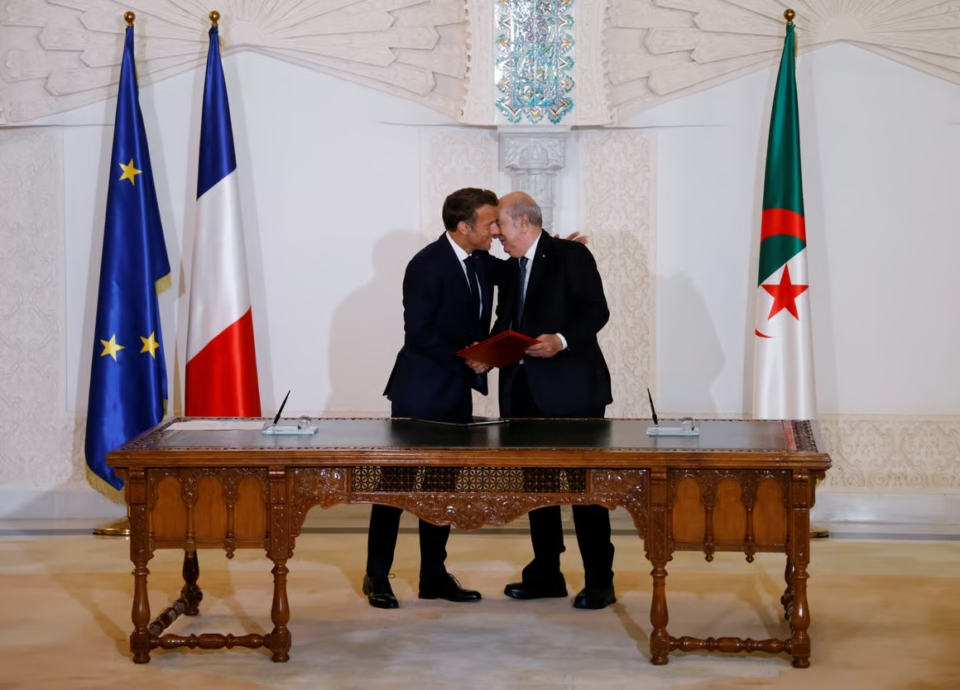
France is struggling to maintain its economic position in Algeria, as diplomatic tensions and declining trade expose the limits of its traditional influence.
For too long, successive French governments have behaved as though Algeria had no alternative but to maintain its historical economic relationship with France. Under Emmanuel Macron, this assumption has become increasingly difficult to defend.
Algeria is sending a clear message: its economic future does not depend on France.
The deterioration of relations between Paris and Algiers is no longer simply a diplomatic disagreement between two governments. It is increasingly becoming an economic problem for French businesses, exporters and investors who have traditionally relied on the Algerian market.
French exports to Algeria have come under considerable pressure, raising concerns among French business communities that have spent decades building commercial relationships in the country. For these companies, political tensions are not abstract diplomatic arguments. They translate into lost contracts, reduced market access, uncertainty and opportunities increasingly taken by competitors from other countries.
And Algeria has alternatives.
Today, Algeria is strengthening and diversifying its international economic partnerships. Its commercial relationships extend well beyond France, with growing opportunities for European, Asian, Arab and other international partners. Whether in energy, infrastructure, agriculture, manufacturing or technology, Algeria has choices that previous generations of French policymakers may have underestimated.
This is precisely what makes the current situation so significant.
While French political circles and sections of the French media continue to criticise Algerian officials, ministers and political actors, voices within France itself are increasingly calling for a change of approach. Intellectuals, economists and business representatives understand that confrontation is not a sustainable economic strategy.
French companies cannot afford to become collateral damage in a political dispute.
The French business community has legitimate reasons to demand that its government reconsider its approach. Companies that have historically traded with Algeria know the value of this market. They also understand that commercial relationships, once lost, are not necessarily easy to recover. If other countries establish themselves as reliable partners, France may discover that its former privileged position is difficult to regain.
There is also a political dimension that Paris cannot ignore. Algerian public opinion has become an important factor in the relationship. Many Algerians expect their government to defend national dignity and sovereignty, and they increasingly want the country to exercise its economic independence. The French president cannot assume that diplomatic pressure or hostile rhetoric will persuade Algerians to return to the old relationship.
The next French president will therefore inherit a difficult challenge. Whoever occupies the Élysée Palace after Macron will have to decide whether France wants to continue down the path of confrontation or rebuild a relationship based on mutual respect, equality and practical economic interests.
It would not be surprising if Algeria became one of the first major diplomatic destinations for a future French president seeking to reset relations. The economic stakes are simply too important to ignore.
France must understand one fundamental reality: Algeria is no longer a country whose international choices can be dictated by Paris.
The relationship between the two countries must be rebuilt on a different foundation. That means abandoning the language of superiority, ending unnecessary provocations and recognising Algeria as a sovereign country entitled to choose its own economic and strategic partners.
Macron’s government may believe that political pressure will bring Algeria back to the negotiating table on French terms. But the changing international economic landscape suggests otherwise.
France needs Algeria’s market, but Algeria does not need to depend exclusively on France.
That is the new reality. And the sooner Paris recognises it, the better it will be for French businesses, Algerian economic interests and the future of relations between the two countries.
The time has come for France to replace arrogance with diplomacy and confrontation with cooperation. Algeria has other choices. France should not wait until those choices become permanent.