
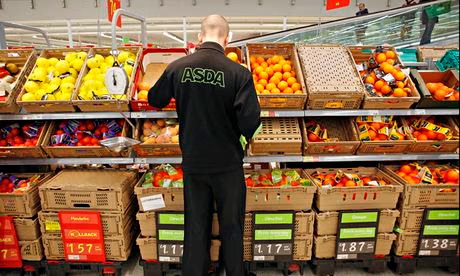
For European supermarket buyers, the biggest change taking place in fresh produce may not be happening on the shelf at all. It is happening several hundred kilometres away, where retailers are reconsidering where their fruit and vegetables should come from when traditional supply routes become increasingly difficult to predict.
Spain, Italy and Greece remain fundamental to European fresh produce supply. But the procurement model built around these markets is being challenged by water availability, extreme weather, production costs and increasingly unpredictable growing conditions. The result is not necessarily a replacement of Southern Europe, but the creation of a much broader Mediterranean sourcing network.
ISN Investigates: North Africa could become one of the most important pieces of that new procurement puzzle.
Morocco has already established itself as a significant supplier to European markets, while Algeria and Tunisia have substantial agricultural potential. The strategic question for retailers is whether these markets can move beyond seasonal or opportunistic supply and become dependable components of supermarket programmes.
That requires more than competitive farm-gate prices. For a supermarket buyer, consistency is everything. Produce must arrive at the distribution centre in the right condition, within the agreed delivery window and at a cost that works throughout the season.
This is where the next stage of the North African opportunity becomes particularly interesting. Investment in irrigation, protected agriculture, renewable energy, cold storage, port infrastructure and digital supply-chain monitoring could gradually turn geographical proximity into a genuine procurement advantage.
The Mediterranean is therefore becoming less of a dividing line and more of a single sourcing zone.
For European retailers, this could change the way fresh categories are planned. Instead of asking which country offers the cheapest product today, procurement teams may increasingly ask which combination of growing regions can provide reliable supply across an entire season.
That distinction matters.
A supermarket cannot build a fresh-produce strategy around one climate zone. The future may instead involve a carefully balanced network stretching from Iberia and Italy across the Mediterranean into North Africa.
The winners in this changing market may not simply be the producers with the lowest costs. They could be the suppliers capable of offering reliability, traceability, logistics discipline and consistent quality at scale.
For supermarket buyers, the Mediterranean supply map is being redrawn — and North Africa is moving from the margins towards the centre of the conversation.