
Europe’s fresh food supply chain is entering a new regulatory phase as the EU Packaging and Packaging Waste Regulation (PPWR) begins to place greater emphasis on packaging reduction, reuse, recyclability, traceability and the responsible use of materials.
For retailers, food producers, growers and logistics operators, the regulation is more than an environmental requirement. It is likely to influence how fresh produce is packed, transported, handled and returned across the grocery supply chain.
From 12 August 2026, manufacturers placing packaging on the EU market must hold formal written Declarations of Conformity for the packaging concerned. This places greater importance on documented evidence covering materials, safety, composition and compliance.
Reusable plastic packaging containers are therefore gaining attention as retailers and suppliers look for systems that can combine regulatory readiness with practical day-to-day logistics.
Reuse at industrial scale
The strongest argument for reusable packaging is that the infrastructure already exists.
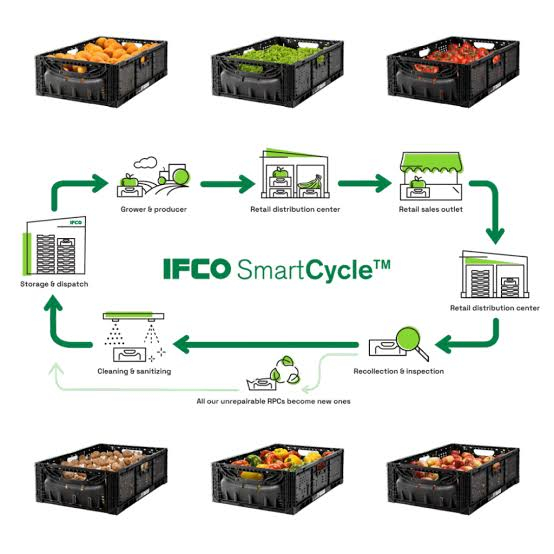
Modern pooling systems allow crates and containers to circulate repeatedly between growers, producers, distribution centres, retailers and service facilities. Instead of treating packaging as a disposable item, the same asset becomes part of a managed logistics system.
Some large European pooling networks are already handling billions of container cycles each year. This demonstrates that reusable packaging is no longer a niche sustainability concept. It is an established operating model within parts of the fresh food sector.
The PPWR could accelerate this transition by making packaging reuse and waste reduction increasingly important commercial considerations.
Recycled content and circularity
The regulation also puts greater focus on recycled content and the circular use of plastics.
Reusable crates can provide an alternative to single-use packaging while incorporating recycled material into their production. In a closed-loop system, damaged or retired containers can be collected, processed and remanufactured into new containers rather than becoming waste.
This creates a different relationship with packaging. Instead of a linear journey from manufacture to disposal, the packaging becomes an asset that remains within a controlled cycle.
For supermarkets and food suppliers, this can potentially reduce the amount of packaging entering the waste stream while providing greater consistency in handling fresh products.
Food safety remains critical
Reusable packaging must also address one of the most important concerns in grocery logistics: hygiene.
Containers travelling repeatedly through the supply chain need controlled cleaning and disinfection before returning to circulation. Industrial washing systems can clean containers after each trip, with quality controls designed to minimise microbiological contamination and prevent unwanted residues from being transferred to fresh food.
This is particularly important for fruit, vegetables and other fresh products where packaging comes into close contact with food throughout the distribution process.
The future of reusable packaging will therefore depend not simply on the number of times a container can be used, but on the ability of the entire system to maintain food safety, material quality and traceability throughout its life.
Environmental performance under scrutiny
Reusable packaging is also being assessed through increasingly detailed life-cycle analysis.
Peer-reviewed studies comparing reusable containers with single-use alternatives have reported reductions in carbon emissions, water consumption, energy use and packaging waste, although the precise environmental advantage depends on factors such as transport distances, container utilisation, washing efficiency and the number of reuse cycles.
Research into fresh produce logistics has also highlighted another potential advantage: stronger reusable containers can provide better protection for products during transport.
Reducing damage to fruit and vegetables can have a significant environmental and economic impact because food that is damaged during distribution represents both lost product and wasted resources.
Digital traceability becomes part of the model
Another important development is the digitalisation of reusable packaging.
PPWR places greater emphasis on proving that reusable packaging is actually operating within a functioning reuse system. This makes tracking and documentation increasingly important.
Digital identification technologies, including RFID, Bluetooth Low Energy and global returnable asset identifiers, can give supply chain operators greater visibility over individual assets and their movements.
The same technology can potentially provide information on transport times, temperature conditions, asset location, utilisation and bottlenecks.
For retailers, this creates an opportunity to move beyond packaging compliance and use reusable containers as part of a wider digital supply chain.
A change in the supermarket supply chain
The significance of PPWR is therefore broader than the packaging itself.
Supermarkets are under pressure to reduce waste, control costs and demonstrate progress on sustainability while maintaining reliable supplies of fresh food. Packaging sits at the intersection of all three challenges.
Reusable systems can offer retailers a controlled alternative to single-use packaging, but their success depends on collaboration between growers, suppliers, logistics providers, distribution centres and stores.
The regulation may consequently encourage a shift from thinking about packaging as a procurement item to viewing it as part of the wider supply chain infrastructure.
For the fresh food industry, the message is becoming increasingly clear: reusable packaging is moving from a sustainability initiative towards a strategic logistics tool.
With PPWR now taking effect, companies that already operate established reuse, washing, tracking and pooling systems may have an advantage as the European grocery industry adapts to a more circular packaging economy.