
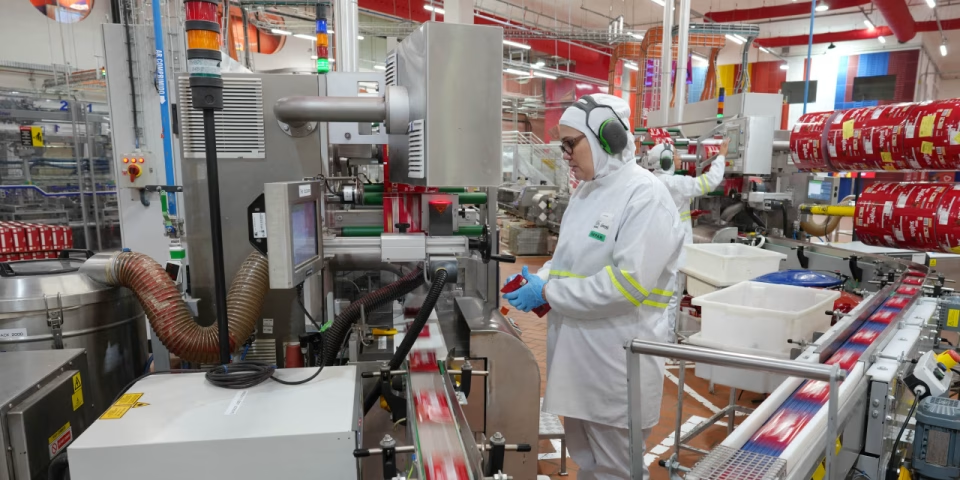
Nestlé is stepping up its investment in advanced manufacturing technology, as artificial intelligence, robotics and data-driven production become increasingly important to the global food industry.
The company has established a Deep Tech Center in Orbe, Switzerland, bringing together specialists to explore technologies that could change how food and beverages are developed and manufactured. The initiative reflects a wider shift among major food producers towards factories that can respond more intelligently to changing ingredients, production requirements and consumer demand.
Smarter factories, more flexible production
One of the biggest challenges in food manufacturing is managing natural variations in raw materials. Milk, coffee, cocoa and other agricultural ingredients do not always behave in exactly the same way. Temperature, quality and composition can influence production, creating challenges for consistency and efficiency.
Nestlé’s research is exploring how artificial intelligence, sensors and robotics could help manufacturing systems respond to these variations. Instead of relying entirely on fixed production settings, intelligent systems could use real-time information to adjust processes and improve operational control.
For large manufacturers, the potential benefits extend beyond automation. Better monitoring and more responsive production could help reduce waste, improve quality management and make factories more adaptable.
A competitive issue for the food industry
The development comes as food manufacturers face pressure from higher operating costs, supply-chain uncertainty and changing consumer expectations. Technology investment is increasingly becoming part of the competitive equation, particularly for companies operating complex international production networks.
However, moving from research to large-scale industrial application will require substantial investment. Manufacturers must demonstrate that advanced systems can deliver reliable results, integrate with existing equipment and generate measurable financial returns.
For retailers, the implications could eventually reach beyond the factory gates. More flexible production may help suppliers respond faster to changing demand, improve product availability and manage manufacturing costs.
Nestlé’s initiative highlights an important question for the industry: will the next generation of food manufacturing be defined as much by artificial intelligence and robotics as by traditional production expertise?
