
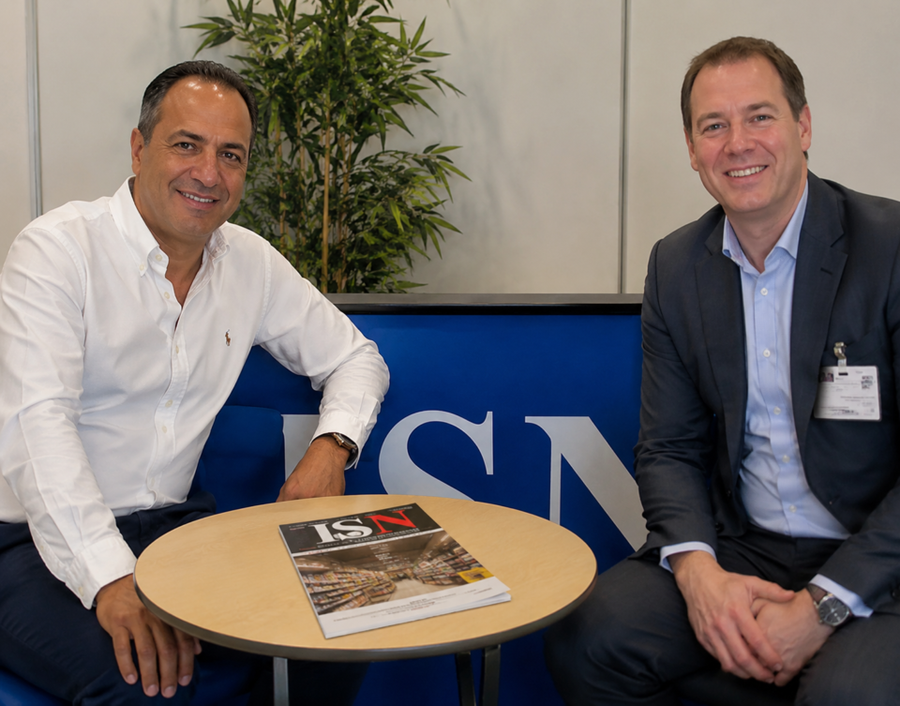
ISN Editor Riad Beladi in conversation with a former Carrefour retail executive who moved from supermarket retail to the retail technology supply side
Original interview conducted in French. Translated and edited for English publication.
Retail technology has moved rapidly from the back office into almost every part of the supermarket.
Electronic shelf labels, self-checkout, smart carts, computer vision, automated stock-taking, retail media, mobile applications, artificial intelligence and increasingly sophisticated data systems are changing both the way supermarkets operate and the way shoppers experience the store.
To examine this transformation, ISN Editor Riad Beladi, who has more than 30 years’ experience covering the international supermarket industry, spoke with Laurent Martin, a former Carrefour retail executive who subsequently moved to the other side of the industry, joining a supplier of retail technology solutions.
Martin has therefore experienced the transformation from both perspectives — first as a supermarket professional responsible for retail operations and technology, and later as a supplier selling technology to retailers.
For him, the speed of change is remarkable.
“I have never seen retail technology take such a central position in the supermarket industry. Technology used to support retail. Increasingly, technology is becoming part of retail itself.”
Riad Beladi: You worked inside Carrefour and later moved to the technology supply side. What has surprised you most about the supermarket industry over the last four years?
Laurent Martin: The speed of change.
Technology was always important in supermarkets. We had systems for stock management, ordering, logistics, checkout and customer data. But technology was often regarded as something operating behind the scenes.
That has changed.
Today, technology is visible to the customer. The shopper sees electronic shelf labels, self-checkout, digital promotions, mobile applications, smart trolleys and increasingly personalised offers.
At the same time, there is technology that the shopper does not see. Computer vision can monitor shelves, systems can identify stock problems, and artificial intelligence can analyse enormous amounts of information.
What is different now is that these technologies are connected to the actual shopping experience.
I have worked on the retail side and now work with retailers as a technology supplier. I can say honestly that I have never seen technology occupy such a central position in retail.
Riad Beladi: Supermarkets say much of this technology is designed to improve the customer experience. Is that really the main objective?
Laurent Martin: It is one of the main objectives, but it is not the only one.
A supermarket has two customers in a sense. It has the shopper, but it also has the employees who have to operate the store.
Take stock-taking.
Traditionally, employees spent considerable time checking shelves and identifying missing products. Today, technology can help identify availability problems much faster.
The same applies to pricing. Electronic shelf labels can make price changes much faster and reduce the amount of manual work required.
Self-checkout is another example. It changes the customer’s experience, but it also changes the role of the employee.
The objective should not simply be to remove people from the supermarket. Good technology should allow employees to spend less time on repetitive tasks and more time helping customers.
That is an important distinction.
Technology should make the supermarket easier to operate, while making the shopping experience easier for the customer.
Riad Beladi: Some people might say this is exaggerated. Supermarket customers still want good prices, promotions and value. Has technology really become more important than price?
Laurent Martin: No. I would not say that technology is more important than price.
Price remains fundamental, particularly in a period when consumers are very conscious of their household budgets.
But I would say that the relationship between price and experience is changing.
If two supermarkets offer similar prices, the customer may choose the one where shopping is easier, faster and more convenient.
That is where technology becomes important.
The shopper does not necessarily think, “I am going to this supermarket because it has artificial intelligence.”
They think, “I can find what I want, the price is clear, I don’t have to wait too long, the product is available and paying is easy.”
The technology is behind that experience.
So I would not put price and technology against each other. Price gets the shopper’s attention, but experience can influence where that shopper chooses to return.
Riad Beladi: After more than 30 years covering supermarkets, do you believe we are seeing a fundamental change in the industry?
Laurent Martin: Yes.
I think the biggest change is that technology is no longer a separate department.
It is becoming part of merchandising, operations, logistics, marketing, pricing and customer service.
Look at retail media, for example. Supermarkets are no longer simply selling products. They are using their digital platforms, customer data and physical stores to communicate directly with shoppers and suppliers.
Look at electronic shelf labels. They are not simply digital versions of paper price tickets. They can become part of a wider pricing, promotion and store-management system.
Look at artificial intelligence. It can analyse customer behaviour, improve forecasting, support employees and increasingly influence how retailers manage their stores.
And look at checkout. What was once simply the final point of a shopping trip has become an area of experimentation involving self-checkout, mobile payment, scan-and-go and computer vision.
So yes, something fundamental is happening.
But I would not describe it as technology replacing retail.
I would describe it as technology becoming part of retail.
That is a very different thing.
Riad Beladi: My own observation is that retailers have spent enormous amounts of time and money on price, promotions and efficiency. Now the customer experience seems to be receiving the same level of attention. Would you agree?
Laurent Martin: Absolutely.
The supermarket of the future will still need competitive prices. Nothing changes that.
But retailers are discovering that the shopping experience is not one single thing.
It starts before the customer enters the store, through advertising and digital communication. It continues with finding products, checking prices, receiving personalised promotions, navigating the store, getting assistance, paying and finally leaving the supermarket.
Technology can influence every one of those stages.
That is why I believe we are seeing a change in the role of technology.
It is no longer simply about making the supermarket more efficient.
It is increasingly about making the supermarket more relevant to the shopper.
Riad Beladi’s conclusion
After more than three decades covering supermarkets, I have seen technology move from relatively isolated systems used by IT and operations departments to something that now touches almost every part of the supermarket.
The interesting question is therefore no longer whether retailers will use technology. They already do.
The question is how far technology will become embedded in the everyday shopping experience.
Carrefour’s recent digital strategy and its continuing investment in AI and smart-store technologies are examples of this wider movement.
The supermarket is becoming increasingly connected: the shelf, the trolley, the checkout, the employee, the customer and the retailer’s digital platforms can all form part of one technology ecosystem.
For shoppers, however, the technology itself may remain invisible.
They will simply notice that the price is correct, the product is available, the queue is shorter, the promotion is relevant and the shopping trip takes less time.
Perhaps that is the real test of retail technology: not how sophisticated the technology is, but whether the shopper notices the difference.