

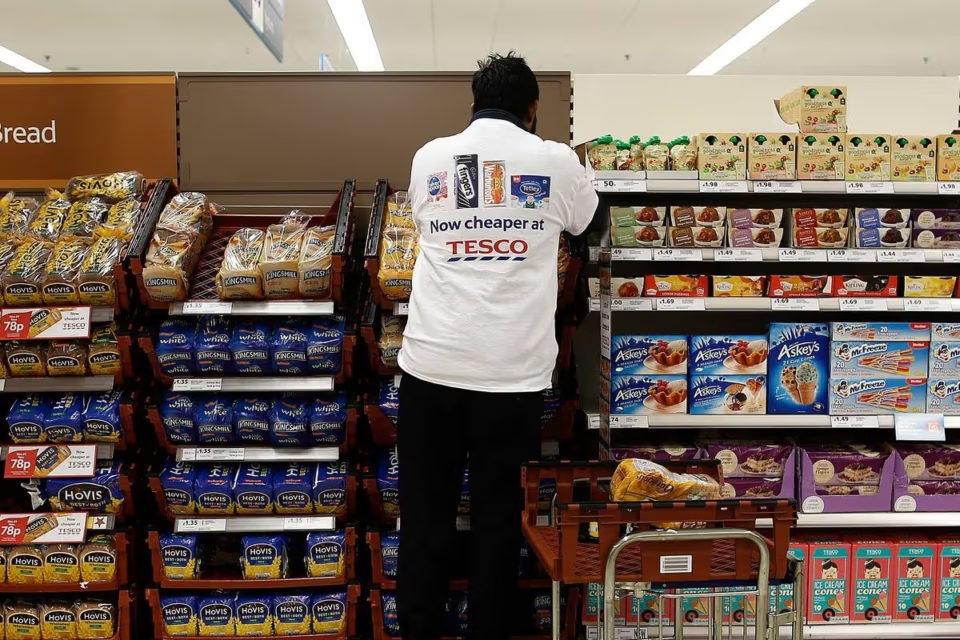
The UK grocery sector is once again witnessing a familiar pattern: Tesco and Sainsbury’s steadily tightening their hold on the market while several competitors struggle under financial pressure. On the surface, this may appear to be a story of operational excellence and strong leadership. Yet beneath the headlines lies a more complex question about competition, pricing power, and the long-term structure of the British supermarket industry.
Over the past year, both Tesco and Sainsbury’s have managed to strengthen their market positions through aggressive pricing strategies, extensive loyalty schemes, and significant investment in technology. Their financial stability has allowed them to negotiate favourable agreements with suppliers while maintaining the image of price competitiveness for consumers facing persistent cost-of-living pressures.
However, critics argue that the current market dynamic is not simply the result of superior management but also reflects the growing imbalance between dominant supermarket chains and financially constrained rivals.
Rivals Struggling Under Financial Pressure
While Tesco and Sainsbury’s continue to expand their influence, competitors such as Asda and Morrisons face mounting challenges.
Both companies have undergone major leveraged buyouts in recent years, leaving them with substantial debt obligations. These financial burdens inevitably restrict the ability of management teams to invest at the same scale as their better-capitalised rivals.
Investment in areas such as:
-
store refurbishment
-
supply chain technology
-
automation
-
digital platforms
has become essential for modern grocery retailing. Yet for heavily indebted retailers, these investments often become secondary to servicing debt and maintaining financial stability.
The result is a widening gap between the market leaders and the rest of the field. Tesco and Sainsbury’s can continue upgrading their operations while competitors struggle simply to maintain parity.
Some analysts warn that this two-tier supermarket system could reshape the competitive landscape of the UK grocery sector over the next decade.
Loyalty Schemes: Smart Marketing or Price Illusion?
Another major factor driving the current market dynamic is the aggressive use of loyalty programmes.
Tesco’s Clubcard and Sainsbury’s Nectar schemes have evolved far beyond simple reward cards. They now function as powerful pricing tools that allow supermarkets to display one price to loyalty members and another to everyone else.
For millions of British shoppers, these schemes have become a routine part of grocery shopping. Discounts linked to loyalty cards can often appear substantial, creating the perception that consumers are securing significant savings.
Yet critics argue that these programmes may also distort price transparency.
Some consumer advocates claim that loyalty pricing can mask the real cost of groceries. Products advertised as discounted for cardholders may in reality be priced artificially high for non-members, creating a two-tier pricing system that pressures consumers into signing up for data-driven marketing programmes.
The question increasingly being asked is whether loyalty schemes genuinely reduce prices or simply repackage them in a more persuasive marketing format.
Supplier Pressure Behind the Scenes
The growing dominance of Tesco and Sainsbury’s also raises questions about supplier relationships.
With their large purchasing volumes and strong market share, the two retailers hold significant negotiating power when dealing with food producers. This influence allows them to secure competitive wholesale prices that help maintain their price leadership on supermarket shelves.
But for suppliers, especially smaller producers, the picture can be more complicated.
Industry insiders frequently point out that the largest retailers often demand:
-
lower wholesale prices
-
stricter supply conditions
-
marketing contributions
-
complex promotional agreements
While these arrangements are part of the modern retail ecosystem, smaller suppliers can struggle to maintain profitability under such pressure.
The concern is that an increasingly concentrated supermarket sector could lead to reduced bargaining power for producers, ultimately affecting innovation and diversity within the food supply chain.
The Discounters Are Not Standing Still
Despite the growing influence of Tesco and Sainsbury’s, the biggest disruption in the UK grocery market still comes from discount chains Aldi and Lidl.
Both retailers continue to expand rapidly across the UK, opening new stores and attracting shoppers with consistently low prices and simplified product ranges.
Their growth has forced traditional supermarkets to respond with aggressive price matching campaigns, expanded private-label ranges, and more frequent promotions.
In many ways, the entire supermarket price war currently underway in Britain can be traced back to the rise of the German discounters.
Even Tesco and Sainsbury’s — despite their current success — remain under constant pressure to prove they can compete with the relentless efficiency of Aldi and Lidl.
A Market That Risks Becoming Too Concentrated
The current trajectory of the UK grocery sector raises a fundamental question: is the market becoming too concentrated around a few dominant players?
Tesco and Sainsbury’s are not simply competing effectively; they are operating from positions of significant structural advantage compared with several rivals.
If weaker competitors continue to fall behind due to financial constraints, the long-term result could be a market with fewer strong competitors. In such a scenario, consumers may initially benefit from aggressive pricing battles, but the lack of real competition could eventually reduce pressure on the dominant retailers.
For now, Tesco and Sainsbury’s appear to be enjoying a moment of strength in a challenging economic environment. Yet the broader implications for the UK retail landscape remain uncertain.
One thing is clear: the British supermarket sector is entering a new phase of consolidation and competitive tension.
And while shoppers may welcome lower prices in the short term, the real test will be whether the market remains genuinely competitive in the years ahead.