

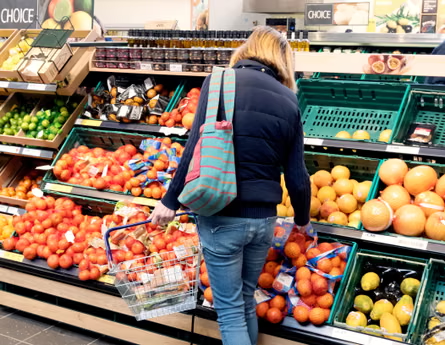
If technology is transforming the operational side of grocery retail, pricing remains the battlefield where supermarkets ultimately compete for customers.
In 2026, the pressure on food retailers has intensified once again. Consumers across Europe and the United States continue to seek value as household budgets remain under strain from the lingering effects of inflation and economic uncertainty.
For supermarket chains, this reality has revived one of the oldest dynamics in the industry: the price war.
Recent statements from Kroger’s leadership highlight the strategic shift currently taking place in the American grocery market. Under its new chief executive, the company has signalled a renewed focus on lowering prices and improving operational efficiency in order to compete more aggressively with Walmart and discount retailers.
The message is clear. In the modern supermarket landscape, price leadership remains a powerful competitive advantage.
Walmart has long understood this principle. Its global strategy has been built on the promise of everyday low prices, supported by a vast supply chain network and unparalleled purchasing power.
For competitors, matching Walmart’s pricing is rarely easy. The company’s scale allows it to negotiate favourable terms with suppliers and operate with extremely thin margins.
This dynamic places enormous pressure on other supermarket groups. Kroger, which operates thousands of stores across the United States, must balance the need to remain competitive on price with the necessity of maintaining profitability.
Lower prices may attract customers, but they also compress margins in an industry where profitability is already limited.
From an analytical perspective, the renewed emphasis on price competition reflects deeper structural changes within the grocery sector.
Discount chains such as Aldi and Lidl have fundamentally altered consumer expectations over the past two decades. By offering a limited assortment of products at extremely competitive prices, these retailers have forced traditional supermarkets to rethink their value propositions.
The impact has been particularly visible in Europe, where discount formats have captured significant market share.
Supermarket groups that once relied on brand loyalty and extensive product ranges are now being challenged by simpler, more cost-efficient retail models.
In response, many established retailers have introduced private-label products designed to compete directly with discount offerings. Store brands, once considered secondary options, are now central to supermarket strategy.
Private labels allow retailers to control pricing more effectively while maintaining acceptable margins.
But the price war is not purely about reducing shelf prices. It is also about operational efficiency.
Kroger’s leadership has emphasised the importance of improving productivity through technology and supply chain optimisation. By reducing operational costs, retailers can create room to lower prices without sacrificing profitability.
This approach demonstrates how pricing strategy and technological innovation are increasingly interconnected.
Retailers are investing in automation, data analytics and logistics systems not only to modernise operations but also to sustain competitive pricing.
Nevertheless, the focus on price raises broader questions about the long-term direction of the supermarket industry.
Can retailers continue to drive prices down indefinitely?
Food production costs, transportation expenses and labour wages remain significant factors in the grocery supply chain. While retailers can optimise operations, there are natural limits to how much prices can be reduced without affecting product quality or supplier relationships.
Another concern relates to the sustainability of intense price competition. Suppliers, particularly smaller producers, may struggle to meet the demands of large retailers seeking ever-lower procurement costs.
This tension between retailers and suppliers has been a recurring theme in the global grocery industry.
From a journalistic viewpoint, the current price battle reflects a deeper transformation in consumer behaviour.
Today’s shoppers are more informed and more selective than ever before. Price comparison has become easier through digital platforms, and loyalty to specific retailers has weakened.
Consumers are increasingly willing to shop across multiple stores in search of the best deals.
This fragmentation of loyalty makes the retail environment even more competitive.
Supermarkets must therefore combine competitive pricing with other factors that attract customers, such as product quality, store experience and convenience.
In many ways, the industry now operates on two parallel fronts. On one side, retailers are investing heavily in advanced technologies to modernise operations. On the other, they are fighting an intense battle over price and value.
Balancing these priorities will be one of the defining challenges for supermarket executives in the coming years.
For observers of the retail sector, the developments unfolding in 2026 are a reminder that the fundamentals of grocery retail have not changed.
Technology may reshape the infrastructure of the industry, but customers still judge supermarkets primarily by the prices they see on the shelf.
As long as that remains the case, the price war will continue to shape the strategies of the world’s largest grocery chains.
And for retailers such as Kroger, Walmart and their competitors, the fight for value is far from over