
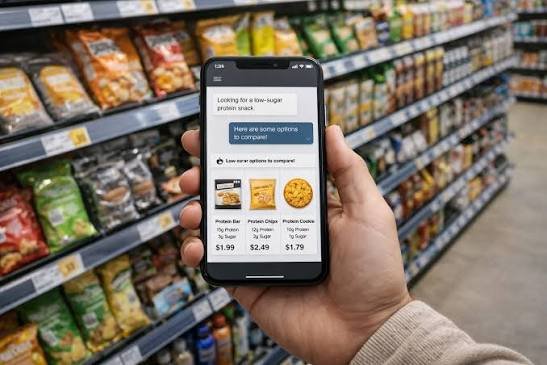
The snack aisle is beginning to look very different — and the next change may not be taking place on the supermarket shelf at all.
Americans are increasingly turning to artificial intelligence when deciding what to eat between meals, according to new research from Conagra Brands. But the significance of the finding goes beyond consumers asking a machine to recommend a packet of crisps or a chocolate bar. The emerging behaviour suggests that shoppers are becoming much more precise about what they want their food to do for them.
Instead of simply searching for a brand, consumers can ask AI for a snack containing a certain amount of protein, more fibre, fewer calories, ingredients they recognise or something suitable for a particular dietary requirement. In other words, the starting point is moving from “What brand should I buy?” to “What do I need?”
That could have significant consequences for food manufacturers and supermarket buyers.
Conagra’s Future of Snacking 2026 report, based partly on more than 53 million shopping transactions across 17,000 products, puts the scale of the opportunity into perspective. The US snacking market is worth an estimated $198.2 billion annually. Products offering targeted benefits such as protein, energy, digestion and hydration have reached $19 billion in retail sales, with high-protein snacks alone generating $12.1 billion.
The message for manufacturers is becoming harder to ignore. A snack is no longer necessarily being judged simply on taste, price and brand recognition. It may increasingly be judged against a consumer’s personal objective.
That is already visible in the products gaining attention. Conagra reports continued growth in bold flavours, including sweet-and-spicy combinations, while consumers are simultaneously looking for products with functional benefits and simpler or more recognisable ingredients. Snacks are being asked to deliver enjoyment and nutrition rather than forcing shoppers to choose between the two.
For supermarket retailers, this could eventually change the way the snack category itself is organised.
If shoppers increasingly arrive through an AI conversation, they may not be thinking in traditional supermarket categories. They may be looking for “a high-protein snack under 200 calories” rather than “a meat snack”, “a biscuit” or “a cereal bar”. That creates a new challenge for retailers: making product information accurate, detailed and machine-readable enough for AI systems to understand what is actually on the shelf.
This is where the story becomes particularly interesting for ISN.
The supermarket has spent decades organising products for the human shopper walking through an aisle. The next phase could require retailers to organise information for both the human shopper and the algorithm helping that shopper make the decision.
AI may not replace the snack aisle. But it could increasingly decide which products consumers even consider before they get there.
And that means the battle for the snack shopper may be moving from the shelf to the search box — and increasingly, to the conversation with AI.