

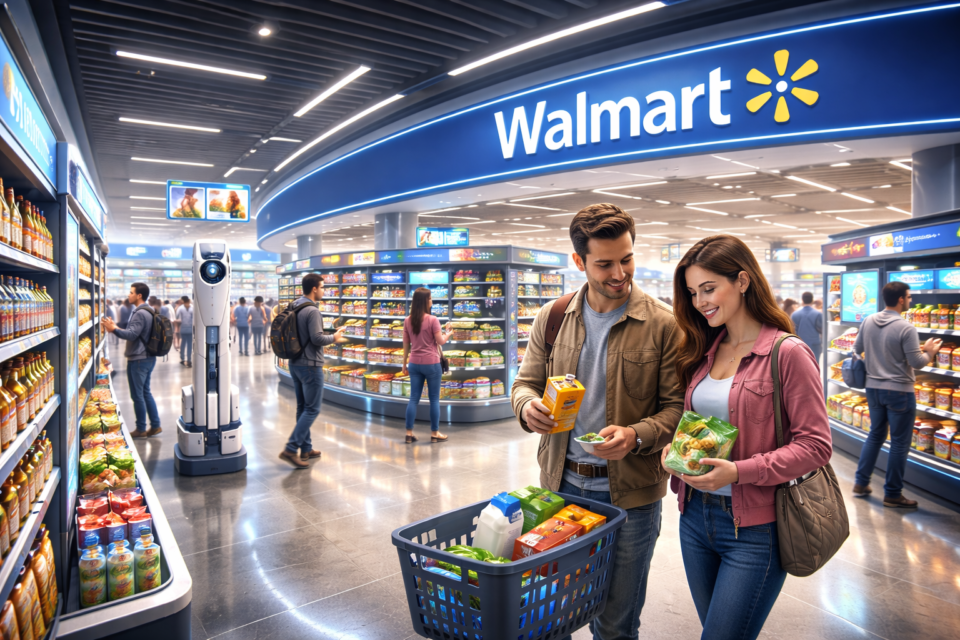
By 2035 the supermarket may look dramatically different from the stores consumers know today. The traditional image of shoppers pushing trolleys through long aisles before queuing at checkout counters could become a relic of retail history. Instead, a new model is gradually emerging—one based on automation, artificial intelligence and frictionless shopping.
At the centre of this transformation is the world’s largest retailer, Walmart. With its enormous scale, technological investment and logistical capabilities, Walmart is uniquely positioned to shape the supermarket of the future.
The concept that analysts increasingly discuss is the “grab-and-go” supermarket—a store where customers simply enter, pick the products they want and leave without ever stopping at a checkout counter.
If the trajectory of retail technology continues, Walmart stores in 2035 may operate very differently from those of today.
The Disappearance of the Checkout
For decades, checkout counters have been the defining feature of supermarkets. Whether staffed by cashiers or replaced by self-service machines, the checkout process has remained the final step in the shopping journey.
But the next generation of retail technology aims to eliminate this step entirely.
In a grab-and-go environment, cameras, sensors and artificial intelligence systems track the products customers pick up from shelves. The moment a shopper leaves the store, the system automatically charges their account.
The technology already exists in experimental formats. By 2035, however, it may become mainstream.
For Walmart, the potential benefits are enormous. Removing checkout counters would free up valuable floor space and reduce labour costs. It would also eliminate one of the most common frustrations experienced by shoppers: waiting in line.
From the consumer’s perspective, the process would resemble entering a digital ecosystem rather than a traditional store.
Customers would simply walk in using their smartphones or biometric identification, collect their groceries and walk out.
The Staffless Store?
The idea of a staffless supermarket is often discussed alongside grab-and-go technology. In theory, automation could reduce the need for employees to operate checkouts or manage certain routine tasks.
Yet the reality is likely to be more nuanced.
Even in a highly automated Walmart store, human staff would still play important roles. Employees would be needed for restocking shelves, managing fresh food departments, assisting customers and ensuring that operations run smoothly.
What is likely to change is the nature of supermarket employment. Instead of large numbers of cashiers, stores may rely more heavily on logistics specialists, technology supervisors and customer service staff.
Automation will reshape jobs rather than eliminate them entirely.
However, the scale of this transformation should not be underestimated. Walmart is one of the largest employers in the world. Any technological shift affecting its workforce would inevitably have broader social and economic implications.
The Rise of Personalised Advertising
Another defining feature of the Walmart supermarket in 2035 could be in-store advertising tailored to individual shoppers.
Digital screens, smart shelves and mobile applications may work together to create highly personalised marketing environments.
Imagine entering a store where promotional displays automatically adapt to your purchasing history. A shopper who frequently buys organic products might see advertisements for new organic ranges, while another customer might receive promotions for ready-to-eat meals or discounted household essentials.
Artificial intelligence would analyse purchasing patterns, loyalty data and online browsing behaviour to generate targeted marketing messages.
For Walmart, this system represents a powerful new revenue stream. Retail media—the practice of selling advertising space within retail platforms—is already becoming a major business for large supermarket chains.
By 2035, in-store advertising could be as data-driven as online marketing.
Brands may compete for visibility not only on supermarket shelves but also within digital displays that adapt dynamically to each customer.
A Data-Driven Store Environment
The supermarket of 2035 will almost certainly operate as a sophisticated data ecosystem.
Every product movement, every purchase and every interaction within the store could generate valuable information.
For Walmart, this data would help optimise inventory management, forecast demand and personalise marketing strategies.
Shelves could automatically detect when stock levels are running low and trigger replenishment orders. Fresh food departments might use predictive systems to minimise waste by adjusting production according to demand patterns.
The integration of artificial intelligence and logistics could make store operations far more efficient than today’s systems.
However, this level of data collection also raises significant questions about privacy and consumer trust.
Shoppers may appreciate convenience, but they may also become increasingly cautious about how their personal information is used.
Retailers like Walmart will need to balance technological innovation with transparency and responsible data management.
The Changing Role of the Physical Store
Another important question concerns the role of the physical supermarket itself.
Over the past decade, online grocery shopping has expanded rapidly. Delivery services and click-and-collect systems have altered the way many consumers purchase food.
Yet physical stores continue to play a crucial role in the grocery ecosystem.
By 2035, Walmart stores may function as hybrid retail hubs. They will serve not only as shopping locations but also as distribution centres for online orders.
Automated storage systems within stores could prepare delivery orders while customers shop in the same building. The boundary between retail and logistics may gradually disappear.
This model would allow Walmart to combine the efficiency of e-commerce with the immediacy of physical shopping.
The Risks of Over-Automation
While the vision of a fully automated supermarket is compelling, it also carries risks.
Technology systems are complex and expensive to maintain. Installing thousands of sensors, cameras and digital displays across large stores requires significant investment.
Moreover, not all consumers may welcome such a highly automated environment.
Some shoppers still value personal interaction with store employees. Others may feel uncomfortable with systems that track their movements and purchases so closely.
Retailers must therefore ensure that technological innovation does not come at the expense of customer comfort.
If the shopping experience becomes too impersonal or intrusive, consumers may simply choose alternative retailers.
A New Retail Landscape
Looking ahead to 2035, it is clear that the supermarket industry will continue to evolve.
For a company as large and influential as Walmart, the decisions made today regarding technology, automation and data management will shape the future of grocery retail.
The grab-and-go supermarket, the disappearance of traditional tills and the rise of personalised advertising all point toward a new retail paradigm.
Yet the fundamental principles of the grocery business remain unchanged.
Customers will still expect fresh products, fair prices and reliable availability.
Technology may transform the infrastructure of supermarkets, but it cannot replace the basic relationship between retailers and the communities they serve.
In the end, the success of Walmart’s future stores will depend not only on innovation but also on maintaining the trust of millions of shoppers.
If the company manages to combine advanced technology with customer-focused retailing, the Walmart supermarket of 2035 may represent one of the most significant transformations the grocery industry has ever experienced.