
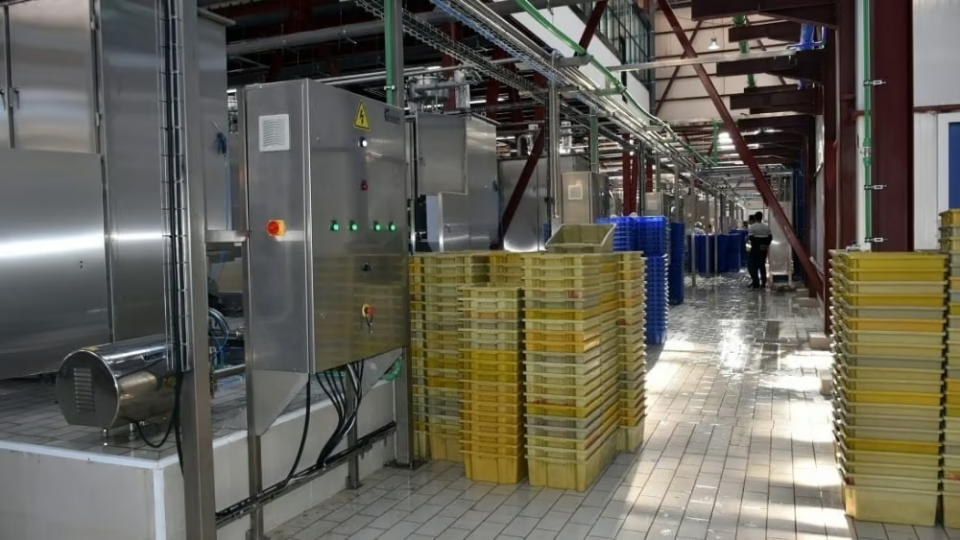
Algeria has taken a significant step towards reshaping its dairy industry with the inauguration of the country’s largest milk processing facility in Rouiba’s industrial zone. The plant, developed by state-owned dairy group Giplait, reflects a broader national strategy aimed at cutting reliance on imported milk powder and strengthening domestic production.
Spread across more than four hectares, the new factory boasts a processing capacity exceeding 1.2 million litres of milk per day — equivalent to around 1,200 tonnes — making it the largest operational dairy unit in the country. Equipped with modern production lines, the facility will manufacture both subsidised pasteurised milk sold at regulated prices and ultra-high temperature (UHT) milk.
According to Giplait CEO Samah Lahlouh, the project represents a strategic milestone for Algeria’s dairy sector. It is designed to enhance food security, stabilise the supply of essential goods, and move the country closer to self-sufficiency in milk production.
Tackling Import Dependence
Algeria’s dairy ambitions are driven by hard economic realities. The country ranks among the world’s top consumers of milk powder and is one of the largest importers globally. Domestic production has struggled to keep pace with rising demand, forcing Algeria to rely heavily on international suppliers such as the European Union, New Zealand, Uruguay and Argentina.
Recent figures highlight the scale of the challenge. In 2023, Algeria accounted for approximately 22% of Africa’s total dairy import bill, which reached $7.5 billion. Milk powder remains the most critical import, used primarily to reconstitute drinking milk. In 2024 alone, Algeria imported 236,000 tonnes of milk powder, making it the second-largest importer worldwide after China.
To address structural weaknesses in the supply chain, Giplait has initiated discussions with Russian dairy giant EkoNiva, one of the world’s leading raw milk producers. The potential partnership could involve the establishment of specialised pilot farms, along with knowledge transfer and technological support to modernise Algeria’s dairy ecosystem and improve competitiveness.
Major International Investments
Interest in Algeria’s dairy market extends beyond Russia. Qatari agribusiness group Baladna is currently developing a massive integrated agro-industrial complex in the southern Adrar region. Valued at $3.5 billion, the project is expected to become one of the largest integrated dairy operations in the world.
The development will include a 117,000-hectare farm designed to house approximately 270,000 dairy cows. Output from this herd will supply a processing plant capable of producing 200,000 tonnes of milk powder annually. Construction is scheduled to begin this year, with first production anticipated by the end of 2027.
The initiative is positioned as a mutually beneficial partnership: Algeria would gain substantial industrial capacity to meet domestic demand — and potentially export surplus — while Baladna would strengthen its footprint across Africa.
The company has already signalled broader continental ambitions, having announced a $1.5 billion dairy project in Egypt in 2023 and plans in 2025 to establish a facility in Nigeria’s Ogun State.
A Structural Shift in the Making
With consumption levels among the highest in Africa and growing demographic pressures, Algeria’s dairy sector stands at a turning point. The commissioning of Giplait’s flagship facility signals not only an expansion of capacity, but a deeper transformation aimed at reducing structural dependency on imports and building a more resilient agri-food industry.
Whether these large-scale investments will significantly curb Algeria’s milk powder imports remains to be seen. However, the direction is clear: the country is moving decisively towards industrial-scale self-reliance in one of its most strategic food sectors.