
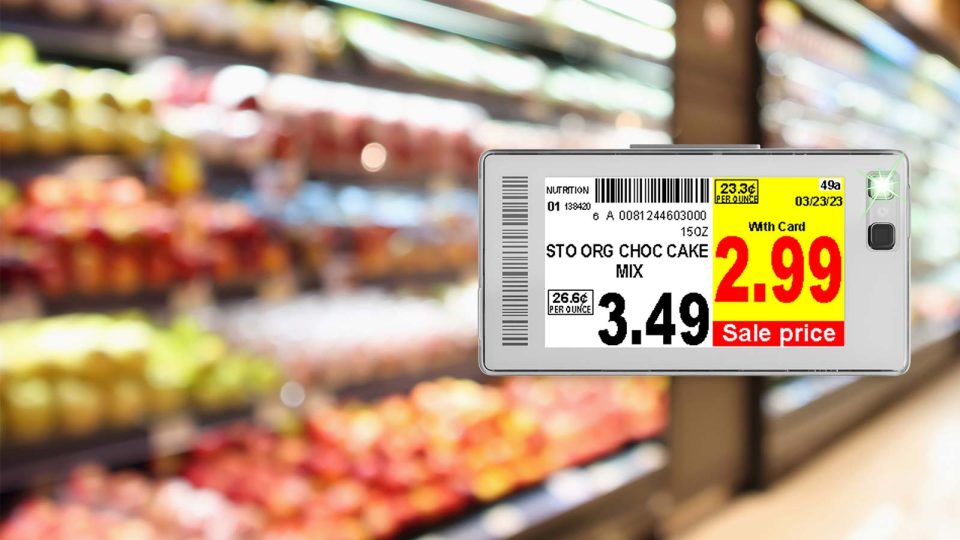
Electronic shelf labels are moving rapidly from a technology trial to a core part of supermarket infrastructure.
Across Europe, major retailers are replacing millions of paper price tags with connected digital labels that can update prices, promotions and product information from central systems. The latest Tesco announcement — a rollout across around 3,000 UK stores — demonstrates just how far the technology has moved.
The battle is also intensifying between the major ESL suppliers, with Hanshow, Pricer, VusionGroup and SOLUM among the companies competing to control the digital shelf.
The shelf edge is becoming a technology battleground.
TESCO: 3,000 STORES WITH HANSHOW
Tesco has signed a multi-year partnership with Chinese ESL specialist Hanshow to roll out electronic shelf labels across approximately 3,000 UK stores over the next two years.
The rollout will cover large-format stores and convenience locations, beginning with four stores — one Express and three larger supermarkets. Tesco had previously tested both Hanshow and VusionGroup technology.
The labels will allow prices and product information to be updated centrally, while additional functions can support online picking and other store operations.
For Tesco, this is much more than replacing paper.
It means connecting the shelf directly to the retailer’s digital infrastructure.
WAITROSE: MORE THAN 200 STORES
Waitrose has already passed the 200-store milestone in its nationwide digital shelf transformation.
The retailer is using SOLUM’s Newton Pro electronic shelf labels, with the rollout continuing across its estate. The system allows centrally managed pricing updates and is designed to reduce routine work for store teams.
Waitrose therefore provides another important example of ESLs moving beyond pilot schemes and into large-scale supermarket operations.
CO-OP: VUSIONGROUP AND NEARLY 2,400 STORES
The Co-op has partnered with VusionGroup to replace paper shelf-edge labels across its nearly 2,400 UK and Irish stores.
VusionGroup describes the project as the largest single-retailer rollout of electronic shelf-edge labels in the UK and Ireland. The technology is designed not only to update prices but also to support online grocery picking, product information and store operations.
Independent regional societies like the East of England Co-op have additionally worked with Pricer for their specific ESL installations
The scale is enormous.
Thousands of stores multiplied by thousands of products means millions of digital labels.
ASDA: VUSIONGROUP IN EXPRESS
Asda is also working with VusionGroup.
The retailer announced a rollout to more than 250 Asda Express stores, with approximately 2,800 labels per store, representing more than 700,000 electronic shelf-edge labels across the rollout.
The labels can display price, weight and unit-price information and can also provide allergen information through QR codes.
Asda’s earlier trial showed how quickly prices could be updated, with changes made from the store system rather than employees physically replacing paper tickets.
CARREFOUR: THE PRICER STORY CHANGES
Carrefour is particularly interesting because it illustrates how the ESL supplier market itself is changing.
Pricer has been a long-standing Carrefour technology partner and had been the retailer’s exclusive ESL supplier for many years.
But in February 2026, Pricer confirmed that Carrefour had decided to introduce an additional supplier in France.
Pricer nevertheless remains a major Carrefour partner, with an installed base of more than 1,600 Carrefour stores across the relationship, including more than 1,200 in France.
This is an important development.
The question is no longer simply whether Carrefour wants electronic shelf labels. It is increasingly about which supplier gets the business — and whether Europe’s largest retailers want to rely on one technology provider or multiple platforms.
Pricer says its Carrefour relationship continues to provide access to its next-generation ESL technology and its Pricer Plaza cloud platform, which centralises monitoring and automates price updates.
Pricer itself is a major global ESL player. The Swedish company says it has delivered more than 380 million electronic shelf labels to more than 28,000 stores in over 80 countries.
AHOLD DELHAIZE: MILLIONS OF LABELS
Ahold Delhaize demonstrates how large the digital shelf can become when a supermarket group commits to the technology across multiple markets.
Its partnership with Hanshow began in 2018 and expanded across European brands.
Hanshow said its platform was managing more than 10 million IoT devices across Ahold Delhaize stores in Europe, with ESL deployments covering hundreds of stores.
The partnership has included Ahold Delhaize brands in the Netherlands, Belgium, Luxembourg, Greece, the Czech Republic, Serbia and Romania.
Albert Heijn in the Netherlands continues to expand its Hanshow ESL deployment, with newer generations of digital labels being introduced across its network.
This shows why ESLs are becoming strategically important.
When millions of labels are connected to the retailer’s systems, the shelf becomes part of the retailer’s digital infrastructure.
AUCHAN: HANSHOW’S EARLY EUROPEAN BREAKTHROUGH
Auchan is another important name in the story.
Hanshow says its major international expansion began in 2016 when it secured a deal to become the exclusive ESL provider to Auchan in France.
That relationship helped establish Hanshow as a significant European retail technology supplier and was followed by expansion into other markets.
Auchan remains among the major retail groups associated with Hanshow’s ESL business.
THE BATTLE FOR THE DIGITAL SHELF
The European ESL market is therefore becoming increasingly competitive.
Hanshow has major relationships with Tesco, Ahold Delhaize and Auchan.
VusionGroup is supplying the Co-op and Asda and has a growing presence across European grocery.
SOLUM is working with Waitrose.
Pricer has one of the largest installed bases in the industry and remains deeply embedded within Carrefour despite the French retailer introducing an additional supplier.
This is no longer a niche technology market.
It is becoming a battle for the infrastructure sitting directly underneath the supermarket’s pricing, promotions and store-management systems.
FROM PRICE TAG TO DIGITAL BRAIN
The most important change is what the ESL can become.
The traditional paper label has one job: tell the shopper the price.
An electronic label can be connected to the retailer’s central pricing system.
That means prices can be updated across thousands of stores, promotions can be synchronised, price accuracy can be improved and employees can spend less time replacing paper labels.
But the technology can go much further.
ESLs can support online order picking, product location, stock management, digital promotions, shopper information and retail media.
Hanshow now describes ESLs as a foundational IoT infrastructure for digital store operations, while its latest systems are being developed alongside AI, store execution and connected-store technologies.
The shelf is therefore changing from a passive display into an active digital interface.
The price tag is becoming a screen.
The screen is becoming a data point.
And the shelf is becoming part of the supermarket’s digital brain.
THE BIG EUROPEAN OPPORTUNITY
Europe is already well ahead of the United States in ESL adoption.
One recent industry assessment cited by AP found electronic labels in around 80% of European supermarkets, compared with roughly 5–10% in the US.
That creates a huge installed base — and an even larger opportunity for the technology companies competing to upgrade it.
The next stage will not simply be about putting digital labels on shelves.
It will be about connecting those labels to AI, inventory, pricing, promotions, waste reduction, online fulfilment and retail media.
That could turn the humble shelf edge into one of the most valuable digital spaces inside the supermarket.
NRF EUROPE: THE NEXT BATTLEGROUND
All eyes will be on NRF 2026: Retail’s Big Show Europe in Paris in September.
For the supermarket industry, ESL technology should be one of the areas to watch closely.
Tesco has just committed to around 3,000 stores.
Co-op is moving towards 2,400.
Waitrose has passed 200.
Asda has deployed the technology across more than 250 Express stores.
Carrefour has more than 1,200 Pricer-equipped stores in France and more than 1,600 across its wider relationship.
Ahold Delhaize has millions of connected ESL devices through its relationship with Hanshow.
And Auchan has been part of Hanshow’s European story for a decade.
The technology race is clearly accelerating.
At NRF Europe, the question will be whether the next generation of ESLs will remain simply electronic price labels — or become the digital operating layer of the supermarket shelf.
