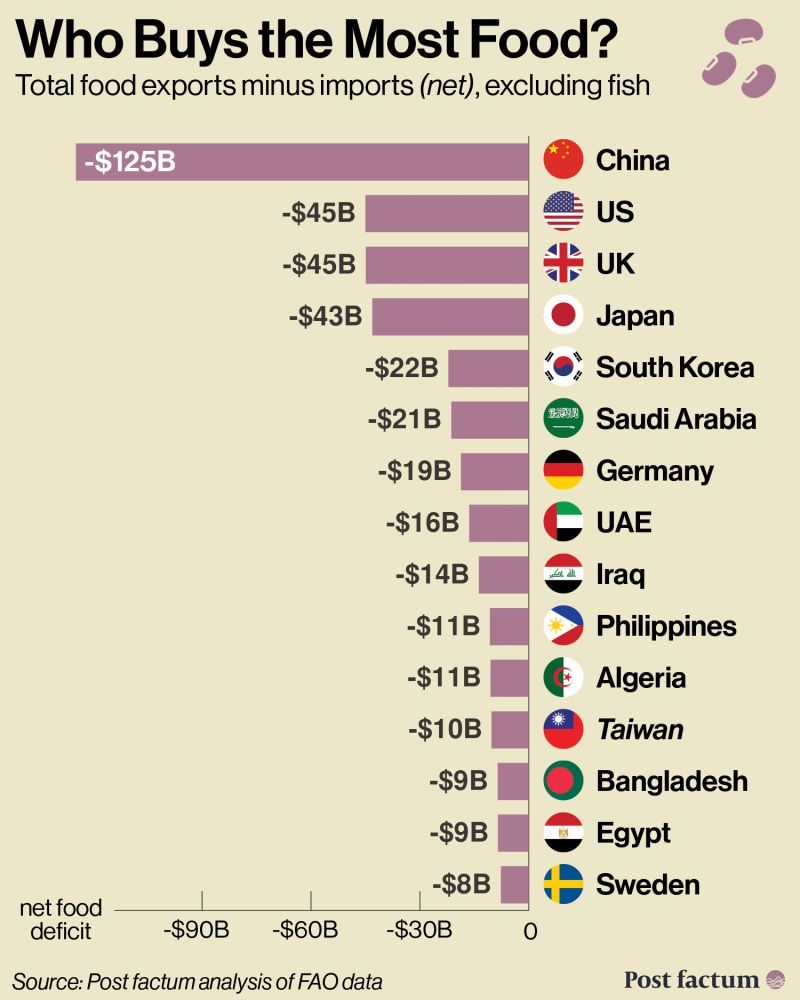
The global food trade is increasingly shaped not only by the countries that produce the most food, but by the countries that have to buy it from the rest of the world. A new analysis based on FAO data highlights the scale of this dependence, showing the countries with the largest net food deficits, excluding fish.
China stands well ahead of the other countries, with a net food deficit of around $125 billion. The United States and United Kingdom follow at approximately $45 billion each, while Japan records around $43 billion. South Korea, Saudi Arabia, Germany and the United Arab Emirates also feature prominently.
What makes the ranking particularly interesting is the variety of countries involved. Some are enormous economies with hundreds of millions of consumers, while others have relatively small populations but a high dependence on imported food. Algeria is a good example. With a population of around 47 million, it records a net food deficit of approximately $11 billion, placing it 11th in the chart and just outside the top ten.
The latest FAOSTAT trade dataset covers food and agricultural trade across countries and territories and demonstrates how international trade has become an essential part of food availability and food security.
CHINA — $125 BILLION NET FOOD DEFICIT
China is by far the largest country on the chart, with a net food deficit estimated at around $125 billion. Its position is partly explained by the sheer size of its population and consumer market, but also by the enormous quantities of agricultural commodities and food products required by its food, livestock and processing industries. China is simultaneously a major food producer and a major importer, making it one of the most important markets for food exporters worldwide. World Bank trade data shows Brazil, the United States, Thailand, Indonesia and Canada among China’s major food suppliers.
UNITED STATES — $45 BILLION
The United States is traditionally one of the world’s agricultural superpowers, exporting enormous quantities of grain, meat and other agricultural products. Yet the chart shows a net food deficit of around $45 billion. This does not mean America is unable to feed itself. Rather, it reflects the scale of the US consumer market and its enormous demand for food products that are imported alongside its major agricultural exports.
UNITED KINGDOM — $45 BILLION
The UK records a net food deficit of approximately $45 billion, putting it level with the United States in this ranking. Britain’s limited agricultural land relative to its population, combined with a highly developed supermarket sector and consumers’ demand for products from around the world, makes food imports a structural part of the British food system. The UK’s food supply therefore depends heavily on international trade and reliable global supply chains. UK government analysis also highlights the country’s reliance on food imports and the importance of international markets to food availability.
JAPAN — $43 BILLION
Japan has one of the world’s most developed food markets but limited agricultural land compared with its population and consumption requirements. The result is a substantial dependence on imported food and agricultural commodities. With a net deficit of around $43 billion, Japan remains one of the world’s most important destinations for food exporters.
SOUTH KOREA — $22 BILLION
South Korea has a net food deficit of approximately $22 billion. The country has a highly developed food manufacturing and retail industry, but limited agricultural land and a dense population make international sourcing essential. Imported grains, meat, feed ingredients and other food commodities support both consumers and the country’s food-processing sector.
SAUDI ARABIA — $21 BILLION
Saudi Arabia’s position reflects the challenges faced by countries with limited agricultural resources and a demanding domestic food market. The country has invested heavily in food security, storage and domestic production, but international sourcing remains essential. FAO estimates cereal import requirements of around 15 million tonnes for 2026/27, including wheat, maize and barley.
GERMANY — $19 BILLION
Germany is one of Europe’s largest food markets and a major agricultural producer, yet the chart shows a net food deficit of around $19 billion. Germany’s position reflects the complexity of modern European food trade: countries can be major producers and exporters while simultaneously importing large quantities of different foods. Consumers expect year-round availability and a wide variety of products, much of which moves across European borders.
UNITED ARAB EMIRATES — $16 BILLION
The UAE records a net food deficit of approximately $16 billion, a remarkable figure for a country with a relatively small population. Limited agricultural land and harsh climatic conditions mean that international food supply chains play a central role in feeding the domestic market. The UAE has consequently developed into an important regional hub for food imports, distribution and re-export.
IRAQ — $14 BILLION
Iraq has a net food deficit of around $14 billion. Its position reflects the gap between domestic food production and consumer demand, with international supplies playing an important role in the country’s food system. Iraq is also part of a wider Middle Eastern market where climatic conditions, water availability and agricultural capacity influence dependence on imported food.
PHILIPPINES — $11 BILLION
The Philippines records a net food deficit of approximately $11 billion. Its large and growing population creates substantial demand for food and agricultural commodities, while domestic production does not fully cover the requirements of the market. International trade therefore plays an important role in maintaining supply and supporting the country’s food-processing and retail industries.
ALGERIA — $11 BILLION
Algeria is one of the most interesting countries in the ranking. With a population of around 47 million, it records a net food deficit of approximately $11 billion, putting it 11th on the chart and just outside the top ten.
The figure highlights Algeria’s importance as a food-import market. Cereals are particularly significant. FAO currently forecasts Algeria’s cereal import requirements at around 14.5 million tonnes for 2026/27, including approximately 8.5 million tonnes of wheat and 5 million tonnes of maize. At the same time, Algeria is expecting an above-average cereal harvest in 2026.
For international food exporters, Algeria is therefore a market that cannot be overlooked. Its position on the chart is especially notable because it achieves this level of net food deficit with a population far smaller than China, the United States, the UK or Japan.
TAIWAN — $10 BILLION
Taiwan records a net food deficit of approximately $10 billion. Its relatively limited land area and high-density population contribute to its dependence on international food supplies. Taiwan is also a sophisticated consumer market, creating demand for a wide range of imported food products in addition to agricultural commodities.
BANGLADESH — $9 BILLION
Bangladesh has a net food deficit of around $9 billion. With a population exceeding 170 million and one of the world’s highest population densities, maintaining food supply is a major logistical and economic challenge. Domestic agriculture remains extremely important, but international trade helps supplement production and meet the requirements of the population and food industry.
EGYPT — $9 BILLION
Egypt also records a net food deficit of approximately $9 billion. Its enormous population and dependence on imported staple commodities make it one of the strategically important food markets in the Middle East and North Africa. Wheat and other grains are particularly important to the country’s food security, while the country’s agricultural sector continues to supply a substantial share of domestic demand.
SWEDEN — $8 BILLION
Sweden completes the chart with a net food deficit of around $8 billion. Despite having a developed agricultural sector, Sweden’s climate, population size and consumer demand mean that imports remain an important part of the food market. European integration also means that food products move extensively across borders, making Sweden part of a highly interconnected regional food system.
A GLOBAL FOOD MARKET BUILT ON IMPORTS
The ranking reveals something important for the international food industry: food import dependence is not limited to countries that cannot produce food.
China and the United States are major agricultural powers. Germany is one of Europe’s largest economies and an important agricultural producer. Yet all three appear on a list dominated by countries with substantial net food deficits.
For food exporters, the implications are significant. The largest opportunities are not necessarily found only in countries with weak agriculture. They are often found where population, consumer purchasing power, food variety, processing industries and domestic production gaps come together.
China is the giant of the market, but the list also highlights major opportunities across Europe, Asia and the Middle East. The UK, Japan, South Korea, Saudi Arabia, the UAE and Algeria all demonstrate how international food trade has become an integral part of modern food retail.
And Algeria is perhaps one of the most revealing examples. A country of around 47 million people generating a net food deficit of approximately $11 billion shows that a relatively medium-sized population can still represent a major opportunity for international food suppliers.
The FAO’s latest trade statistics underline the fundamental role of international trade in distributing food around the world, particularly where domestic production cannot satisfy the full requirements of consumers and food industries.