

The UK’s first nationwide deposit return scheme (DRS) has taken a decisive step towards launch with the unveiling of its official consumer-facing identity: Exchange for Change. The new name, revealed in an exclusive published by The Grocer, comes as the industry accelerates preparations for a system due to go live in October 2027 — a deadline that is fast becoming very real for retailers, producers and brands.
At the heart of the initiative is UK DMO (Deposit Management Organisation), the industry-led body tasked with designing, managing and operating the scheme across England, Scotland and Northern Ireland. Once implemented, the DRS will introduce a small, refundable deposit on single-use drinks containers — typically plastic bottles and cans — which consumers reclaim when they return the empty packaging for recycling.
What Is the Deposit Return Scheme — and Why It Matters
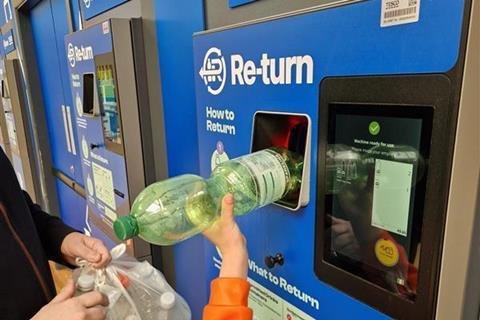
Under Exchange for Change, consumers will pay a deposit at the point of purchase and receive it back when the container is returned via a reverse vending machine (RVM) or approved manual return point. The aim is simple but ambitious: reduce litter, dramatically increase recycling rates and ensure valuable materials remain within the UK’s recycling loop.
Deposit return schemes are not new. Across Europe, they are widely regarded as one of the most effective tools for driving recycling behaviour. Germany, Norway, Finland and Lithuania consistently achieve return rates above 90%, supported by clear branding, nationwide infrastructure and strong retailer participation. In comparison, the UK has lagged behind — until now.
Branding as Infrastructure, Not Marketing
The introduction of a clear and memorable identity is widely seen as a foundational element of the scheme’s success. For consumers, Exchange for Change is intended to become an instantly recognisable symbol — a visual cue at shelf-edge, on-pack and in-store — signalling participation and reinforcing habitual behaviour.
Russell Davies, Chief Executive of UK DMO, said the name reflects the broader ambition of the scheme:
“Our new name reflects what this scheme is about: making a simple change that has the power to transform streets, communities and recycling habits across the UK. The brand icon is intended to become synonymous with the scheme itself, providing a consistent visual cue that supports participation and helps drive cleaner streets and communities.
“We’re excited to take this next step and will keep working closely with partners across the UK, supporting them in preparing for the launch of the scheme and making sure that together we deliver real change and a scheme that works for everyone.”
For retailers and producers, the message is clear: branding is not cosmetic — it is operational infrastructure.
Retailers: Between Opportunity and Operational Reality
For supermarkets, convenience stores and forecourt operators, DRS represents one of the most significant operational changes in decades. Space allocation, staff training, hygiene standards, machine maintenance and customer flow will all be affected.
Large supermarket groups are expected to rely heavily on automated RVMs, while smaller retailers may opt for manual take-back models. Either way, the transition will require early planning and capital investment — particularly in urban locations where space is limited.
From a buyer’s perspective, DRS will also influence pack formats, supplier compliance, labelling standards and pricing structures. Buyers will increasingly favour suppliers who are “DRS-ready” — not just compliant, but operationally aligned.
Technology and the Circular Economy
Reverse vending technology will sit at the core of the scheme, and this is where industry specialists see both challenge and opportunity.
Travis Way, Managing Director at EcoVend, the reverse vending machine experts and a brand of international circular economy specialists Reconomy, highlighted the importance of public engagement and alignment across the value chain:
“Public engagement will be one of the defining factors in whether the UK’s deposit return scheme succeeds, so giving it a clear, consumer-friendly identity is a significant and welcome step. A scheme like DRS only works when consumers, producers and retailers are all aligned, and consistency in naming, branding and messaging will be critical to driving participation at scale.”
Way noted that while environmental benefits are clear, the scheme will require behavioural and operational change across the board:
“There’s no doubt DRS represents a major adjustment – behaviourally for consumers and operationally for producers and retailers – but a joined-up approach that prioritises clarity and simplicity will help make that transition smoother. The commercial opportunities are substantial, and the circular economy benefits are even greater.”
2026: The Year That Will Decide Success or Failure
With the launch date fixed for October 2027, industry insiders increasingly view 2026 as the decisive preparation year. Systems must be tested, infrastructure installed and consumer communication strategies rolled out well in advance.
Way underlined the urgency:
“With the October 2027 deadline approaching, 2026 will be the key preparation year for businesses, giving them a narrow but vital window to get systems, infrastructure and communications in place ahead of launch.”
European experience shows that late adoption leads to friction — confused consumers, overwhelmed stores and political backlash. Countries that invested early in education and retailer readiness saw smoother rollouts and faster behaviour change.
ISN Analysis: More Than Recycling
Beyond litter reduction, Exchange for Change should be viewed as a strategic economic tool. High-quality recycled material supports domestic manufacturing, reduces reliance on imported raw materials and helps brands meet tightening ESG and regulatory requirements.
For retailers, DRS could drive increased footfall, longer dwell time and incremental spend — provided execution is right. For producers, it accelerates the shift towards circular packaging design. For consumers, it normalises recycling as part of everyday shopping behaviour.
The unveiling of Exchange for Change marks the moment when the UK’s deposit return scheme moves from policy debate to operational reality. The name is now in place. The deadline is fixed. The responsibility is shared.
The question is no longer if DRS will happen — but who will be ready when it does.