

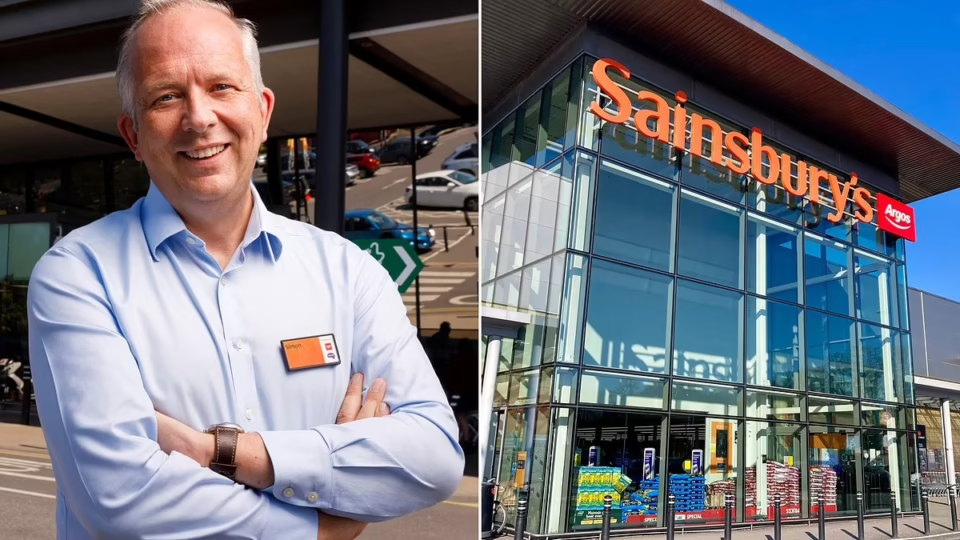
Inside J Sainsbury plc’s Strategic Reboot: Price War, Market Share Gains and a UK Grocery Battleground
In a grocery market where every penny counts, J Sainsbury plc is fighting to keep pace with its rivals while navigating a complex mix of inflationary pressure, shifting consumer behaviour, and intensifying competition. The British supermarket, long positioned between quality and value, is now aggressively recalibrating its strategy — and the results are beginning to show cracks and opportunities that could reshape its future.
A rare moment of momentum
Recent industry data reveals that Sainsbury’s is outpacing key competitors in a sluggish UK market, recording a 5.2 % increase in sales and lifting its market share to 16.1 % in the most recent grocery performance period. This growth, which narrowly eclipses the broader market, underscores the chain’s ability to attract customers even as inflationary pressures bite into household budgets.
Yet these numbers belie a deeper tension: while food sales are climbing, the broader retail environment remains challenging. Grocery inflation in the UK has ticked higher to 4.3 %, bringing renewed scrutiny to supermarket pricing strategies and shifting competitive dynamics.
The balancing act: premium assortment vs. price competitiveness
Where Sainsbury’s has always struggled is in defining its identity between premium supermarket and value destination. Recent industry analysis suggests that the chain’s middle‑market position leaves it exposed on both fronts: premium rivals like Waitrose attract affluent shoppers, while aggressive discounters undercut it on price.
Sainsbury’s response has been striking. The retailer has doubled down on premium lines such as “Taste the Difference”, which have driven strong category growth and elevated basket values during festive trading. At the same time, it has leaned into pricing initiatives and loyalty offers designed to appeal to cost‑conscious shoppers seeking everyday value.
This dual approach is proving difficult to manage. Premium ranges can boost profitability, but they risk alienating budget‑focused shoppers in a climate where the cost of living dominates consumer priorities.
Loyalty as a strategic lever
Central to Sainsbury’s strategy is its Nectar loyalty platform, which has become a critical tool in expanding personalised pricing and targeted savings. By linking shopper behaviour to tailored offers and incentives, the chain aims to foster deeper customer engagement and repeat visits.
This strategy is not merely about discounts; it’s about insight. Nectar data allows Sainsbury’s to design promotions based on actual purchasing patterns rather than generic price cuts. This means more effective basket stimulation and a more profitable way to compete with rivals that simply slash headlines prices.
Retail wage battle and internal dynamics
Beyond pricing, Sainsbury’s is also navigating the broader labour context of UK supermarkets. Against a backdrop of rising wage expectations and intense competition for frontline staff, Sainsbury’s recently announced above‑inflation pay increases for colleagues. This move, intended to boost recruitment and retention, reflects a broader trend among supermarket chains to invest in labour as a differentiator.
However, wage inflation adds pressure on operating margins, forcing the company to balance frontline pay with cost management elsewhere. This underscores the precarious tightrope that Sainsbury’s is walking: improving the shopping experience while controlling expenses.
Price positioning in a tightening market
New independent analysis of UK supermarket pricing reveals a stark truth: Sainsbury’s stands behind some competitors when it comes to headline grocery prices. In recent price comparisons, Aldi retained its crown as the cheapest grocer, with Lidl and Asda closely following. Sainsbury’s was noticeably higher, reinforcing perceptions of the chain as less competitive on the absolute cost of a weekly shop.
In an era of rising food inflation, this positioning threatens to strain Sainsbury’s value proposition. Shoppers faced with prolonged economic uncertainty are increasingly drawn to discounters, forcing mainstream supermarkets to rethink price leadership.
Promotions and the wider price war
The broader UK grocery sector has been engaged in a quiet but costly price war, with chains spending heavily on promotions and discounting to defend market share. While not always headline news, this unrelenting competitive pressure is reshaping margins and forcing retailers to innovate in how they attract and retain customers. The pressure is particularly acute for mid‑tier supermarkets like Sainsbury’s, which must compete simultaneously with value chains and premium operators.
Digital and convenience growth
Sainsbury’s is investing in digital grocery channels and convenience formats as part of its growth blueprint. Online sales growth remains strong, with digital grocery orders climbing significantly, supported by personalised loyalty pricing and improved logistics.
This reflects a broader strategic pivot towards seamless omnichannel retailing. Customers today expect flexibility: home delivery, click‑and‑collect, rapid fulfilment and personalised prices. By integrating these elements with its physical store network, Sainsbury’s hopes to capture consumers who might otherwise defect to pure online players or discounters.
Store transformation and network optimisation
While Sainsbury’s has reported a net increase in market share, its store portfolio evolution is equally noteworthy. Over the past year, the supermarket has opened new convenience outlets, repositioned existing supermarkets and invested in formats aimed at urban and convenience‑centric shopping patterns. Data from recent financial reporting shows that the group plans continued expansion of its convenience footprint, emphasising smaller, local stores that align with contemporary consumer behaviour.
However, this transformation is not without controversy. Local community discussions and internal feedback hint at concerns over store closures, facility maintenance and in‑store services — issues that can erode brand perception if not addressed effectively.
Internal perceptions and customer experience
Beyond corporate strategy, the lived experience of shopping and working at Sainsbury’s paints a more nuanced picture. Customer feedback highlights issues ranging from infrastructure and hygiene concerns to staffing levels and service quality. Such ground‑level realities can undermine broader strategic efforts if not swiftly corrected.
Employee feedback from internal channels also signals pressure points, including concerns about shrinkage (loss through theft or waste) and operational efficiency. While anecdotal, these insights underscore the daily retail challenges that influence overall performance.
Navigating a deeper strategic crossroads
Sainsbury’s current position reflects a supermarket at a strategic crossroads. It is achieving pockets of growth and demonstrating resilience in categories such as fresh food and online grocery, yet it confronts the dual challenge of maintaining value perception while protecting margins.
With grocery inflation on the rise and competition intensifying on all fronts, Sainsbury’s faces a critical moment. Its ability to refine pricing, strengthen customer engagement through loyalty innovation, and deliver a frictionless omnichannel experience will determine whether it emerges as a stronger competitor or becomes increasingly squeezed between discounters and premium rivals.
What happens next at Sainsbury’s will not just shape the company’s future — it may also signal broader shifts in how mainstream supermarkets must adapt to survive in a new era of retail where price, convenience and customer experience rule supreme.