
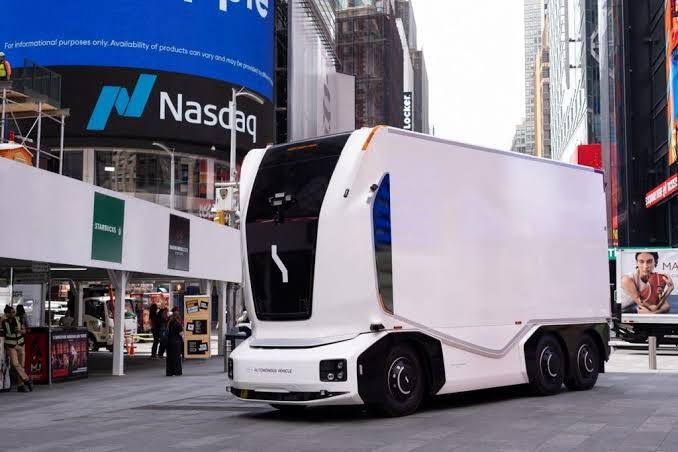
This is the future of grocery delivery
The next big change in grocery retail may not happen inside the store at all. It may happen on the road between the distribution centre and the supermarket.
Lidl has begun using a cab-less electric truck with SAE Level 4 autonomous driving capability on public roads in Germany, in a real store-delivery operation. The vehicle is operating between Lidl’s distribution facilities in Edermünde, near Kassel, and a nearby store under approval from Germany’s Federal Motor Transport Authority. It can carry 15 Euro pallets and make up to three journeys a day, with the four-month project expected to move more than 3,000 pallets.
The headline may be the absence of a driver, but for supermarket retailers the more important development is what the technology could eventually do to store replenishment.
Supermarkets are built around timing. A product arriving late at a distribution centre can eventually mean an empty shelf. A delivery that cannot be scheduled efficiently can add cost to an already tightly controlled supply chain. Retailers therefore spend enormous amounts of money trying to make the movement of products more predictable, from warehouse systems and inventory technology to route planning and automated distribution.
This is where autonomous transport becomes interesting.
Lidl’s current operation is deliberately limited rather than a nationwide replacement for conventional trucks. The vehicle is working on a defined route and under a specific regulatory approval. Lidl and Einride say the next stage could involve a multi-stop “milk run”, linking several locations rather than simply travelling between two points.
That could eventually create a different model for supermarket logistics: smaller, highly predictable autonomous journeys operating repeatedly between distribution points and stores.
For retailers, the attraction is not simply removing a driver from a truck. It is the possibility of creating a logistics network that can operate with greater consistency while dealing with pressure on transport capacity and labour availability. Lidl itself says the project is intended to address logistics bottlenecks and the shortage of skilled workers.
There is another important point. Autonomous trucks will not replace good retail logistics; they will depend on it. The better the retailer understands inventory, delivery windows, store demand and route planning, the more useful autonomous transport becomes.
That means the driverless truck could be just one piece of a much bigger supermarket technology system connecting the warehouse, the road and eventually the store shelf.
For ISN, this is perhaps the most interesting part of the Lidl experiment. The future supermarket may not simply be automated at the checkout or equipped with smarter electronic shelf labels. Its supply chain could also become increasingly automated before the customer has even walked through the doors.
The supermarket of the future could therefore start moving towards the customer long before the customer starts shopping.