

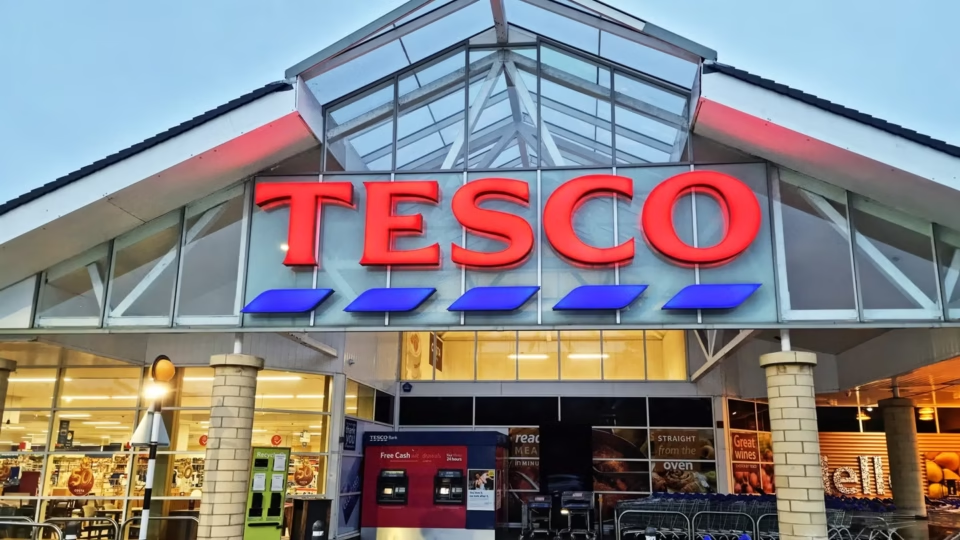
Tesco’s share price journey through 2025 tells a story of steadiness rather than drama, a year defined by resilience, disciplined management and growing investor confidence rather than sharp spikes or collapses. From the opening weeks of the year, the market treated Tesco as a defensive stock, one that could perform reliably in an uncertain economic environment. That perception largely held true as the months progressed.
In the first quarter of 2025, Tesco shares moved gradually higher, supported by reassuring trading updates and a clear message from management around cost control and margin protection. Investors were not expecting explosive growth from a mature grocery business, but they were encouraged by Tesco’s ability to defend its market share while continuing to generate strong cash flow. At a time when UK consumers remained cautious with spending, Tesco’s scale and pricing strategy worked in its favour.
As spring turned into summer, the share price gained further momentum. This period was marked by growing confidence in Tesco’s capital return strategy. Share buybacks played an important psychological role in the market, signalling that the company was comfortable with its balance sheet and confident about future earnings. Dividends added to the appeal, particularly for long-term and income-focused investors who see Tesco as a relatively safe holding in the UK retail sector. By mid-year, the shares were trading comfortably above where they had started, reflecting a re-rating rather than a speculative rally.
The second half of 2025 introduced more mixed sentiment. Competitive pressure from discounters remained intense, and investors were well aware that price wars can quickly erode supermarket margins. Despite this, Tesco avoided any major missteps. Trading updates suggested stable volumes and solid seasonal performance, particularly as the business moved towards the crucial autumn and Christmas period. The share price showed occasional pullbacks, mostly driven by profit-taking rather than any deterioration in fundamentals.
By the final quarter of the year, Tesco shares were trading close to their annual highs, though with noticeable short-term volatility. This was less a sign of weakness and more an indication that the stock had already delivered much of its annual gains. Investors became more selective, questioning how much further the shares could rise without a clear acceleration in earnings growth. Even so, the overall tone remained constructive, with Tesco still seen as one of the stronger names in UK food retail.
Looking ahead, the outlook for Tesco’s share price appears measured rather than exuberant. The company is unlikely to surprise the market with rapid expansion, but it does not need to. Its strength lies in consistency. Continued buybacks, stable dividends and careful cost management should underpin the shares over the coming year. If inflation remains under control and consumer confidence improves, Tesco could see modest upside as earnings gradually expand.
Risks remain, particularly from aggressive competition and any renewed pressure on household spending. However, these are well understood and largely priced into the stock. Unless there is a significant shock to the retail sector, Tesco is more likely to move steadily than sharply.
In summary, 2025 reinforced Tesco’s reputation as a dependable, well-managed retailer. The share price performance reflected trust rather than excitement. The forecast points to further gradual progress rather than sudden leaps, making Tesco a stock that rewards patience rather than speculation.