

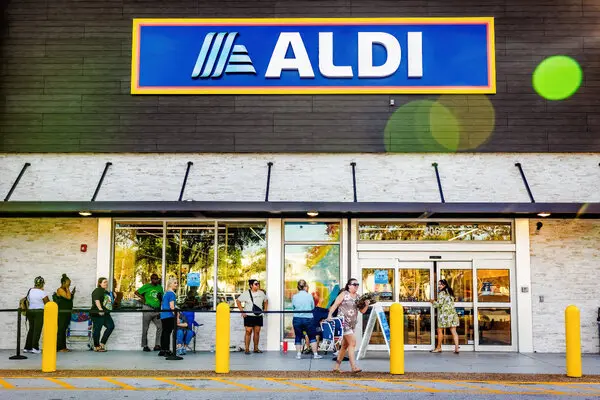
The American supermarket industry is entering a period of profound transformation, and at the centre of this shift stands the German discount retailer Aldi. Once considered a niche player catering primarily to price-conscious consumers, the company is now emerging as one of the most influential forces in grocery retail across the United States. Its expansion strategy is bold, aggressive and highly calculated, reflecting a deep understanding of how consumer behaviour is evolving in an uncertain economic climate.
Aldi’s growth trajectory is accelerating at a remarkable pace. The company has announced plans to open more than 180 new stores across the United States during 2026, expanding into dozens of additional cities and states while strengthening its presence in existing markets.
This expansion represents far more than a simple increase in store numbers. It signals a structural shift in the competitive dynamics of the American grocery industry.
For decades, the United States grocery sector was dominated by large national chains and regional supermarket groups operating full-service stores with tens of thousands of products. Aldi has challenged this model by introducing a radically different approach to food retail: limited assortment, private-label dominance and relentless cost control.
The result is a retail model capable of offering prices that often undercut traditional supermarkets.
A model built on simplicity
At the core of Aldi’s strategy lies a philosophy that contrasts sharply with the conventional supermarket formula. While many grocery stores stock up to 40,000 items, Aldi typically carries only around 1,500 to 2,000 products.
This limited assortment allows the company to streamline logistics, negotiate stronger supplier deals and reduce operational complexity. The store design itself reflects this efficiency: compact layouts, minimal staffing and rapid checkout processes.
Customers participate in the cost-saving model as well. They bring their own bags, deposit coins for shopping carts and pack their groceries themselves. These small operational adjustments collectively reduce expenses and enable Aldi to maintain its low-price positioning.
The simplicity of the system has become one of the retailer’s most powerful competitive advantages.
Expansion into new territories
One of the most notable aspects of Aldi’s current expansion is its move into regions where the brand previously had little or no presence. The company has announced entry into new states and markets as part of its strategy to achieve nationwide coverage.
For example, Aldi recently confirmed the opening of its first store in Maine, marking a milestone that brings the retailer closer to operating in all regions of the country.
This development may appear symbolic, but it reflects a broader geographical push. Aldi’s long-term objective is to reach approximately 3,200 stores in the United States by 2028, a figure that would place it among the largest grocery chains in the country.
The company is also investing heavily in distribution infrastructure, including new logistics centres designed to support the rapid expansion of its store network.
Transforming existing supermarkets
Aldi’s growth strategy is not limited to building new stores. Another key element involves converting existing supermarkets into the Aldi format.
Following its acquisition of Southeastern Grocers’ Winn-Dixie and Harveys chains, Aldi began converting hundreds of these locations into its own brand stores. Approximately 220 locations are expected to transition to the Aldi format over several years, fundamentally altering the grocery landscape across parts of the southeastern United States.
This conversion strategy allows Aldi to accelerate expansion while avoiding the lengthy process of building entirely new sites.
The transformation also reflects a broader retail trend: struggling traditional supermarkets are increasingly giving way to discount formats better aligned with current consumer priorities.
The consumer shift toward value
Aldi’s success cannot be understood without examining the economic environment shaping consumer behaviour.
Inflation, rising living costs and economic uncertainty have forced many households to reconsider their grocery spending habits. Shoppers who once prioritised brand selection or premium shopping experiences are increasingly focusing on price and value.
Discount retailers have benefited significantly from this shift.
In recent years, millions of American households have visited Aldi stores for the first time, attracted by the promise of lower grocery bills without sacrificing product quality. Company executives report that tens of millions of new customers have discovered the brand in recent years, reflecting a growing acceptance of private-label products.
This trend mirrors similar developments in Europe, where discount supermarkets have long held strong market positions.
Private label as a strategic weapon
One of Aldi’s defining characteristics is its overwhelming reliance on private-label goods. Unlike traditional supermarkets, where national brands dominate shelf space, Aldi’s product assortment consists primarily of store brands.
These private labels often replicate well-known products but are produced at lower cost through simplified packaging, streamlined supply chains and long-term supplier partnerships.
The strategy offers several advantages.
First, it allows Aldi to maintain tight control over pricing and margins. Second, it reduces dependence on major multinational manufacturers whose brands typically demand higher retail prices. Finally, it reinforces the retailer’s identity as a value-driven supermarket.
Over time, many Aldi private labels have gained strong consumer trust, challenging the perception that lower prices necessarily imply lower quality.
Pressure on traditional supermarkets
Aldi’s expansion is sending shockwaves through the American grocery industry.
Traditional supermarket operators now face competition from multiple directions: warehouse clubs such as Costco, mass merchants like Walmart, online grocery platforms and, increasingly, discount retailers.
Aldi’s pricing strategy is particularly disruptive because it forces competitors to reconsider their own cost structures. When a discounter consistently sells staples at significantly lower prices, other retailers must either match those prices or risk losing customers.
For many supermarket chains operating large stores with complex assortments, matching Aldi’s cost structure is extremely difficult.
This reality is reshaping strategic decisions across the industry.
The future of grocery retail
The expansion of Aldi raises broader questions about the future structure of the supermarket sector in the United States.
For decades, the dominant model involved large stores offering extensive product ranges and emphasising brand choice. But the success of discounters suggests that a simpler, value-focused format may be equally attractive—or even preferable—for a growing segment of consumers.
At the same time, technology is introducing new possibilities in grocery retail, from automated warehouses to data-driven pricing systems. These innovations may further reduce operating costs and enable retailers to refine their value propositions.
Aldi’s disciplined approach positions it well for this evolving environment.
A quiet transformation
Unlike some competitors, Aldi rarely relies on flashy marketing campaigns or dramatic announcements. Its strategy unfolds quietly, store by store, market by market.
Yet the cumulative impact of these decisions is enormous.
With hundreds of new stores planned, billions of dollars invested and millions of new customers discovering the brand each year, Aldi is gradually reshaping the competitive landscape of American food retail.
For traditional supermarket chains, the message is clear: the era of discount dominance is no longer confined to Europe. It is now firmly taking root in the United States.
And the consequences for the grocery industry may only just be beginning.