
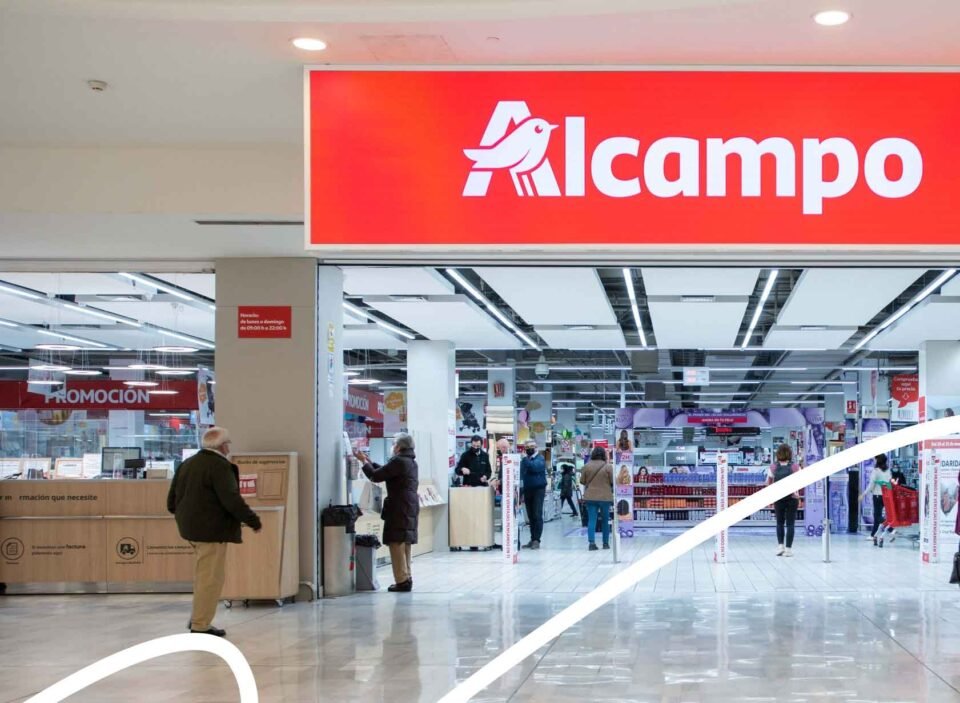
Alcampo is accelerating the digital transformation of its Spanish supermarket network with a €3.8 million investment that will see more than 560,000 electronic shelf labels installed across 84 stores during 2026. The move represents one of the more significant deployments of electronic shelf labels in Spain and signals how supermarket operators are increasingly turning to digital technology to improve pricing accuracy, store productivity and the management of thousands of products.
The French-owned retailer is replacing traditional paper price labels across a wide range of departments, including dry grocery, fresh food and frozen products. The scale of the project means that electronic pricing will become a much more visible part of the shopping experience for customers across Alcampo’s network.
The investment is not simply about replacing paper with electronic screens. Electronic shelf labels allow prices and product information to be managed digitally, reducing the need for employees to repeatedly print, distribute and replace paper labels when prices change. Alcampo expects the technology to free more than 42,750 hours of store staff time every year, allowing employees to concentrate on other activities, particularly customer service.
The environmental impact is also significant. Alcampo estimates that the deployment will eliminate the need for approximately 1,843 kilometres of paper shelf strips every year, while avoiding around 8.4 tonnes of CO₂ equivalent emissions. The figures give an indication of how even a seemingly small element of supermarket operations can create a substantial material footprint when multiplied across dozens of stores and hundreds of thousands of products.
The project is being rolled out across several Spanish regions. Before the end of 2026, the electronic labels are expected to be operating in more than 50 stores in locations including Madrid, Málaga, Burgos, León, Valladolid, Salamanca, Soria, Palencia, La Rioja, Álava, Zaragoza, Huesca and Teruel, with the wider programme covering 84 supermarkets.
Importantly, Alcampo is deploying the technology beyond conventional supermarket aisles. The electronic labels will also be used in fresh-food areas and frozen sections, with larger formats designed for traditional service counters and versions capable of operating in low-temperature environments. This demonstrates how electronic shelf labels are moving from a technology associated mainly with standard grocery shelving into more demanding areas of the supermarket.
The labels are being manufactured by Hanshow, with the installation using HL Display’s Slimline system, bringing together electronic pricing technology and existing shelf-display infrastructure.
For supermarket operators, however, the most important part of the investment may be the operational benefit rather than the environmental saving. Price changes are traditionally labour-intensive. A promotion, price adjustment or correction can require thousands of labels to be printed and physically replaced. With electronic shelf labels, the supermarket can manage those changes through a digital system, potentially reducing the time between a pricing decision and its appearance on the shop floor.
That becomes increasingly important as supermarket competition intensifies and retailers face pressure to respond quickly to competitors, promotions and changing costs. The ability to manage prices digitally gives retailers greater flexibility over what happens at the shelf — the point where the customer ultimately makes the purchasing decision.
There is also a customer-facing benefit. By reducing the possibility of outdated or incorrectly positioned paper labels, electronic shelf labels can help supermarkets maintain greater consistency between the price displayed on the shelf and the price held in their systems. For a retailer operating tens of thousands of product lines, reducing pricing errors can become a significant operational advantage.
Alcampo’s decision also illustrates a broader change taking place across European grocery retail. Supermarket digitalisation is no longer restricted to self-checkouts, mobile applications or automated warehouses. Increasingly, technology is reaching the physical shelf itself.
The supermarket shelf is becoming a digital interface.
Alcampo’s €3.8 million investment therefore deserves to be viewed as more than an environmental initiative. The deployment of more than half a million electronic labels across 84 supermarkets represents a significant investment in the infrastructure of the modern supermarket and could provide Alcampo with a faster, more flexible and more efficient way of managing prices across its stores.
As retailers continue to search for productivity improvements without compromising the customer experience, electronic shelf labels are likely to become an increasingly important part of the European supermarket landscape. Alcampo’s latest deployment provides a clear indication that the technology is moving from selective trials to large-scale supermarket implementation.