
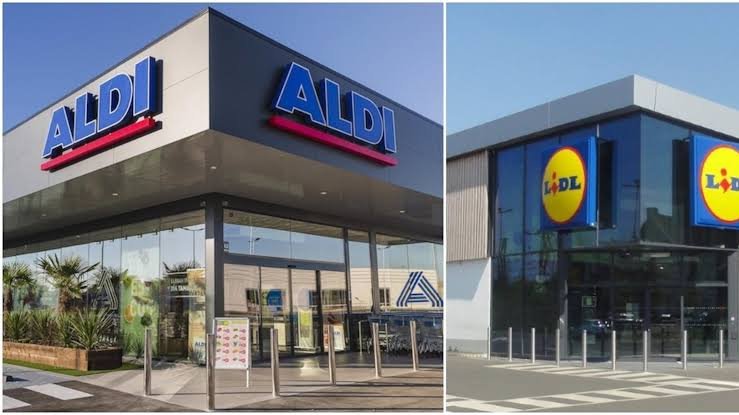
BRUSSELS – Europe’s grocery sector is becoming increasingly competitive as discount supermarket chains Aldi and Lidl continue to expand their market share, forcing traditional retailers to accelerate investment in pricing, technology and customer loyalty programmes.
The German discount retailers have transformed food retailing across Europe over the past two decades, and their influence continues to grow. By combining competitive pricing with an expanding range of high-quality private-label products, Aldi and Lidl have attracted millions of shoppers looking for greater value while maintaining product quality.
The continued growth of the two discounters is reshaping strategies at some of Europe’s largest supermarket groups, including Tesco, Carrefour, Sainsbury’s, Edeka, Rewe, Ahold Delhaize, Coop Italia and Intermarché. Established retailers are responding with increased investment in promotions, loyalty schemes, store refurbishments and digital innovation to defend market share.
Although inflation across Europe has eased compared with the sharp increases experienced over the past two years, consumers remain highly focused on value. Rising housing costs, higher utility bills and continued economic uncertainty have encouraged many households to compare prices more closely than ever before.
Retail analysts say this shift in consumer behaviour continues to benefit discount retailers. Aldi and Lidl have strengthened their reputation by offering simple store layouts, efficient operations and a carefully selected product range that keeps operating costs low while delivering consistent quality.
Unlike traditional supermarkets, which may carry tens of thousands of stock-keeping units (SKUs), discount retailers operate with a much smaller assortment. This streamlined approach allows them to negotiate larger purchasing volumes with suppliers, improve logistics efficiency and pass savings on to customers.
Private-label products remain central to the success of both Aldi and Lidl. In many categories, their own-brand products now compete directly with established branded goods on both quality and innovation. Independent consumer surveys across several European markets continue to show increasing confidence in supermarket own-label products.
Traditional supermarket operators have responded by expanding their own private-label portfolios while improving premium ranges to offer customers greater choice across different price segments.
Technology is also becoming an increasingly important competitive tool. Retailers throughout Europe are investing in artificial intelligence, automated warehouses, digital shelf labels, self-checkout systems and personalised loyalty programmes to improve operational efficiency and customer engagement.
Online grocery shopping continues to evolve alongside physical retail. While discounters have traditionally focused on store-based operations, many are gradually expanding digital services where customer demand supports investment.
Sustainability has become another key area of competition. Supermarkets across Europe are investing in energy-efficient stores, reducing plastic packaging, cutting food waste and sourcing products more responsibly. Consumers are increasingly considering environmental credentials alongside price when choosing where to shop.
The pressure created by Aldi and Lidl is also encouraging consolidation within parts of the European grocery industry, as retailers seek greater economies of scale and stronger purchasing power.
Despite the intense competition, Europe’s grocery market remains one of the most dynamic retail sectors in the world. Consumer expectations continue to evolve, requiring supermarkets to deliver value, convenience, quality and innovation simultaneously.
As Aldi and Lidl continue expanding across both established and emerging markets, traditional supermarket groups are adapting their strategies to remain competitive. The result is an industry undergoing rapid transformation, where operational efficiency, technology and customer value are becoming just as important as store size or market presence.
For European consumers, the competition is likely to remain good news, driving continued investment, sharper pricing and greater choice across the continent’s grocery landscape.