

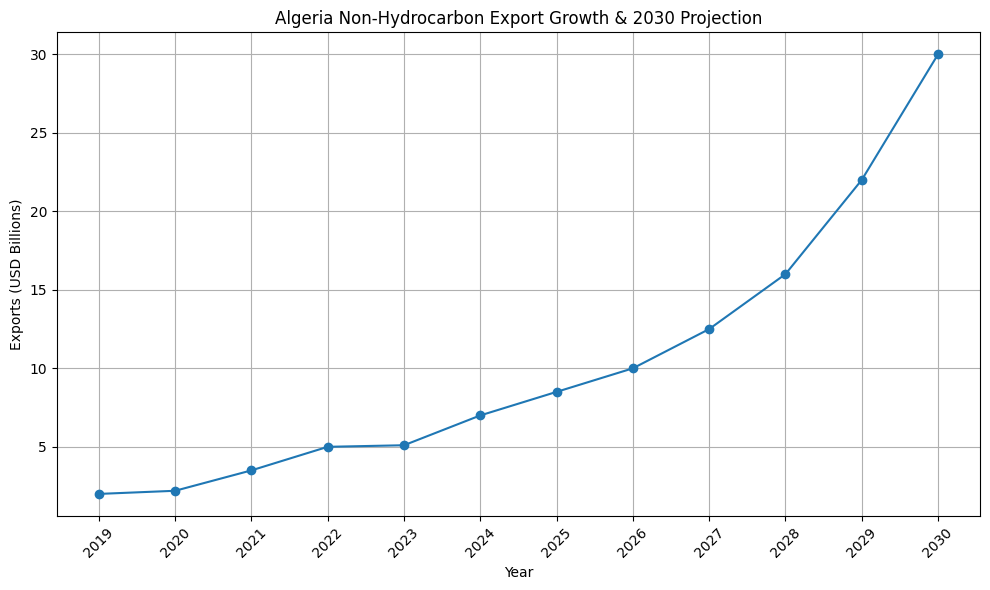
Algeria is entering a decisive economic era. The country that for decades relied overwhelmingly on oil and gas exports is now accelerating toward a diversified export model — one that could reach $30 billion in non-hydrocarbon exports by 2030.
 This is not a marginal adjustment. It is a structural shift in how Algeria produces, trades, and positions itself globally.
Over the past few years, non-oil and non-gas exports have climbed sharply. What was once a modest contribution to foreign currency earnings has become a strategic national priority. The growth is broad-based, touching agriculture, steel, phosphate transformation, fertilisers, pharmaceuticals, household equipment, and light manufacturing.
The direction is clear: build resilience, reduce vulnerability to energy price fluctuations, and create sustainable employment.
Agriculture: Toward Self-Sufficiency and Export Expansion
Agriculture is at the heart of Algeria’s transformation. Large-scale farming projects, irrigation investments, and expansion in southern regions are steadily increasing domestic production. The objective is bold but realistic — achieve food self-sufficiency in key staples and transition from major importer to competitive exporter.
Cereals, vegetables, dates, citrus fruits, olive oil, and processed food products are increasingly entering regional and Mediterranean markets. Agro-processing capacity is rising, adding value rather than exporting raw produce.
By 2030, agriculture is expected not only to secure internal supply but to become a consistent export contributor, particularly across African markets where food demand continues to grow rapidly.
Self-sufficiency strengthens national sovereignty. Export capacity strengthens economic power.
Steel and Industrial Materials: Building Heavy Industry
Steel production has expanded significantly, reducing reliance on imports and positioning Algeria as a supplier of construction materials. Rebar, flat steel, and structural components are now being exported to neighbouring regions.
The country’s infrastructure drive has created domestic demand, but surplus capacity is increasingly targeting foreign markets. Cement, ceramics, glass, and building materials form a growing part of the export basket.
Heavy industry reinforces industrial credibility. It signals that Algeria is no longer solely a raw material economy but a manufacturing competitor.
Phosphate and Fertilisers: Strategic Resource Conversion
Algeria’s phosphate reserves provide a natural advantage. Instead of exporting raw material alone, the country is increasingly focusing on processed fertilisers and value-added derivatives.
Global agricultural demand ensures strong long-term prospects for fertiliser exports. By expanding transformation capacity, Algeria multiplies export value while securing strategic positioning in global supply chains.
Phosphate conversion exemplifies the broader strategy: transform natural resources into industrial exports with higher margins.
Pharmaceuticals: Toward Continental Leadership
One of the most ambitious pillars of diversification is pharmaceuticals. Domestic manufacturing capacity has expanded through new facilities, partnerships, and regulatory strengthening.
The ambition is clear: become the number one pharmaceutical producer in Africa. By increasing local production of medicines and medical supplies, Algeria reduces import dependency while building export capability toward sub-Saharan markets.
If sustained, this sector alone could become a flagship industry by 2030, combining industrial output with healthcare sovereignty.
Household Equipment and Light Industry
Light manufacturing is emerging as a dynamic engine of growth. Algerian factories now produce refrigerators, washing machines, air conditioning units, and electronic appliances for domestic consumption and export.
The private sector plays a central role here. Entrepreneurial industrial groups are expanding assembly lines, improving standards, and targeting regional distribution.
Light industry creates employment at scale, supports supply chains, and increases export diversity. By 2030, this segment could represent one of the most flexible and scalable contributors to non-hydrocarbon trade.
The Expanding Role of the Private Sector
Diversification depends on private enterprise. Increasingly, Algerian SMEs and industrial groups are entering export markets. Agro-processing, packaging, manufactured goods, and specialised industrial components are becoming more competitive.
Export promotion, trade fairs, and regional partnerships are helping firms gain visibility abroad. The shift toward a stronger private-sector footprint is essential for sustainable export expansion.
By 2030, private industry is expected to lead much of the non-hydrocarbon growth, complementing state-driven strategic sectors.
The 2030 Forecast: $30 Billion and Structural Rebalancing
The projected target of $30 billion in non-hydrocarbon exports by 2030 represents more than a numerical ambition. It signifies a fundamental rebalancing of Algeria’s economy.
If achieved, it would dramatically reduce exposure to oil price cycles, stabilise foreign currency inflows, and strengthen macroeconomic resilience.
Reaching this level will require:
-
Continued industrial investment
-
Logistics modernisation and port efficiency
-
Competitive financing mechanisms for exporters
-
Quality certification and global standards alignment
-
Deeper integration into African and Mediterranean trade corridors
The momentum suggests that the goal, once aspirational, is becoming increasingly realistic.
A New Export Identity
Algeria’s transformation is not about abandoning hydrocarbons. It is about expanding beyond them. Agriculture moving toward self-sufficiency, steel and heavy industry expanding output, phosphate transformation scaling globally, pharmaceuticals aiming for continental leadership, and household equipment driving light manufacturing — together they form a diversified industrial base.
The surge in non-oil exports is not temporary. It reflects structural change in production, mindset, and ambition.
By 2030, Algeria could stand as one of Africa’s most diversified export economies — industrial, agricultural, pharmaceutical, and manufacturing-driven.
The era of singular dependency is fading. A broader export identity is emerging. And if the trajectory continues, the $30 billion forecast will mark not the end of the transformation — but the beginning of a new economic chapter.