
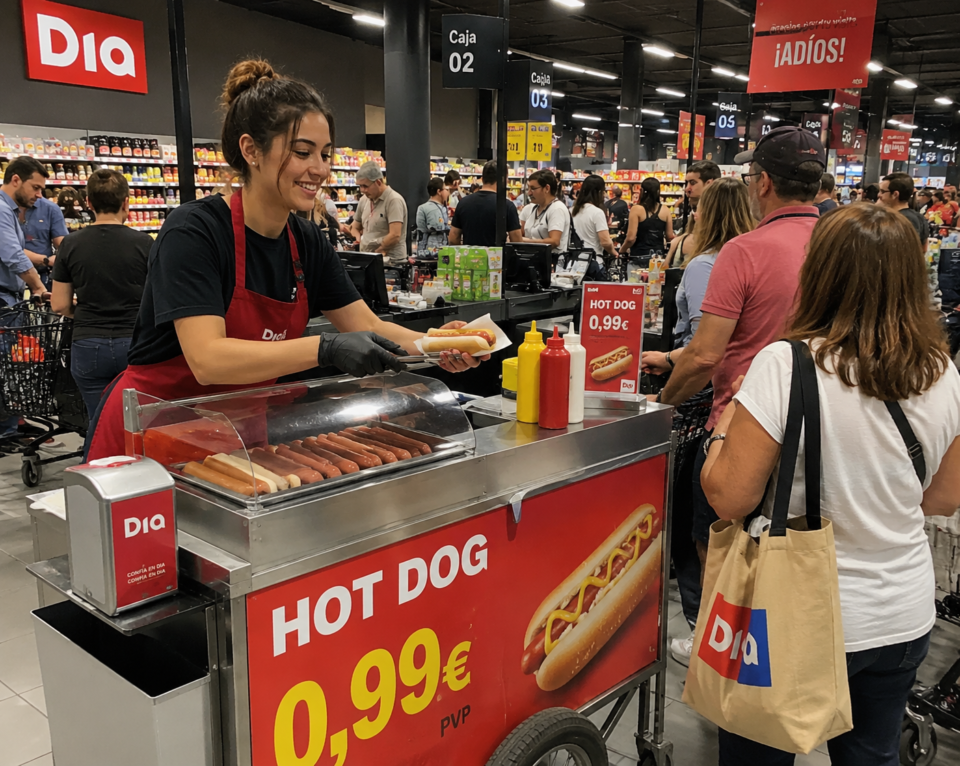
In the competitive world of Spanish grocery retail, innovation does not always arrive through sweeping digital transformation or major store redesigns. Sometimes it appears in far simpler form: a small trolley near the checkout, offering a hot dog for just 99 cents.
At DIA, one of Spain’s most widely recognized discount supermarket chains, this kind of micro-retail strategy reflects a deeper understanding of how modern consumers behave inside stores. The idea is straightforward. Place a low-cost, ready-to-eat food item near the till, where customers are already in a decision-making transition zone, and capture impulse purchases at the final moment of the shopping journey.
On the surface, it seems almost too simple to matter. But in retail economics, simplicity is often where the strongest performance emerges. The checkout area is one of the most psychologically active zones in any supermarket. Customers have already completed most of their planned shopping, they are processing their total bill, and they are mentally shifting out of “task mode.” This makes them more receptive to small, emotional, or convenience-driven purchases.
The 99-cent hot dog fits perfectly into this environment. It is inexpensive enough to avoid triggering budget hesitation, familiar enough to feel safe, and immediately consumable. It also solves a subtle but important customer need: convenience. For shoppers who are hungry, short on time, or simply influenced by suggestion, the option becomes difficult to ignore.
For DIA, a retailer built on efficiency and high-volume low-margin economics, this kind of offer is not a side experiment—it is part of a broader commercial logic. Discount supermarkets rely heavily on turnover and basket optimization. While large retail chains may focus on premium experiences or wide assortment strategies, discount operators focus on maximizing the value of every square meter of store space.
The checkout zone, often underutilized beyond queue management, becomes a strategic asset. By introducing low-cost food trolleys, DIA effectively converts waiting time into sales opportunity. Even if the profit per item is small, the volume of transactions and frequency of purchases can create meaningful cumulative returns across a large store network.
There is also a behavioral dimension at play. Impulse food purchases are driven less by rational planning and more by sensory triggers and environmental cues. The visual presence of a warm, ready-to-eat product in a high-traffic area activates immediate consumption desire. In retail terms, this is not about selling a hot dog—it is about selling a moment.
The pricing is equally important. At 99 cents, the product sits below a psychological threshold that customers tend to associate with “small change” rather than a meaningful expense. This reduces friction and increases conversion. In discount retail environments, such price points are carefully chosen not only for affordability but also for cognitive simplicity.
What makes this strategy particularly interesting is how it aligns with DIA’s broader positioning in the Spanish market. The company operates in a segment where efficiency, accessibility, and value are central. Unlike premium supermarkets that compete on experience or assortment depth, discount chains compete on speed, simplicity, and price perception. The hot dog trolley fits naturally into this ecosystem.
It also reflects a wider trend in European grocery retail, where prepared food and immediate consumption items are becoming increasingly important. As lifestyles become faster and more urbanized, supermarkets are no longer just places to buy ingredients—they are becoming hybrid spaces where customers also consume ready-to-eat meals.
In this context, the checkout hot dog is not an isolated idea but part of a broader shift toward convenience-driven retail. Small food offerings, coffee stations, and ready-made meals are increasingly integrated into store layouts, blurring the line between supermarket and quick-service food outlet.
Operationally, the model is low complexity. It requires minimal infrastructure, simple preparation, and limited space. Yet its effectiveness lies in placement rather than sophistication. By positioning the product at the final point of contact, DIA maximizes visibility at the exact moment when purchasing decisions are most fluid.
There is also a subtle strategic advantage in reinforcing brand perception. While 99-cent offers may seem marginal, they communicate affordability in a very direct and visible way. Customers are reminded not only of price competitiveness in packaged goods, but also in immediate consumption items. This strengthens the overall value image of the retailer.
Ultimately, the success of such initiatives depends on consistency. Small-format impulse strategies only work when integrated into a broader retail environment that supports high foot traffic, predictable customer flow, and efficient store design. In DIA’s case, the model appears to function as part of a larger system rather than a standalone experiment.
What the 99-cent hot dog trolley represents is not a novelty, but a reminder of a fundamental truth in retail: the smallest decisions often happen at the very end of the shopping journey. And in that final moment, even a simple, low-cost item can quietly influence both customer behavior and store performance in meaningful ways.