
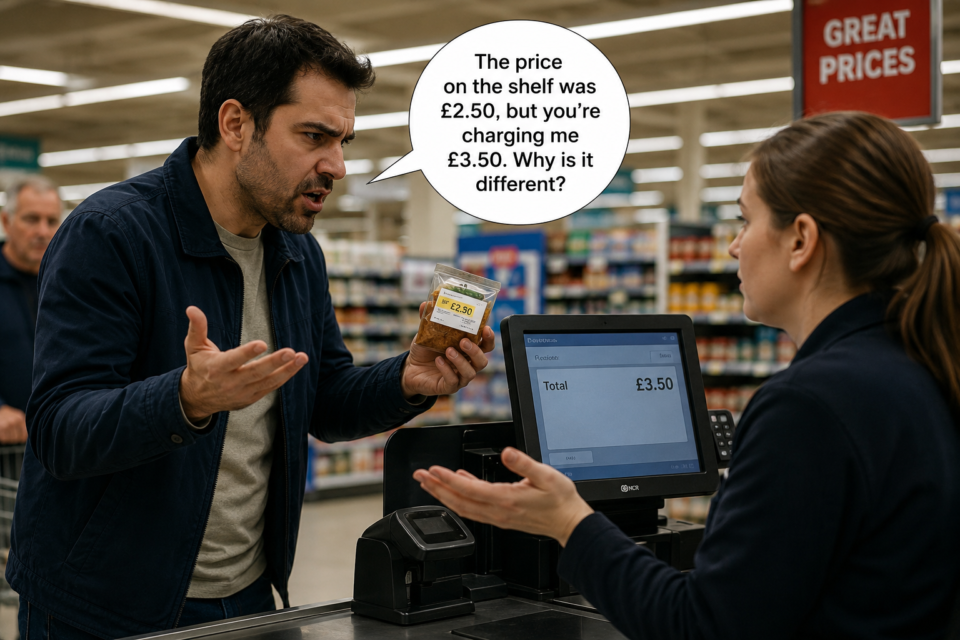
Supermarkets are increasingly deploying Electronic Shelf Label (ESL) systems to improve pricing accuracy, operational efficiency, and customer trust. The technology is being positioned not as a dynamic pricing tool, but as a store-wide synchronisation system ensuring that prices remain consistent from shelf edge to checkout. This report examines the operational drivers, academic evidence on pricing volatility, and the impact of ESL adoption on retail transparency.
1. Introduction: The Importance of Price Consistency
In grocery retail, price consistency is a fundamental requirement of customer trust. A mismatch between the price displayed on the shelf and the amount charged at the till creates friction, complaints, and reputational risk. Even small discrepancies can influence customer perception of fairness, particularly in high-frequency shopping environments such as supermarkets.
The modern retail environment, characterised by frequent promotions and rapid price updates, has increased the risk of inconsistency—especially in paper-based labelling systems.
2. Scale of Pricing Complexity in Supermarkets
Large-format supermarkets typically process thousands of price changes each week. These changes arise from supplier cost adjustments, promotional cycles, seasonal campaigns, and inventory optimisation strategies.
In traditional paper systems, each update requires manual replacement of shelf labels across the store. This creates:
- High labour demand
- Increased probability of human error
- Delays between system updates and shelf execution
- Risk of mismatch between promotional and shelf pricing
The operational burden increases with store size and promotional intensity, making manual pricing increasingly inefficient.
3. Evidence on Pricing Volatility and Misconceptions
Concerns around automated pricing systems often assume widespread volatility. However, large-scale academic research challenges this perception.
A study conducted by UC San Diego, the University of Texas at Austin, and Northwestern University—covering more than 180 million product observations—found that extreme price surges occurred in approximately 0.0006% of cases. This indicates that significant pricing fluctuations are statistically rare, rather than systemic.
This evidence suggests that the perceived risk of widespread pricing instability in modern retail systems is significantly higher than observed behaviour.
4. Regulatory and Accuracy Standards
Retail pricing systems are also guided by accuracy expectations. Frameworks referenced by organisations such as NIST indicate that shelf-to-register discrepancies should remain within a low tolerance threshold, commonly cited around 2%.
While leading retailers typically aim for far higher internal accuracy standards, the benchmark highlights the importance of alignment between:
- Shelf displayed price
- Promotional pricing
- Point-of-sale (till) systems
Failure to maintain alignment can result in customer disputes and operational inefficiencies.
5. Role of Electronic Shelf Labels (ESL)
Electronic Shelf Labels are being adopted across supermarket estates as a core infrastructure upgrade. Their primary function is not to enable dynamic pricing, but to ensure real-time synchronisation of pricing data across all store touchpoints.
ESL systems allow:
- Instant updates from central pricing systems
- Simultaneous changes across shelf and till systems
- Elimination of manual label replacement
- Reduced labour requirements for pricing updates
- Improved accuracy during promotional campaigns
Retailers across Europe and the UK are increasingly moving toward full-store deployment models, replacing hybrid paper-and-digital systems with unified digital pricing networks.
6. Customer Experience and Trust
The most significant impact of ESL adoption is on customer perception. A key retail failure point occurs when customers encounter:
One price on the shelf and a different price at the till.
This inconsistency undermines trust and increases dispute resolution at checkout. ESL systems are designed to eliminate this gap by ensuring:
- One price on the shelf
- The same price in the promotion system
- The same price at the register
This alignment reduces friction and reinforces pricing transparency.
7. Operational and Strategic Implications
Beyond customer trust, ESL adoption delivers measurable operational benefits:
- Reduced manual labour for label changes
- Faster execution of promotional campaigns
- Lower error rates in pricing updates
- Improved consistency across large store networks
Strategically, ESL supports centralised pricing governance, enabling retailers to implement uniform pricing policies across entire estates with minimal delay.
Electronic Shelf Label systems represent a structural shift in supermarket operations. While often associated with concerns about dynamic pricing, their primary function is standardisation and accuracy.
By ensuring that shelf pricing, promotional pricing, and checkout pricing are fully synchronised, ESL technology addresses one of the most persistent friction points in retail: the gap between what customers see and what they pay.
In doing so, supermarkets move toward a model defined by consistency, operational efficiency, and strengthened consumer trust—where one price truly means one price across the entire shopping journey.