

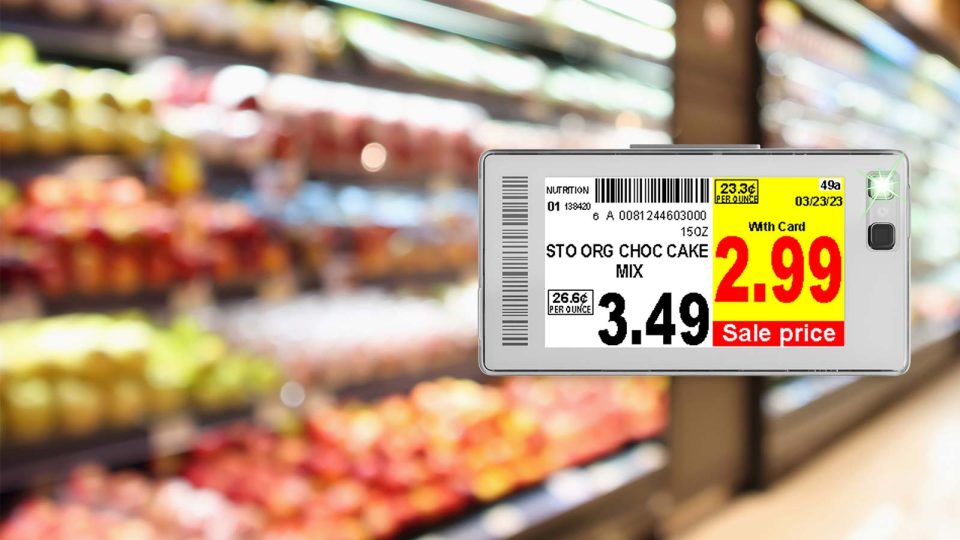
Electronic Shelf Labels are no longer just a digital replacement for paper tickets. They are becoming the backbone of a new retail model where pricing is no longer static, but fluid, responsive and increasingly autonomous. What started as a cost-saving tool is now evolving into a strategic weapon.
Most supermarkets today use ESLs to update prices instantly, reduce human error and improve operational efficiency. That alone has delivered measurable benefits. Yet the reality is that in most stores, these systems remain passive. Prices are still decided by humans, often based on delayed data, then pushed to shelves digitally. The speed has improved, but the intelligence behind the decision has not caught up.
The real transformation begins when ESLs are connected to Artificial Intelligence. This is where the gap becomes obvious. The technology exists, the data exists, but the integration is still missing. Retailers are sitting on a system that could completely redefine pricing, yet they are only using a fraction of its capability.
What are they missing? According to Riad Beladi, the answer is simple but powerful:
“Supermarkets are missing a system where AI takes into consideration the buying price of the product, its expiry date, the competition, the stock in the warehouse and customer behaviour before deciding the price.”
This statement goes to the core of the issue. Pricing today is still fragmented. One team looks at costs, another at promotions, another at stock. The consumer sees one number on the shelf, but behind it, the logic is incomplete.
An intelligent ESL system should connect everything. It should know exactly when a product was bought, at what cost, how fast it is selling, how close it is to expiry, and what competitors are doing at the same moment. Only then can pricing become truly dynamic.
Take expiry dates as an example. Every supermarket loses money through waste. Products are discounted too late or not at all. With AI connected to ESLs, this becomes a solved problem. The system can automatically reduce prices progressively as the expiry date approaches, ensuring maximum sell-through while protecting margin. No human intervention, no delay, no guesswork.
The same applies to competition. Today, retailers monitor competitors, but the process is slow and often manual. In a connected system, AI can track competitor pricing online and in-store in real time, then adjust shelf prices instantly. This is not future thinking, this is already technically possible.
Another missing link is warehouse integration. Pricing decisions are often disconnected from stock levels. A product may be heavily discounted while inventory is already low, or remain full price while excess stock sits in the warehouse. This is inefficient. AI can correct this by aligning price with availability, ensuring that stock flows smoothly through the system.
Customer behaviour is the final piece. Retailers collect vast amounts of data, yet rarely use it in real time. AI can analyse when customers buy a product, how sensitive they are to price changes, and what triggers a purchase. This allows pricing to become predictive rather than reactive.
Riad Beladi emphasises this point clearly:
“The system should calculate profit or loss on each product and analyse customer behaviour when they buy it. Only then can pricing become a real strategy, not just a reaction.”
This is where ESLs become more than labels. They become decision points. Each shelf becomes part of a network that constantly adjusts to maximise performance.
For shoppers, the impact will be noticeable. Prices may change more frequently, but they will also become more relevant. Discounts on short-dated products will appear earlier. Promotions will be more targeted. The overall experience could become more efficient, but also more complex.
There is, however, a balance to maintain. Too much price fluctuation can create confusion or mistrust. Retailers must ensure transparency and fairness, especially in food, where pricing sensitivity is high. AI must be controlled, not left entirely unchecked.
There are also operational challenges. Integrating data from multiple sources is complex. Systems must be reliable, secure and accurate. A pricing error at scale can have immediate financial consequences. This is why many retailers are moving cautiously.
Yet the direction is clear. The industry is moving towards full automation of pricing decisions. The combination of AI and ESLs will allow supermarkets to operate with a level of precision never seen before.
The competitive advantage will be significant. Retailers using intelligent pricing systems will reduce waste, protect margins and respond faster to market changes. Those who delay will find themselves constantly reacting, always one step behind.
The shift is not just technological, it is cultural. Retailers must be willing to trust systems over instinct, data over tradition. This is not an easy transition, particularly in an industry built on experience and manual control.
But the logic is undeniable. When a system can analyse cost, competition, stock, expiry and behaviour simultaneously, it can make better decisions than any individual or team.
Electronic shelf labels are no longer just tools for displaying prices. They are becoming the interface between data and action. When fully connected to AI, they turn every shelf into a real-time pricing engine.
The future supermarket will not wait for weekly price updates or manual reviews. It will adjust continuously, quietly, efficiently. Prices will reflect reality at every moment, not yesterday’s assumptions.
And in that environment, the question is no longer whether AI will decide prices.
It is whether retailers are ready to let it.