
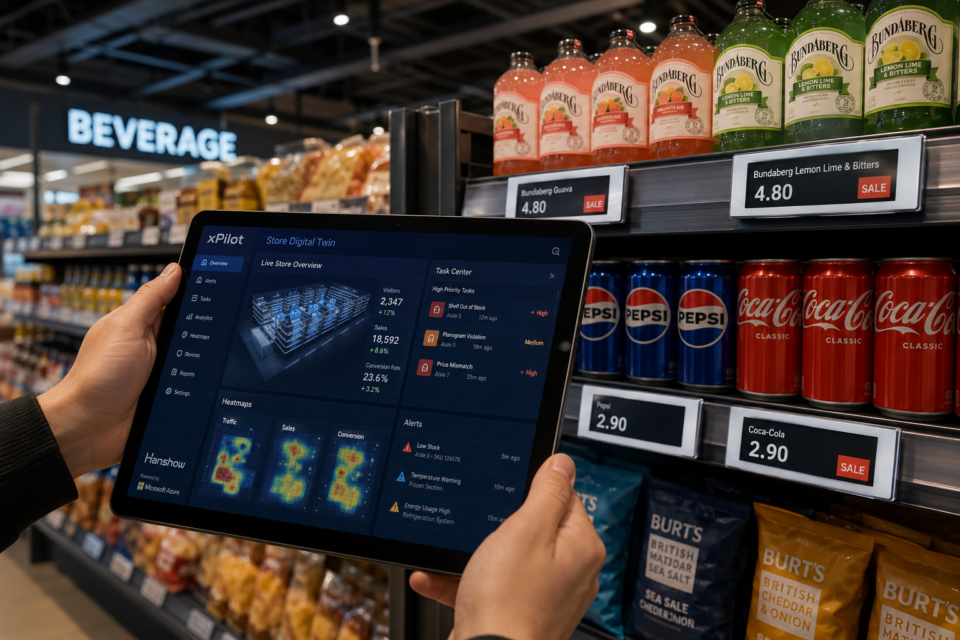
For years, retailers have invested billions in digital transformation, deploying analytics platforms, IoT sensors, cameras, electronic shelf labels, and cloud infrastructure in an effort to improve store operations. Yet a persistent challenge remains: transforming insights into consistent action on the sales floor.
At NRF 2026 APAC in Singapore, retail technology provider Hanshow unveiled what it believes is the missing piece of the puzzle. Developed in collaboration with Microsoft, xPilot is an AI-powered retail execution assistant designed to turn real-time store intelligence into immediate operational action.
The launch represents more than a new software product. It signals Hanshow’s ambition to evolve from a supplier of digital store infrastructure into a provider of intelligence-led retail operations.
Built on Microsoft Azure and powered by Microsoft Fabric and AI agents from Microsoft Foundry, xPilot serves as the operational brain of Hanshow’s Store Digital Twin platform. The system continuously gathers and analyzes information from connected store technologies—including electronic shelf labels, smart shelves, smart carts, robotics systems, inventory platforms, workforce applications, and other IoT devices—to create a living digital representation of store operations.
Rather than simply reporting issues, xPilot is designed to identify problems, prioritize responses, and trigger actions automatically.
For store managers, this means real-time visibility into shelf availability, planogram compliance, pricing accuracy, labor deployment, customer traffic patterns, and energy consumption. Staff can receive prioritized tasks instantly, while automated workflows can address operational issues before they impact customers or sales.
The objective is simple but ambitious: move retailers from reactive management to proactive execution.
“Retailers don’t need more tools in the store—they need more intelligence,” said Christian O’Donohue, Senior Industry Advisor for Retail and Consumer Goods at Microsoft. “A real-time store digital twin, paired with unified data and AI agents, helps teams move from seeing what’s happening to acting on it in the moment.”
The technology is already being tested in live retail environments. Chinese retailer Rainbow has become one of the first companies to deploy xPilot, using the platform to reduce manual inspections and improve pricing accuracy, inventory management, and display compliance. By integrating Hanshow’s in-store IoT ecosystem with AI-driven workflows, Rainbow aims to create a more responsive and scalable operating model across its stores.
For Hanshow, the launch of xPilot marks the next phase of a strategy that has been years in the making.
Founded in 2012, the company built its reputation as one of the world’s leading suppliers of electronic shelf labels (ESLs), helping retailers digitize the shelf edge and replace paper pricing systems with connected displays. Today, Hanshow’s technologies are deployed in tens of thousands of stores across more than 70 countries.
However, the company’s vision extends far beyond digital price tags.
Industry observers increasingly view electronic shelf labels as a foundational layer of retail digital infrastructure. Once every shelf becomes connected, retailers gain access to real-time product, pricing, and inventory data that can support broader automation initiatives. Hanshow has leveraged this foundation to develop a wider ecosystem that includes IoT sensors, smart retail devices, digital twin technology, and now AI-powered operational intelligence.
Recent customer wins suggest the strategy is gaining traction.
One of the most notable examples is Tesco’s decision to partner with Hanshow on a large-scale rollout of electronic shelf labels across thousands of stores in the United Kingdom. The deployment is expected to modernize shelf-edge operations, improve pricing accuracy, reduce paper waste, and provide store associates with new tools for inventory and fulfillment tasks.
The agreement is significant not only because of its scale but also because it demonstrates how retailers increasingly view shelf-edge technology as part of a broader digital transformation strategy rather than a standalone pricing solution.
Hanshow’s success in securing major retail contracts suggests the company has developed one of the industry’s most compelling value propositions. Rather than competing solely on hardware costs, it has positioned itself as a provider of integrated retail infrastructure capable of supporting everything from pricing automation to AI-driven store execution.
That approach aligns with a broader shift taking place across the retail sector.
As labor shortages, rising operating costs, and growing consumer expectations place increasing pressure on retailers, technology investments are being judged less by the amount of data they generate and more by their ability to improve execution. Retailers are looking for systems that can detect problems, recommend actions, and automate routine decisions across thousands of locations simultaneously.
This is where concepts such as digital twins and AI agents are beginning to attract serious attention.
A digital twin provides retailers with a real-time operational view of the physical store, while AI agents can interpret data, prioritize issues, and coordinate responses. Combined, they offer the possibility of a store environment that is continuously monitored, constantly optimized, and increasingly autonomous.
“Our collaboration with Microsoft and many partners established the foundation for Store Digital Twin,” said Relvin Sun, Dean of Hanshow Retail Research Institute. “xPilot is where that vision becomes reality, turning insights into actions in real time and enabling retailers and suppliers to move from reactive operations to proactive, intelligence-led execution.”
Whether xPilot becomes a defining platform for next-generation retail remains to be seen. But the direction is clear. The future store is unlikely to be built around isolated technologies or disconnected data streams. Instead, it will be powered by connected infrastructure, unified intelligence, and systems capable of acting on information the moment it becomes available.
With its combination of digital shelf technology, IoT infrastructure, digital twins, and AI-driven execution, Hanshow is positioning itself at the center of that transformation. What began as a shelf-edge technology company is increasingly becoming something much larger: a provider of the operational intelligence layer for the modern retail enterprise.