

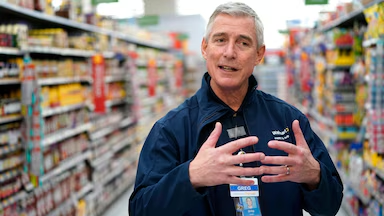
In February 2026, Kroger entered a new era with the appointment of Greg Foran as Chief Executive Officer. The leadership transition comes at a pivotal time for the nation’s largest traditional supermarket operator. The grocery industry is being reshaped by digital acceleration, price competition, shifting consumer expectations, and regulatory pressures. Against this backdrop, Kroger’s decision to bring in a seasoned global retail executive suggests a deliberate move toward operational discipline and strategic recalibration.
Foran is not a newcomer to large-scale retail complexity. His career spans more than four decades across grocery, mass merchandising, and aviation. That breadth of experience positions him uniquely to address the challenges Kroger now faces. His leadership style, forged in store aisles and refined in global boardrooms, reflects a balance between frontline execution and enterprise-level transformation.
From Store Floor to Global Leadership
Greg Foran’s professional journey began at the ground level of retail. Starting in grocery stores early in his career, he developed firsthand knowledge of store operations, merchandising, staffing, and customer engagement. That operational grounding shaped a leadership philosophy centered on execution, accountability, and customer focus.
His ascent through international retail organizations eventually led him to senior leadership roles at Walmart, where he oversaw operations in multiple global markets before leading Walmart U.S., the company’s largest and most complex division. Managing thousands of stores and over a million employees required a disciplined focus on supply chain efficiency, cost control, and digital integration.
Later, as chief executive of Air New Zealand, Foran led through one of the most turbulent periods in aviation history. Steering an airline through pandemic-related disruptions demanded adaptability, financial prudence, and long-term resilience planning. That chapter of his career demonstrated his capacity to lead through crisis and uncertainty — a skill set increasingly valuable in today’s volatile retail environment.
Why Kroger Needs a Reset
Kroger’s leadership transition follows a period of instability. After its previous CEO stepped down and a highly publicized merger attempt with Albertsons collapsed under regulatory pressure, the company found itself navigating strategic ambiguity. While Kroger remains financially strong and operationally significant, investor confidence and competitive positioning required reinforcement.
The failed merger left Kroger needing to redefine its growth narrative independently. Without consolidation as a growth engine, the company must now compete through innovation, operational excellence, and customer loyalty. Foran’s appointment signals that the board believes disciplined retail fundamentals — combined with selective modernization — will drive that next chapter.
Kroger operates nearly 2,800 stores under multiple banners across the United States and employs more than 400,000 associates. Its size brings scale advantages but also operational complexity. Coordinating merchandising, pricing strategies, digital fulfillment, and supply chain logistics across such a broad footprint demands cohesive leadership. Foran inherits not just a grocery chain but a multifaceted ecosystem of brands, private-label manufacturing, digital platforms, and pharmacy services.
The Competitive Landscape: Intensifying Pressure
The grocery sector in 2026 is more competitive than at any time in recent memory. Walmart continues to dominate U.S. grocery market share, leveraging its vast distribution network and aggressive pricing. Amazon remains a disruptive force through delivery innovation and ecosystem integration. Meanwhile, discount retailers such as Aldi and Lidl expand their footprint with streamlined assortments and lower operating costs.
Traditional supermarkets are squeezed in the middle. Consumers have become more price sensitive following years of inflationary pressure, yet they also demand convenience, digital access, and personalized promotions. Kroger must therefore deliver value while maintaining margin discipline — a delicate balance.
Foran’s experience at Walmart may offer a strategic advantage. Having operated inside the largest competitor, he understands the mechanisms behind scale-driven cost efficiency and omnichannel integration. However, replicating Walmart’s model at Kroger is neither feasible nor desirable. Instead, Foran’s challenge lies in differentiating Kroger while sharpening its competitive fundamentals.
Digital Strategy at a Crossroads
Over the past decade, Kroger invested heavily in e-commerce, automated fulfillment centers, and delivery partnerships. While online grocery sales grew significantly, profitability in digital channels has proven elusive across the industry. Automated warehouse investments have yielded mixed returns, and fulfillment costs remain high.
Foran steps into a company that must refine — rather than merely expand — its digital ambitions. The next phase is likely to focus on integration and efficiency rather than rapid infrastructure expansion. Improving in-store picking systems, optimizing last-mile partnerships, and leveraging customer data more effectively may become central priorities.
Digital transformation in grocery is less about flashy innovation and more about seamless execution. Customers expect frictionless ordering, reliable substitutions, transparent pricing, and accurate delivery windows. Meeting these expectations consistently requires operational alignment across IT systems, store operations, and logistics networks.
Given Foran’s background overseeing complex digital-store integrations, Kroger may shift toward disciplined, measurable digital investments tied closely to profitability metrics.
Strengthening the Core Business
While digital capabilities matter, grocery retail still revolves around fundamentals: price perception, product availability, freshness, and customer service. Foran’s leadership history suggests he may prioritize strengthening these essentials.
Private-label brands represent a significant opportunity. Kroger already maintains a strong portfolio of store brands, which offer higher margins and reinforce customer loyalty. Expanding premium and value-tier private-label lines could help Kroger compete against both discount grocers and premium chains.
Supply chain optimization will also be critical. Persistent disruptions in recent years exposed vulnerabilities across the retail industry. Building more resilient sourcing strategies, diversifying supplier relationships, and investing in predictive inventory management tools could enhance stability and reduce out-of-stocks.
Additionally, employee engagement may become a focal point. With hundreds of thousands of associates, Kroger’s culture plays a decisive role in execution. Store-level morale directly affects customer experience. Foran’s early-career store management experience may enable him to reconnect corporate strategy with frontline realities.
Financial Discipline and Investor Expectations
Investors responded positively to Foran’s appointment, viewing his track record as a stabilizing force. However, expectations will be high. Shareholders will look for improved comparable-store sales, disciplined cost management, and clearer long-term capital allocation strategies.
Kroger must decide how to balance dividends, share repurchases, debt management, and reinvestment in technology and stores. Without the merger as a growth lever, organic growth becomes paramount. Strategic clarity regarding store remodels, market expansion, and digital profitability will likely define investor sentiment over the next several quarters.
Financial discipline does not mean austerity. Instead, it involves aligning capital investments with measurable returns. Foran’s prior leadership roles suggest a methodical approach to performance metrics and accountability — traits that resonate with public market investors.
Cultural and Organizational Impact
Leadership transitions inevitably reshape company culture. Kroger employees have experienced uncertainty over the past year. A clear strategic direction combined with consistent communication could rebuild internal confidence.
Foran’s leadership style has historically emphasized operational visits, direct engagement with store teams, and data-informed decision-making. If applied at Kroger, this approach could foster alignment between corporate headquarters and individual store operations.
Large organizations often struggle with bureaucratic inertia. Streamlining decision-making processes and empowering regional leaders may enhance agility. At the same time, maintaining standardized operational excellence across thousands of locations requires structured oversight. Balancing autonomy with consistency will be a key leadership challenge.
Long-Term Strategic Possibilities
Looking beyond immediate operational adjustments, Foran’s tenure could shape Kroger’s long-term evolution in several ways.
First, partnerships may become increasingly important. Collaborations with technology providers, delivery platforms, or even healthcare services could expand Kroger’s ecosystem. Grocery stores are increasingly viewed as community hubs capable of offering pharmacy, health clinics, and financial services.
Second, sustainability initiatives may rise in prominence. Consumers and regulators alike demand stronger environmental accountability. Enhancing supply chain transparency, reducing food waste, and investing in energy-efficient store designs could improve brand perception while generating long-term savings.
Third, data analytics represents untapped potential. Kroger’s loyalty program generates vast amounts of consumer data. Leveraging this information for personalized marketing, dynamic pricing, and inventory forecasting could unlock competitive advantages.
Measuring Success
The first year of Foran’s leadership will set the tone. Early indicators of success will likely include stabilization of market share, improved digital cost structures, and stronger execution metrics at the store level.
However, the broader measure of his impact will unfold over several years. Grocery retail transformation is incremental rather than instantaneous. Building operational resilience, enhancing brand differentiation, and restoring investor confidence require sustained execution.
Foran does not enter a struggling company; Kroger remains profitable and deeply embedded in American communities. Yet the margin for complacency is narrow. The industry’s evolution demands both steady leadership and adaptive strategy.
Conclusion: A Defining Inflection Point
Greg Foran’s arrival at Kroger marks more than a routine executive change. It represents a strategic recalibration at a time when grocery retail stands at a crossroads. His background combines store-level insight, multinational operational leadership, and crisis management experience — a rare blend suited to today’s challenges.
Kroger’s future will depend on how effectively it can refine its digital ambitions, reinforce its retail fundamentals, and differentiate itself in an intensely competitive landscape. If Foran can translate disciplined execution into measurable performance gains, his tenure may redefine Kroger’s trajectory for the next decade.
In an industry where margins are thin and competition relentless, leadership clarity becomes a competitive advantage. Kroger’s new chapter begins with that premise — and the retail world will be watching closely to see how it unfolds.