

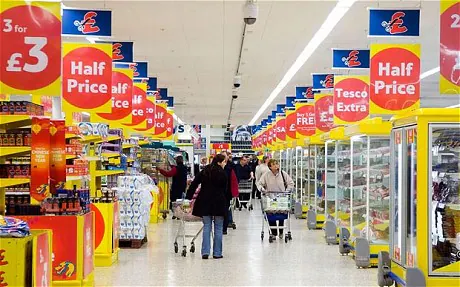
In early 2026, promotions are back at the centre of European grocery retail, but not in the way they once were. After years of inflation, margin pressure and supply chain disruption, supermarkets are rediscovering promotions as theatre rather than blunt instruments. Few retailers illustrate this shift more clearly than Tesco, whose Valentine’s Day meal deal in Ireland has become a case study in how modern promotions are designed to reassure shoppers, protect margins and reinforce brand positioning all at once.
Tesco’s €16 Valentine’s bundle in Ireland, offering a main, sides and dessert for two to Clubcard holders, is not revolutionary in itself. Meal deals have long been part of the supermarket playbook. What makes this promotion significant is timing, structure and intent. In a market where shoppers remain acutely price-sensitive, Tesco is using a seasonal event to send a broader message: value has returned, even if prices have not fallen across the board.
This approach is mirrored across Europe. Carrefour in France, Sainsbury’s in the UK, E.Leclerc, Intermarché and Auchan have all reintroduced heavily signposted promotions tied to moments rather than margins. The goal is no longer to flood stores with discounts, but to create controlled, high-visibility price moments that anchor the perception of affordability.
Retail executives privately admit that promotions had become almost radioactive during the peak inflation years. Deep discounts risked destroying margins at a time when costs were unpredictable and supplier negotiations tense. As a result, many chains quietly reduced promotional intensity, replacing it with everyday price messaging and loyalty mechanics. By 2026, however, supermarkets have realised that the absence of promotions came at a cost: shoppers stopped believing prices were fair.
Promotions today are therefore less about volume and more about narrative. Tesco’s Valentine’s offer, like similar campaigns at Marks & Spencer, Coop Italia and Monoprix in France, is carefully curated. The products are selected to showcase quality rather than sheer quantity. The pricing is sharp enough to feel meaningful, but not so aggressive that it undermines the rest of the range. Crucially, access is often gated through loyalty schemes, reinforcing data capture and repeat visits.
Loyalty has become the backbone of promotional strategy. Tesco’s Clubcard, Sainsbury’s Nectar, Carrefour Plus and Lidl Plus now function as promotional filters, allowing retailers to offer targeted value without collapsing base prices. Shoppers increasingly accept this trade-off. In exchange for personalised discounts, they hand over data. For supermarkets, this data-driven approach allows far greater control than the mass promotions of the past.
In Ireland and the UK, Tesco has been particularly adept at using promotions to defend its middle ground position. Facing pressure from Aldi and Lidl at the value end, and from Marks & Spencer and Waitrose at the premium end, Tesco uses promotions to flex its identity. Meal deals, price locks on staples and Clubcard exclusives allow it to speak simultaneously to budget-conscious families and aspirational shoppers.
The same dynamic is visible elsewhere in Europe. In France, E.Leclerc continues to use aggressive promotions as a competitive weapon, often forcing Carrefour and Intermarché to respond. In Italy, Coop and Conad focus promotions around fresh food and regional specialities, reinforcing trust rather than chasing price headlines. In Spain, Mercadona largely avoids traditional promotions altogether, relying instead on consistent everyday pricing and simplified assortments to maintain credibility.
What has changed most is the role of suppliers. During the inflation surge, branded manufacturers resisted promotions, wary of funding discounts while their own costs were rising. In 2026, many are returning to the table, but under stricter conditions. Promotions are shorter, more targeted and often tied to specific pack sizes or seasonal SKUs. Retailers such as Tesco, Carrefour and Rewe are demanding promotional funding that aligns with clear objectives, whether driving trial, clearing inventory or reinforcing category leadership.
Seasonality has regained importance. Valentine’s Day, Easter, Ramadan and Christmas are once again being used as promotional anchors. These moments allow retailers to justify temporary value without resetting consumer expectations year-round. Tesco’s Valentine’s campaign in Ireland is a textbook example: a limited-time offer that creates urgency while avoiding long-term price erosion.
Discounters have responded in their own way. Aldi and Lidl rarely engage in classic meal deals, but they use temporary special buys and seasonal ranges to create similar excitement. Their Valentine’s assortments, while simpler, reinforce the idea that affordability does not mean absence of celebration. This puts further pressure on full-range supermarkets to justify why their promotional offers deserve attention.
Online channels have added another layer of complexity. Promotions now need to work both in-store and digitally. Tesco, Carrefour and Ahold Delhaize have invested heavily in aligning online pricing with physical stores, ensuring that meal deals and bundles translate seamlessly into click-and-collect and home delivery. Failure to do so risks undermining trust in an environment where shoppers compare prices instantly.
Critically, promotions are no longer expected to drive growth on their own. With volumes largely flat across mature European markets, the objective is retention rather than expansion. Promotions are used to keep shoppers within the ecosystem, not to dramatically increase basket sizes. This is particularly true in the UK, where supermarket footfall has stabilised but loyalty remains fragile.
There is also a reputational dimension. After years of being accused of profiteering during inflation, supermarkets are acutely aware of public scrutiny. High-profile promotions serve as visible proof that retailers are “giving something back”. While critics argue that these offers are selective and symbolic, retailers counter that sustainable value is better delivered through controlled promotions than reckless price cutting.
Looking ahead, the promotional landscape in Europe is likely to remain disciplined rather than exuberant. Tesco, Sainsbury’s, Carrefour and their peers have learned hard lessons about margin erosion. The era of constant deep discounting is unlikely to return. Instead, shoppers will see fewer promotions, but clearer ones, tied to moments, loyalty and emotion rather than pure price war tactics.
Tesco’s Valentine’s Day meal deal may be modest in scale, but it captures the mood of European grocery retail in 2026. Promotions are no longer about shouting the loudest. They are about saying just enough to be believed again. In a market still shaped by inflation anxiety, that credibility may be the most valuable discount of all.