

A Windfall for Thousands of Workers
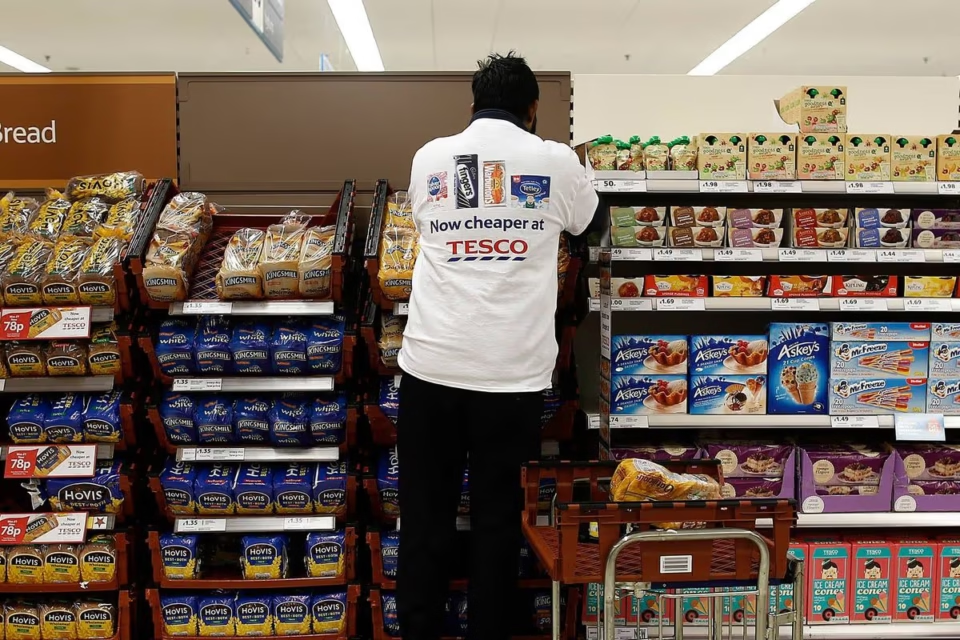
In an industry often criticised for tight margins and relentless cost control, the decision by Tesco to distribute a staff share windfall worth approximately £134 million stands out as a striking moment in British retail.
More than twenty thousand employees are set to benefit from the scheme, with some payouts reaching several thousand pounds depending on tenure and share allocations. For supermarket workers who typically operate in one of the most demanding sectors of the service economy, such financial rewards represent a rare recognition of their role in the company’s success.
Yet behind the celebratory headlines lies a more complex reality. Tesco’s share distribution is not merely an act of corporate generosity. It is a strategic move designed to reinforce loyalty, strengthen employee engagement and maintain stability within a highly competitive labour market.
In modern retail, staff motivation can be just as important as pricing strategies.
The Changing Economics of Supermarket Labour
Supermarkets employ hundreds of thousands of workers across store operations, logistics networks and administrative functions. These employees represent the human infrastructure behind every grocery transaction.
But labour in food retail has historically been undervalued.
Checkout operators, shelf stockers and warehouse staff often work irregular hours, handle demanding workloads and interact with customers in stressful environments. Despite this, wages have traditionally remained modest.
The pandemic altered public perceptions of these roles. During lockdowns, supermarket workers became essential frontline staff, ensuring that food supply chains continued to function while much of society shut down.
That moment of recognition forced many retailers to reconsider how they treat and reward their workforce.
Tesco’s share scheme can be viewed as part of this broader shift.
Shares Instead of Simple Bonuses
Unlike traditional cash bonuses, share-based rewards link employees directly to the financial performance of the company.
When Tesco’s share price rises, workers holding those shares benefit directly. This creates a psychological connection between daily operational performance and the broader success of the organisation.
In theory, such programmes transform employees into stakeholders rather than simply wage earners.
For corporate strategists, the logic is straightforward. Staff who feel invested in the company are more likely to remain loyal, maintain higher service standards and contribute to operational efficiency.
In a sector where staff turnover can be extremely high, these incentives may offer significant long-term value.
The Competitive Labour Market
Tesco’s decision also reflects growing competition for retail labour in the United Kingdom.
The supermarket sector no longer competes only with other retailers for employees. Logistics companies, online delivery platforms and warehouse operators are all drawing from the same workforce pool.
The rise of e-commerce has created thousands of new jobs in distribution centres and last-mile delivery operations, many of which offer wages comparable to or higher than traditional store roles.
To retain experienced staff, supermarkets must therefore provide more than just basic salaries.
Benefits such as share schemes, staff discounts and career progression opportunities have become increasingly important recruitment tools.
Employee Morale and Customer Experience
Retail executives often emphasise the link between staff morale and customer satisfaction.
A motivated workforce is more likely to deliver better service, maintain well-stocked shelves and create a pleasant shopping environment.
Conversely, disengaged employees can quickly damage the customer experience.
In supermarkets, where profit margins are typically measured in fractions of a percentage point, customer loyalty is critical. Shoppers who feel comfortable and well served are more likely to return week after week.
Tesco’s investment in employee rewards therefore carries implications beyond internal culture. It directly influences how customers perceive the brand.
The Economics Behind the Gesture
While £134 million sounds substantial, it must be viewed within the broader financial scale of Tesco’s operations.
The company generates tens of billions of pounds in annual revenue. Within that context, the share scheme represents a relatively modest investment designed to protect long-term performance.
From a corporate perspective, the cost of losing experienced staff can be far greater than the expense of rewarding them.
Training new employees, managing recruitment processes and dealing with operational disruption all carry hidden financial burdens.
Share-based incentives help reduce those risks by encouraging staff to remain with the company.
A Strategic Signal to the Industry
Tesco’s decision may also influence behaviour across the wider supermarket sector.
Rival chains such as Sainsbury’s and Asda are closely watching how such initiatives affect employee engagement and public perception.
If the programme proves successful in improving staff retention and customer satisfaction, other retailers may adopt similar strategies.
Retail competition is not limited to pricing or product range. It increasingly includes corporate culture and employee treatment.
Companies that cultivate strong internal communities often gain reputational advantages with both workers and consumers.
The Symbolism of Shared Success
There is also an important symbolic dimension to employee share programmes.
In an era where corporate profits sometimes attract public criticism, distributing financial rewards to staff sends a powerful message about shared success.
It suggests that prosperity is not confined to boardrooms and shareholders but extends to the individuals working on shop floors and warehouse loading bays.
For Tesco, this symbolism is particularly valuable. The company has spent decades positioning itself as a retailer closely connected to local communities.
Rewarding employees reinforces that narrative.
The Limits of Corporate Generosity
However, it would be naïve to interpret the share windfall purely as an act of benevolence.
Supermarkets remain commercial enterprises operating under intense financial pressure. Profitability depends on efficiency, cost control and operational discipline.
Employee share schemes are therefore carefully calibrated instruments rather than spontaneous acts of generosity.
They must deliver measurable benefits in productivity, loyalty and brand perception.
If the economic environment deteriorates significantly, such programmes could quickly be scaled back.
Retail’s Human Dimension
Despite the strategic calculations behind it, Tesco’s staff windfall highlights an often overlooked truth about the supermarket industry.
Behind every neatly arranged produce display and every smoothly operating checkout lies a vast network of human effort.
From early-morning warehouse shifts to late-night shelf replenishment, supermarket employees keep one of the most essential sectors of modern life functioning.
Recognising that contribution — whether through financial rewards or workplace culture — is not simply good public relations. It is good business.
A Model for the Future?
As retail evolves in response to technological change, automation and digital commerce, the role of human workers will inevitably shift.
Self-checkout machines and online ordering systems are already transforming store environments. Yet the physical supermarket still relies heavily on people.
Employees guide customers, manage fresh food departments and maintain the complex logistics of in-store operations.
For that reason, companies that treat their workforce as a strategic asset rather than a cost centre may ultimately gain a decisive advantage.
Tesco’s £134 million windfall could therefore represent more than a single corporate gesture.
It may signal a broader recognition that in the age of automation and digital transformation, human loyalty remains one of retail’s most valuable resources.