
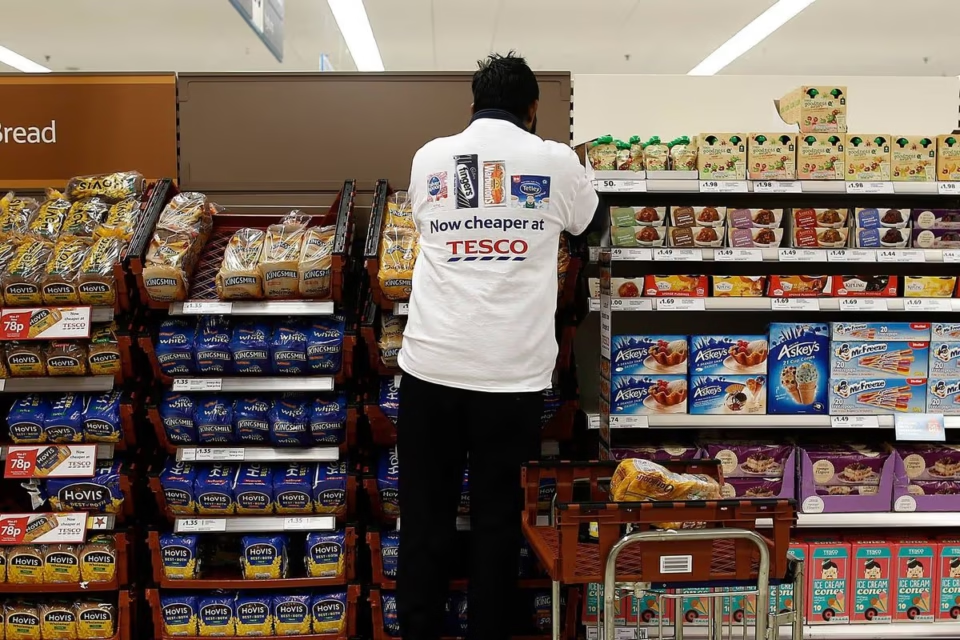
For decades, Tesco has stood as one of the defining names in global grocery retail. Its blue-and-red logo has become a familiar sight across cities, suburbs, and rural communities, representing a company that has evolved alongside generations of shoppers. Yet the Tesco of today is very different from the supermarket giant that dominated the early years of the twenty-first century. Faced with changing consumer habits, technological disruption, economic uncertainty, and fierce competition, the retailer is quietly reshaping itself for a new era.
The transformation is taking place at a moment when the grocery industry is experiencing one of the most significant periods of change in its history. Traditional supermarket models are under pressure from discount chains, online platforms, convenience operators, and increasingly demanding consumers. Shoppers expect lower prices, faster service, better quality, and greater flexibility than ever before. Retailers that fail to adapt risk losing relevance in a market where loyalty can disappear with a single click.
Tesco’s response has been neither dramatic nor revolutionary. Instead, the company has embraced a strategy of continuous adaptation. Across the United Kingdom and international markets, the retailer is focusing on operational efficiency, technology investment, and local convenience. The goal is simple: remain the first choice for consumers regardless of how, where, or when they choose to shop.
One of the most notable shifts has been the growing importance of convenience retailing. Large hypermarkets once represented the future of grocery shopping. Today, many consumers prefer smaller stores located closer to home or work. Tesco has responded by strengthening its network of neighborhood locations, allowing shoppers to make quick purchases without committing to lengthy visits. These stores are becoming increasingly important as urban lifestyles accelerate and convenience becomes a primary purchasing factor.
At the same time, technology is reshaping the company’s operations behind the scenes. Modern supermarkets generate vast amounts of data every day. Every purchase, stock movement, and customer interaction provides information that can be used to improve efficiency. Tesco is investing heavily in systems that help forecast demand, manage inventory, and reduce waste. The objective is not merely to lower costs but also to ensure products are available when customers need them.
Artificial intelligence is becoming an increasingly valuable tool in this effort. Advanced forecasting systems can identify purchasing patterns that would have been impossible to detect only a few years ago. Weather conditions, local events, seasonal trends, and consumer behavior can all be analyzed to predict demand more accurately. Such capabilities allow stores to maintain better stock levels while reducing unnecessary waste, a challenge that has long troubled the grocery sector.
Sustainability is another area receiving significant attention. Consumers increasingly expect retailers to demonstrate environmental responsibility. Tesco has responded by pursuing initiatives designed to reduce emissions, improve packaging efficiency, and tackle food waste. While sustainability efforts often require substantial investment, they are increasingly viewed as essential rather than optional. Retailers are finding that environmental performance is becoming closely linked to brand reputation and customer trust.
Competition remains intense. Discount chains continue to attract shoppers seeking value, while online platforms challenge traditional retail models. Tesco’s strategy has therefore focused on balancing competitive pricing with product quality and service. Maintaining that balance is no easy task in an environment where margins remain under pressure and costs continue to rise across supply chains.
Private-label products have emerged as a crucial component of this strategy. Supermarket-owned brands allow retailers to offer value while maintaining greater control over product development and pricing. Tesco’s own-label ranges now span multiple categories, from entry-level essentials to premium offerings. This diversification enables the company to appeal to a broad spectrum of consumers while strengthening profitability.
The evolution of loyalty programs is also playing a significant role in Tesco’s future. Modern loyalty schemes have become sophisticated data platforms rather than simple reward systems. By understanding purchasing behavior in greater detail, retailers can personalize promotions and create more targeted offers. For shoppers, the experience feels increasingly customized. For retailers, the result is deeper engagement and improved customer retention.
Online grocery shopping continues to reshape the industry as well. Although physical stores remain central to Tesco’s business model, digital channels are becoming increasingly important. Consumers now expect seamless integration between online ordering, home delivery, and in-store collection services. Retailers that successfully combine these channels create a more flexible shopping experience, one that reflects the realities of contemporary consumer behavior.
Industry analysts often describe the future of grocery retail as an ecosystem rather than a collection of stores. In this environment, supermarkets function as logistics hubs, digital platforms, data centers, and community destinations simultaneously. Tesco appears to be embracing this vision. Rather than choosing between physical and digital retail, the company is investing in both, recognizing that modern consumers move fluidly between channels.
The retailer’s future success will depend largely on its ability to execute this transformation while maintaining the trust it has built over many decades. Grocery shopping remains a deeply personal activity. Consumers may appreciate innovation, but they also value reliability, familiarity, and consistency. Tesco’s challenge is to modernize without losing the qualities that made it successful in the first place.
As the global supermarket industry enters a new phase of development, Tesco stands at an interesting crossroads. It is no longer simply a supermarket chain. It is becoming a technology-enabled retail ecosystem designed to serve consumers across multiple formats and channels. The changes may appear gradual from the outside, but together they represent one of the most significant transformations in the company’s history.
The next chapter for Tesco is unlikely to be defined by dramatic headlines or revolutionary breakthroughs. Instead, it will be shaped by thousands of incremental improvements, from smarter forecasting systems and more efficient supply chains to better convenience stores and enhanced digital services. In a retail environment where adaptation is often the key to survival, that steady evolution may prove to be Tesco’s greatest strength.
