
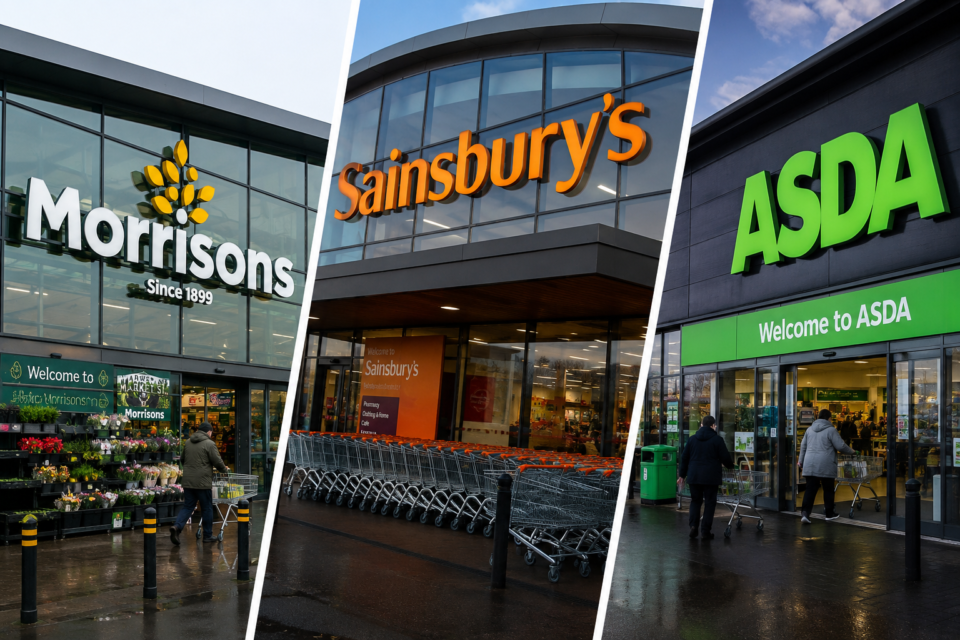
The UK supermarket landscape can be “mapped” into a few realistic consolidation paths, but it’s important to be clear: actual mergers are constrained by regulation, brand identity, and how different operating models fit together. So what follows is not prediction as certainty, but the most structurally plausible directions based on cost pressure, overlap, and strategic weakness.
One of the most frequently discussed pairings is between Asda and Morrisons, because they sit in similar “big store, value-led” territory. Both are large-scale, both are heavily exposed to physical retail overheads, and both struggle with the same structural issue: too many large-format stores in a market that is shifting toward either discount efficiency or convenience formats. In theory, combining them could unlock serious savings in procurement, logistics, and head office duplication. In practice, it would also create a very complex integration problem, because both have different supply chain legacies and store operating cultures. Still, if consolidation happens in the mid-market value segment, this is one of the most logically consistent pairings.
A different kind of “pressure alignment” exists around Sainsbury’s. Rather than being a merger target in a simple sense, it is more likely to be a consolidator or a partial restructurer. Its closest strategic tension is not with other full-line supermarkets, but with the dual pressure from discounters like Lidl on price and premium convenience formats on service. A full merger with another major supermarket is less likely because of regulatory barriers and the risk of destroying its balanced positioning. Instead, if any structural move occurs, it would more likely involve selective asset swaps, format conversions, or deeper partnership structures rather than full corporate merger activity.
The discounter side, particularly Lidl, does not really need mergers in the same way. Its model is already structurally efficient: limited product range, tight logistics, and high turnover per square metre. If anything, the “expansion strategy” here is organic rather than consolidative—opening more stores, increasing distribution density, and slowly absorbing market share rather than acquiring competitors. This is why Lidl acts more like a gravitational force in the market than a merger participant. It changes the behaviour of others without needing to combine with them.
A more speculative but structurally interesting scenario is partial convergence between traditional supermarkets and non-grocery retail infrastructure. In this context, chains like Sainsbury’s (through its convenience and non-food channels) represent a model where grocery becomes part of a broader retail ecosystem rather than a standalone grocery-only business. Instead of merging with another supermarket, the strategic evolution may involve deeper integration with logistics, online delivery platforms, and convenience retail networks. This reduces the need for “big mergers” and replaces them with “system mergers” across supply chain and technology layers.
If you zoom out, the most realistic consolidation map of the UK grocery sector is not a clean set of two or three giant mergers. It looks more like a gradual compression into three layers. At the top, you have scaled generalists like Sainsbury’s trying to defend margin through efficiency and ecosystem expansion. In the middle, you have structurally pressured large-format retailers like Asda and Morrisons, where consolidation pressure is highest. At the bottom, you have discounters like Lidl, which continue to expand and reshape price expectations without needing structural mergers.
So the real “map” is not a chessboard of equal pieces merging into one another. It is a slow compression where mid-tier complexity is being squeezed out, and companies are forced to choose: either move closer to the simplicity of discounting, or evolve into broader retail ecosystems that justify their overhead. The most unstable position is the middle ground—and that is where the strongest merger pressure actually sits.