

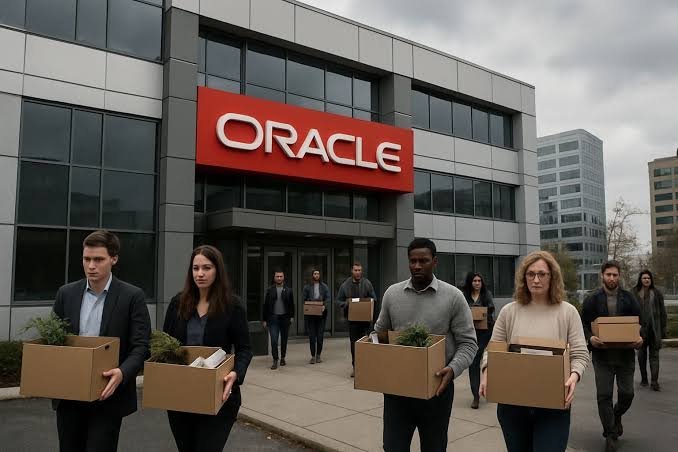

ORACLE PREPARES ANOTHER JOB-CUT WAVE AS AI SPENDING SOARS
Oracle is reportedly preparing another round of job cuts, adding to the growing evidence that the artificial intelligence boom is changing not only how companies operate, but also how many people they need.
The technology giant has reportedly asked managers to identify employees who could be affected by a fresh workforce reduction, with the cuts expected before the start of Oracle’s second fiscal quarter on 1 September.
Some teams could reportedly face reductions in the double digits.
The latest move comes after Oracle reduced its workforce by around 21,000 employees during fiscal 2026, equivalent to approximately 13% of its workforce.
BILLIONS FOR AI, THOUSANDS FEWER EMPLOYEES
What makes Oracle’s latest restructuring particularly significant is what is happening elsewhere inside the business.
While employees are facing further job uncertainty, Oracle is pouring extraordinary amounts of money into AI infrastructure.
The company spent approximately $55.7 billion on infrastructure during fiscal 2026 and has been borrowing heavily to finance its expansion into cloud computing and AI infrastructure. Its cloud infrastructure business has been growing rapidly, with reported year-on-year growth of 77%.
The contrast is striking.
More machines. More data centres. More AI capacity. Fewer employees.
That is becoming one of the defining characteristics of the current technology investment cycle.
THE NEW CORPORATE CALCULATION
For decades, companies invested in technology primarily to help employees work more efficiently.
AI changes the calculation.
Businesses can now ask whether a task needs to be performed by a person at all.
That does not mean that every Oracle job being eliminated is directly being replaced by AI. Oracle has undertaken a broader restructuring and has cited multiple reasons for workforce changes.
But the company’s workforce reduction comes at a time when AI adoption is accelerating across the organisation. Oracle’s fiscal 2026 disclosures linked workforce changes partly to the adoption and deployment of AI.
WHY RETAIL SHOULD BE WATCHING
The Oracle story is particularly relevant to the retail industry.
Supermarkets and major retailers are making similar investments in artificial intelligence.
AI is moving into customer service, pricing, forecasting, merchandising, marketing, supply chains, warehouses and back-office operations.
Retailers have traditionally operated with enormous workforces because millions of individual tasks have required human intervention.
That is changing.
The question now is no longer simply:
“Can AI make employees more productive?”
It is increasingly:
“How many employees will the business need once AI is fully deployed?”
Oracle provides a powerful example of what that question can mean in practice.
THE AI EMPLOYMENT DIVIDE
There is another important side to the story.
AI is not simply destroying employment. Companies building AI infrastructure, data centres, software and cloud services are creating enormous demand for new skills and new investment.
But the jobs being created are not necessarily the same jobs being lost.
That creates a growing employment divide between workers whose roles complement AI and those whose work can increasingly be automated.
Oracle’s reported new cuts therefore deserve attention well beyond the technology sector.
For retailers, manufacturers, banks and other large employers, the message is clear.
The AI revolution is no longer a future workforce story. It is already becoming a headcount story.
And as companies continue spending billions on artificial intelligence, investors and employees alike will increasingly be watching one number alongside AI investment:
the number of people left on the payroll.