

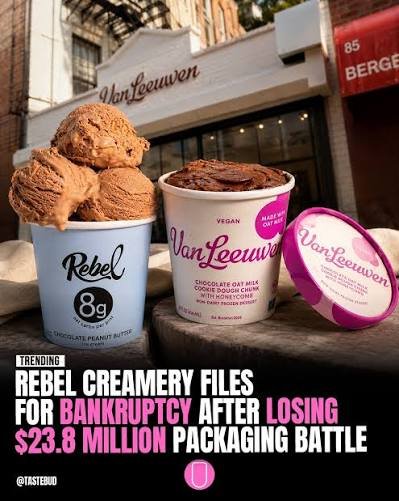

A US ice cream brand sold through supermarkets has filed for bankruptcy after losing a major court battle over the design of its packaging.
Rebel Creamery, known for its low-carb and keto-friendly ice cream, is facing the financial consequences of a legal dispute with rival brand Van Leeuwen Ice Cream.
The court battle centred on something shoppers see every time they walk down the freezer aisle — the packaging.
Van Leeuwen claimed that Rebel had copied important elements of its visual identity, including the colours, lettering and overall appearance of its ice cream containers.
The dispute eventually went to court, where Rebel was found to have infringed Van Leeuwen’s trade dress.
The financial consequences were severe.
Rebel was ordered to pay almost $23.8 million, while also being required to change the packaging of the products involved in the dispute.
For a food company operating in supermarkets, such a judgement can have a major impact.
Packaging is much more than a container. On a supermarket shelf, it is part of the brand.
Companies spend considerable amounts of money developing colours, fonts, images and layouts designed to make their products instantly recognisable.
That creates a difficult balance for brands.
A new product needs to look familiar enough to attract shoppers, but different enough to establish its own identity.
The Rebel case shows what can happen when that distinction becomes a legal argument.
Following the judgement, Rebel filed for Chapter 11 bankruptcy protection.
The company is also challenging the court decision and is seeking to continue operating while the legal process develops.
For the supermarket industry, the case is worth watching because competition between food brands increasingly takes place on the shelf.
In categories such as ice cream, snacks, drinks and confectionery, hundreds of products can compete for attention in a relatively small space.
A strong visual identity can help a product stand out.
But if another company believes that identity has been copied too closely, the consequences can extend far beyond a disagreement between two marketing departments.
The case also raises questions for retailers.
Supermarkets regularly introduce new brands and products, and packaging is often one of the first things buyers and consumers notice.
A legal dispute can potentially force a manufacturer to change packaging after products have already entered the market.
That could mean redesigning products, replacing stock, changing promotional material and rebuilding consumer recognition.
For Rebel, the packaging dispute has now become a much bigger business problem.
What began as a battle over the appearance of an ice cream container has ended with a $23.8 million judgement, a packaging redesign and a bankruptcy filing.
It is a powerful reminder that on the supermarket shelf, looking too much like your competitor can become an extremely expensive mistake.