
Spain’s supermarket giant is betting €54 million on automation. The bigger question is whether robots can finally solve one of grocery retail’s biggest problems: making online shopping work at scale.
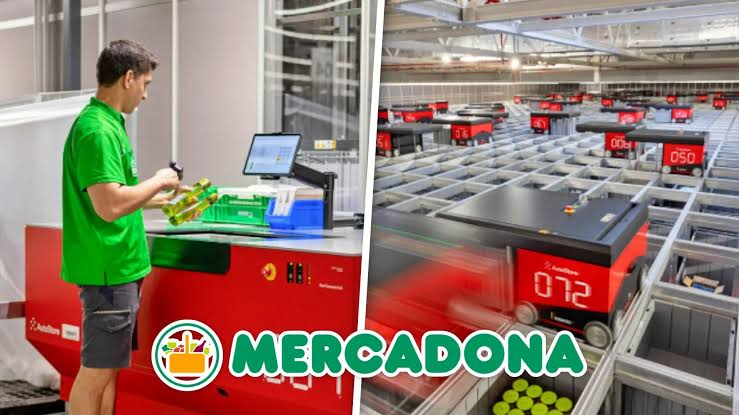
Mercadona has taken another significant step into the future of online grocery shopping with the opening of its first semi-automated “Colmena” warehouse in Madrid. The Vallecas facility covers 32,000 square metres, includes 70 robots and has the capacity to prepare up to 5,000 online orders a day. The investment is €54 million, while around 700 people will work at the site.
At first glance, the headline is about robots.
But that is not really the most important part of the story.
The real issue is whether Mercadona can use automation to change the economics of online grocery retail.
The problem with online supermarkets
Selling groceries online has always had an awkward problem.
A customer can place an order in seconds, but somebody still has to find hundreds of individual products, collect them, pack them and get them into a delivery vehicle.
In a traditional supermarket, the customer does much of that work.
They walk through the aisles.
They find the products.
They put them in the trolley.
They take them to the checkout.
Online shopping reverses the process.
The supermarket has to do all of that work instead.
That makes grocery e-commerce fundamentally different from selling books, electronics or clothing online.
A supermarket can sell a €1 product online, but the cost of picking, packing and delivering that product does not magically become €1.
This is why automation matters.
Mercadona’s answer is to bring the supermarket to the worker
The new Vallecas Colmena uses 70 robots to partially automate the preparation of more than 2,700 dry-grocery product references.
Instead of workers walking repeatedly through long warehouse aisles looking for products, the automated system brings products to preparation stations where employees assemble customer orders.
It sounds like a relatively simple change.
Economically, however, it can be extremely important.
Every unnecessary metre a worker walks costs time.
Every unnecessary journey adds labour.
Every delay reduces the number of orders that can be processed.
Automation is therefore not simply about replacing people.
It is about changing what people spend their time doing.
The robots are not replacing the 700 workers
That point is important.
Mercadona’s new facility is expected to employ around 700 people.
The company says the automation is designed to reduce the physical effort involved in preparing orders and improve the efficiency of the process.
That makes the warehouse a useful example of where supermarket automation is actually heading.
The future is not necessarily a warehouse with hundreds of robots and nobody inside.
It is a warehouse where machines handle repetitive movement while people concentrate on the tasks that still require human intervention.
For grocery retailers, that may be a much more realistic model.
Five thousand orders a day changes the equation
The Vallecas site has capacity for up to 5,000 orders per day.
That is a substantial volume.
At that scale, even small improvements in picking efficiency can become financially significant.
If an automated system saves a few minutes on every order, those minutes multiply across thousands of orders.
If it reduces physical strain, that can matter for working conditions.
If it allows the warehouse to process more orders without increasing labour at the same rate, the economics become even more attractive.
And if it improves consistency and speed, the customer notices too.
That is where automation becomes more than a technology story.
It becomes a retail strategy.
Mercadona is betting on the online customer
There is another reason this investment matters.
Mercadona’s online business has become significant enough to justify dedicated infrastructure.
The company’s online sales exceeded €1 billion in 2025, according to reporting on the Vallecas project, representing strong growth from the previous year.
That changes the conversation.
Online grocery is no longer simply an experiment for Mercadona.
It is a major channel.
And once online sales reach that scale, the question becomes how efficiently the business can serve those customers.
The supermarket without customers
There is something fascinating about the Colmena model.
It is a supermarket that customers never visit.
There are no shopping trolleys.
No checkout queues.
No customers comparing two brands of pasta.
No promotional displays.
The entire building exists to perform one job:
prepare somebody else’s shopping.
That could become increasingly important as grocery retail separates the physical store from the fulfilment operation.
The traditional supermarket combines shopping, storage, merchandising and fulfilment under one roof.
The Colmena separates them.
That allows Mercadona to design the building around logistics rather than around the customer’s shopping experience.
And logistics is where automation becomes particularly powerful.
This could be the real future of supermarket e-commerce
For years, retailers have struggled with the economics of online grocery.
Customers expect convenience.
They expect fast delivery.
They expect competitive prices.
And increasingly, they expect the service to be inexpensive or even free.
Those expectations are difficult to reconcile.
Someone has to pay for the labour involved in preparing the order.
Someone has to pay for the warehouse.
Someone has to pay for the delivery vehicle.
Someone has to pay for fuel, refrigeration, technology and infrastructure.
Automation cannot eliminate those costs.
But it may reduce the cost of fulfilling each individual order.
That is the prize.
Mercadona is not stopping at Madrid
The Vallecas warehouse is part of a much wider investment in Mercadona’s online infrastructure.
The company is also planning a new Colmena in Palma de Mallorca, expected to begin operating in 2027. That facility will cover more than 14,300 square metres and represents an estimated investment of €19.5 million, with more than 200 jobs expected.
The significance is that Mercadona is continuing to separate online fulfilment from its conventional stores.
In Mallorca, online orders are currently prepared manually inside physical supermarkets.
The new facility will change that model.
That suggests the Colmena concept is not simply a one-off experiment in Madrid.
Mercadona is building a network.
And that puts pressure on the competition
Mercadona’s move will inevitably be watched by other Spanish supermarket operators.
Carrefour.
Lidl.
Dia.
Alcampo.
And the growing number of companies competing for Spain’s online grocery customer.
The question is not whether they can also buy robots.
They can.
The more important question is whether their online businesses generate enough volume to justify similar investment.
Automation makes more sense when there are thousands of orders flowing through a facility.
That means scale becomes increasingly important.
And scale can create another competitive advantage.
The strange economics of supermarket robots
There is also a risk.
Automation is expensive.
The Vallecas project required €54 million.
Technology needs maintenance.
Systems need upgrading.
Robots need to operate reliably.
And the warehouse still requires hundreds of employees.
So automation does not automatically mean lower costs.
The investment only makes sense if the increase in capacity, efficiency and productivity generates enough value over time to justify the expenditure.
That is the gamble Mercadona is making.
The biggest winner could be the customer
If the strategy works, customers may not notice the robots at all.
And that is probably the point.
They may simply notice that their order arrives faster.
That products are available.
That substitutions are less frequent.
That delivery slots improve.
That online shopping becomes more reliable.
The technology disappears into the background.
The customer experiences the result rather than the machinery.
That is how successful retail technology usually works.
But there is a bigger question for the supermarket industry
Mercadona’s investment raises a question that goes far beyond Spain.
Can automation finally make online grocery economics work?
For years, supermarkets have been caught between two realities.
Consumers want online grocery shopping.
But fulfilling grocery orders is expensive.
If automation can reduce the cost of picking and packing sufficiently, retailers may finally be able to expand online without sacrificing as much profitability.
That could transform the industry.
The supermarket of the future may therefore not simply be a building where customers shop.
It could be a network of specialised fulfilment centres, automated warehouses, physical stores and delivery operations working together.
The ISN View
Mercadona’s 70 robots are interesting.
The €54 million investment is interesting.
The 32,000-square-metre warehouse is interesting.
But none of those numbers is the real story.
The real story is the economic experiment happening inside the building.
Mercadona is asking whether technology can take one of the most labour-intensive parts of grocery retail — preparing thousands of individual shopping orders — and make it faster, more scalable and ultimately more efficient.
If the answer is yes, the consequences could extend far beyond Madrid.
Because every supermarket wants the same thing: more online customers without allowing the cost of serving them to destroy the business.
Mercadona is betting that robots can help solve that problem.
And if the experiment works, the next supermarket battle may not be fought over who has the biggest store.
It may be fought over who has the smartest warehouse.
