
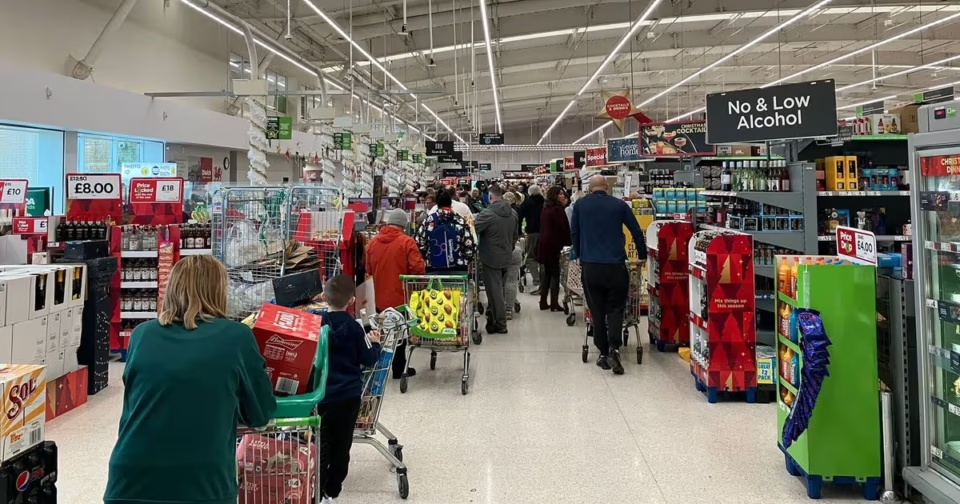
Years of food inflation have changed the way people shop. Consumers are comparing prices more carefully, experimenting with private-label products and becoming increasingly comfortable with discount supermarkets. The biggest question for the grocery industry is whether these new habits will remain even when inflation becomes less painful.
For many years, supermarket shoppers were creatures of habit. Consumers often returned to the same supermarket every week, bought familiar brands and were prepared to pay a little more for products they trusted. A well-known brand carried a certain value, and many shoppers were reluctant to replace it with a cheaper alternative simply to save a few pence. That behaviour has changed significantly after several years of food-price inflation.
The consumer has become much more price conscious. A weekly grocery shop that once felt relatively predictable can now represent a significant part of the household budget, encouraging shoppers to compare prices between supermarkets, examine promotions and question whether a branded product is really worth the additional cost. What began as a response to rising prices has gradually developed into a new shopping habit.
The most important change may be that consumers have discovered they have more choices than they previously realised. A shopper who always bought a particular brand of pasta, cereal, coffee or household product may now be willing to try a supermarket’s own-label version. If the cheaper product performs well, there may be little reason to return to the more expensive brand.
That creates a serious challenge for food manufacturers because getting a consumer to try a private-label alternative is only the first step. The bigger problem is what happens afterwards. If the consumer discovers that the cheaper product is good enough, the traditional brand may permanently lose part of its position in the shopping basket.
Trading down has become normal
Trading down was once associated primarily with consumers experiencing financial difficulties. It could be seen as a temporary decision made during difficult economic periods, with shoppers expected to return to their previous purchasing habits once their financial circumstances improved.
Today, trading down has become much more mainstream. Consumers from a much wider range of income groups are paying attention to value, and many are discovering that buying cheaper does not necessarily mean accepting poor quality.
This is an important psychological change for the supermarket industry. The consumer is no longer necessarily asking, “Can I afford this product?” The question is increasingly, “Why should I pay more for this product?”
That is a much more difficult question for brands to answer.
Private label has benefited enormously
The biggest winner from this change has been supermarket private label. Retailers have invested heavily in improving their own products, from basic economy ranges to premium products designed to compete directly with established brands.
The result is that supermarket own-label products no longer have to be positioned simply as the cheapest option. Many retailers now offer several levels of private label, allowing shoppers to choose between basic, standard and premium products.
This gives supermarkets something that food manufacturers cannot easily replicate. The retailer controls the shelf, the price, the promotion and the relationship with the customer. It can also use customer data to understand which products are gaining popularity and adjust its ranges accordingly.
For consumers, meanwhile, the decision can be remarkably simple. If a supermarket’s own product costs significantly less and delivers a similar experience, the economic argument becomes difficult to ignore.
The discounters have changed consumer expectations
Aldi and Lidl have played a major role in this transformation. Their growth has shown consumers that a supermarket can operate with a very different business model, relying heavily on private label, limited ranges, efficient stores and aggressive pricing.
The importance of Aldi and Lidl therefore extends beyond their individual market shares. They have changed what consumers consider a reasonable price.
When a shopper sees a product available for considerably less at a discount supermarket, that price becomes a reference point. Even if the consumer continues shopping at a traditional supermarket, they may start questioning the price of similar products there.
This creates pressure across the entire industry. Traditional supermarkets increasingly have to demonstrate why their products and services justify the difference.
Brand loyalty is being tested
For major food manufacturers, this is one of the most important developments to watch. Brand loyalty remains powerful, but it is no longer something that companies can simply assume.
Consumers may still have favourite brands, but they are increasingly willing to experiment. Promotions can encourage that experimentation, while private-label improvements make it easier for shoppers to find acceptable alternatives.
Once the consumer breaks the habit of buying a particular brand, the manufacturer has to work much harder to win them back.
This is particularly important for everyday products. If a household changes its choice of pasta, milk, cereal or cleaning products and discovers that the cheaper alternative works perfectly well, the change can become permanent.
The danger for manufacturers is therefore not necessarily a dramatic collapse in sales. It can be a slow erosion of brand loyalty, one shopping basket at a time.
Promotions are changing the way people shop
The growth of promotional shopping is another indication of how consumers have adapted. Shoppers increasingly plan purchases around discounts, loyalty-card offers and supermarket promotions rather than simply buying the same products at the same store every week.
That behaviour gives consumers more power, but it also makes the supermarket market more competitive.
A shopper who is willing to compare prices between retailers is much harder to retain. If Tesco has the best offer on one group of products and Lidl has the best price on another, consumers can divide their shopping between different retailers.
The weekly grocery shop is therefore becoming less predictable.
The rise of the second supermarket
One of the clearest consequences of this behaviour is that consumers are increasingly comfortable shopping at more than one supermarket.
A household may use a traditional supermarket for its main shop, a discounter for selected products and an online retailer for convenience. Another household may do its fresh-food shopping locally while buying packaged goods from a discount chain.
This creates a new challenge for retailers because the objective is no longer simply to attract a shopper once a week.
They have to become important enough to retain a significant share of the customer’s total grocery spending.
That is a much harder battle.
Will consumers trade back up?
This is the question that supermarkets and food manufacturers should be asking now.
If food inflation continues to moderate and household finances improve, will consumers return to the brands they bought before?
Possibly.
But there is a strong reason to believe that some of the changes will remain.
Consumers have now had several years to test private-label products, discover discount supermarkets and compare prices. Many have discovered that they can reduce their grocery bills without feeling that they have dramatically reduced the quality of what they eat.
Once that knowledge has been acquired, it cannot easily be forgotten.
A shopper who has learned that a supermarket own-label product is perfectly acceptable may continue buying it even when their disposable income increases.
That means the impact of inflation could last much longer than the inflation itself.
The premium market may survive, but it has to justify itself
This does not mean consumers will abandon premium products.
There will always be shoppers willing to pay more for quality, provenance, health benefits, convenience, sustainability or a particular brand.
But the premium product increasingly has to explain why it deserves its premium price.
That is an important distinction.
The consumer is not necessarily becoming cheap.
The consumer is becoming selective.
They may save money on everyday household products so they can spend more on premium fresh produce, speciality foods, restaurant meals or products they genuinely value.
The future grocery basket could therefore become more polarised, with consumers trading down in some categories while trading up in others.
What this means for supermarkets
For retailers, this creates an opportunity as well as a challenge. Supermarkets that can offer strong private-label products, competitive prices and a clear value proposition can gain loyalty from consumers who have become more price conscious.
But retailers cannot rely exclusively on low prices.
They also need quality, convenience, availability and a good shopping experience. Consumers may be willing to save money, but they are unlikely to tolerate poor service or consistently empty shelves simply because the price is lower.
The winning supermarket may therefore be the one that makes the customer feel they are getting the best value, rather than simply the lowest price.
What this means for food brands
For food manufacturers, the message is even more important. The years ahead could require brands to prove their value more clearly than ever.
Strong marketing alone may no longer be sufficient. Brands will need to demonstrate quality, innovation, taste, health benefits, provenance or something else that makes consumers willing to pay the difference.
The strongest brands will probably survive because they offer something consumers genuinely value.
The weaker brands could find themselves squeezed between powerful private-label ranges and aggressive discount retailers.
The ISN View
The biggest change in supermarket retail may not be the rise of Aldi, Lidl or private label by itself. It may be the change that has taken place inside the consumer’s mind.
The shopper has learned to question prices.
They have learned to compare.
They have learned that supermarket own-label products can be good.
They have learned that discount supermarkets can offer quality as well as low prices.
And, most importantly, they have learned that they have choices.
That knowledge is unlikely to disappear simply because inflation falls.
The supermarket industry may therefore be entering a new era in which consumers are permanently more demanding about value. They will still buy brands, they will still pay for quality and they will still enjoy premium products, but they are increasingly asking one question before putting something into the trolley:
“Is this really worth paying more for?”
For supermarkets, that question creates enormous opportunity.
For food manufacturers, it could become one of the biggest challenges of the next decade.