
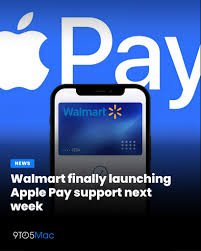
After more than a decade of resisting Apple Pay and other contactless payment services, Walmart has finally changed course. The retail giant announced on August 21 that it will begin introducing tap-to-pay at selected Walmart and Sam’s Club locations in the United States from August 24, with the technology expected to reach all U.S. stores by the end of 2026. The rollout will also eventually extend to Walmart and Sam’s Club fuel stations, with the company targeting mid-2027.
The decision is particularly notable because Walmart was not simply slow to adopt Apple Pay; it actively chose a different direction. For years, the retailer promoted its own Walmart Pay system, which required shoppers to use the Walmart app and scan a QR code at checkout. Walmart also invested in Scan & Go and other proprietary digital tools, giving the company greater control over the checkout experience and its relationship with customers. As Apple Pay, Google Pay and contactless cards became increasingly normal across the retail industry, Walmart remained one of the most prominent holdouts.
Walmart’s resistance goes back to the early days of mobile payments. The company was involved in CurrentC, a retailer-backed alternative to emerging mobile-wallet systems, alongside other major retailers. CurrentC ultimately failed and was shut down in 2016, while Apple Pay continued to expand. Walmart nevertheless continued to favour its own payment solution rather than adopting NFC-based services such as Apple Pay and Google Pay.
There was a clear strategic logic behind Walmart’s position. By encouraging customers to use Walmart Pay, the retailer could keep shoppers inside its own digital ecosystem rather than sending the payment interaction through a third-party wallet. Analysts have also pointed to the value of customer transaction data and the costs associated with upgrading payment terminals to support NFC technology. Apple Pay, by contrast, is designed to protect payment information by using a device-specific token rather than sharing the customer’s actual card number with the merchant.
But the market around Walmart changed. Contactless payments moved from being a relatively new technology to an everyday expectation. Competitors that had once resisted tap-to-pay began adopting it, leaving Walmart increasingly isolated. By January 2026, Walmart was still refusing to accept Apple Pay across its more than 4,500 U.S. stores, despite the widespread availability of contactless payment technology elsewhere.
Now Walmart says the priority is choice. The company says customers and members should be able to pay in the way that works best for them, meaning Apple Pay, Google Pay, Samsung Pay and contactless cards will be added alongside existing options such as Walmart Pay. The company is therefore not abandoning its own payment system; instead, it is acknowledging that customers should not have to use Walmart’s preferred technology simply because they are shopping at Walmart.
The timing is also interesting. Walmart’s announcement comes after years in which customers repeatedly asked for tap-to-pay, while the retailer continued to defend its proprietary approach. The fact that Walmart is now embracing the very technology it once resisted suggests that customer expectations have ultimately become more important than maintaining a closed payment ecosystem.
For retailers, the Walmart decision carries a wider message. Controlling the customer journey can be strategically attractive, but there is a point at which control can become friction. Consumers increasingly expect to use the digital wallet already installed on their phone or smartwatch rather than download another app, create another account or change their normal payment behaviour simply to complete a purchase.
Walmart’s reversal therefore represents more than the arrival of Apple Pay at its checkouts. It is an acknowledgement that even the world’s largest retailers cannot ignore changing consumer habits indefinitely. After years of trying to persuade customers to use Walmart’s way of paying, Walmart has finally decided that giving customers more choice is the better strategy.
The irony is difficult to miss: Walmart spent years building its own alternative to Apple Pay, only to eventually open its doors to Apple Pay anyway. The technology may have taken more than a decade to arrive, but for millions of Walmart shoppers, the change will be much simpler — hold the phone or watch near the terminal, tap and go.
