

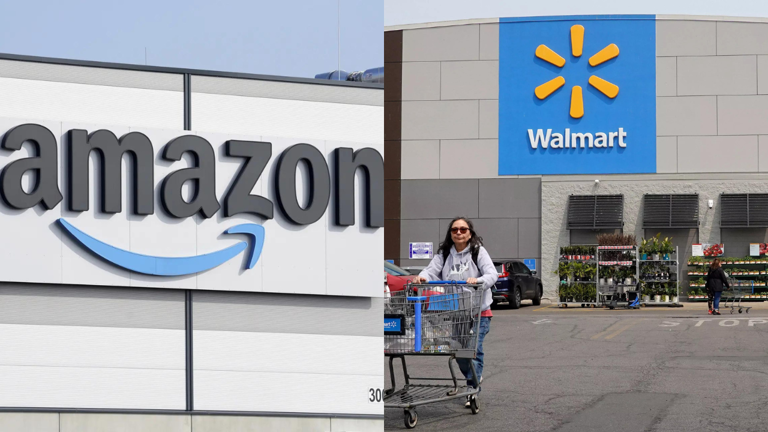
For the first time in history, Amazon has surpassed Walmart to become the world’s largest retailer by annual revenue. Walmart reported $713.2 billion in revenue for its most recent fiscal year—impressive, but still short of Amazon’s $716.9 billion. This milestone marks a symbolic yet significant shift in the retail landscape, highlighting the fierce competition between two giants fighting to win over ever-changing consumer habits.
Amazon’s rise isn’t just about being an online store. While its retail business remains the backbone of its sales, other divisions—cloud computing, advertising, and third-party seller services—have been major growth engines. In 2025, services for third-party sellers accounted for nearly a quarter of Amazon’s revenue, while Amazon Web Services contributed about 18%.
Walmart hasn’t faltered. Its revenue has more than doubled over the last 20 years, and its 4,600 U.S. stores and roughly 600 Sam’s Club locations remain a core strength. Its digital business is growing fast, posting 27% growth in the U.S. in the last quarter alone, with double-digit gains for 15 consecutive quarters. Walmart has been borrowing from Amazon’s playbook, repositioning itself as a tech-forward retailer and embracing new business models.
A clear signal of Walmart’s ambitions came with its move to the tech-heavy Nasdaq and a market value surpassing $1 trillion—a milestone mostly associated with tech giants. Its fourth-quarter earnings, boosted by digital advertising and its growing third-party marketplace, show the company’s focus on higher-margin businesses beyond traditional brick-and-mortar retail.
The AI Race: Sparky vs Rufus
Both Amazon and Walmart see artificial intelligence as a key to future growth—but they are taking very different approaches.
Walmart has partnered with OpenAI and Google to enhance its online shopping experience. Its AI-powered assistant, Sparky, helps shoppers find products more easily. Early results are promising: customers using Sparky spend about 35% more per order, and roughly half of Walmart’s app users have interacted with it. Walmart CEO John Furner and executives emphasise that AI is improving store operations, associate productivity, and customer experiences, while keeping development in the hands of tech partners rather than building everything in-house.
Amazon, on the other hand, has taken a more insular approach. It has limited external AI access to its platform, focusing on its proprietary shopping assistant, Rufus, which is powered by its own AI models and Anthropic’s Claude. Already used by over 300 million customers, Rufus drove nearly $12 billion in incremental sales last year. Amazon CEO Andy Jassy describes Rufus as the digital equivalent of a store employee, helping customers discover products intuitively.
The company is also betting big on AI infrastructure. Amazon plans to spend up to $200 billion on AI this year alone, more than any other tech company, focusing on data centers, chips, and networking to support its sprawling operations. While Wall Street has expressed some scepticism over the scale of these investments, Amazon is clearly positioning itself for the next era of retail.
A New Chapter in Retail
This revenue milestone underscores more than just numbers—it signals a fundamental shift in retail. Walmart is trying to keep pace with Amazon’s platform dominance while exploring AI as a way to boost customer engagement. Amazon is leveraging AI to deepen its already massive ecosystem, making shopping faster, smarter, and more personalised.
The next few years will reveal whether Walmart can catch up or if Amazon’s investment in AI and diversified businesses will cement its place at the top. One thing is clear: the future of retail will be defined not just by stores or websites, but by who can master the art of technology, data, and customer experience.