

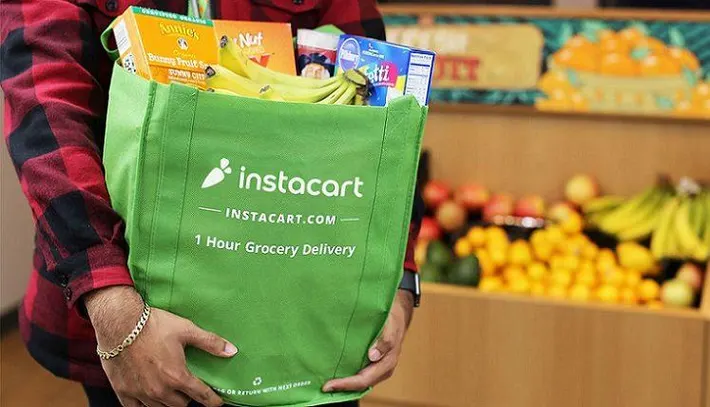
For much of the past decade, online grocery in the United States was framed as a disruption. A threat. A revolution that would upend the traditional supermarket. In 2026, that narrative feels outdated. Online grocery has not replaced the supermarket. It has simply become part of it. At the centre of this quiet normalisation sits Instacart, a platform now so embedded in American food retail that its presence is no longer debated but assumed.
Instacart’s announcement that it has delivered more than 1.8 billion bananas since launch may sound anecdotal, but it reveals something deeper about the US grocery market. Bananas are not a premium product. They are a staple, bought weekly by households shopping at Kroger, Publix, Albertsons, Safeway, Costco and regional chains. The fact that such a basic item is routinely ordered online signals a structural shift in consumer behaviour rather than a pandemic-era anomaly.
In the early years, online grocery was dominated by convenience-driven, higher-income consumers. Today, Instacart’s data shows that digital baskets increasingly mirror in-store shops, heavy with fresh produce, private-label goods and everyday essentials. This mirrors the strategy of its retail partners, including Kroger, Aldi, Costco, Wegmans and H-E-B, which now treat online ordering as a core sales channel rather than an add-on service.
For traditional supermarkets, Instacart has evolved from a necessary experiment into a strategic utility. Chains such as Kroger and Albertsons use Instacart to extend reach without investing heavily in their own last-mile infrastructure, while retailers like Aldi and Costco leverage the platform selectively to attract incremental customers without diluting their low-cost operating models. In many cases, Instacart functions as a shared logistics layer across competing banners, something unthinkable a decade ago.
The relationship between Instacart and supermarkets is no longer defined by fear of disintermediation. Early concerns that the platform would “own the customer” have softened as retailers realised that Instacart drives volume, data and loyalty rather than eroding it. Kroger, Publix and Wegmans all maintain strong branded experiences within the Instacart ecosystem, using personalised pricing, digital promotions and loyalty integration to retain shopper identity.
However, normalisation does not mean stagnation. Online grocery in the US has entered a phase of optimisation, not expansion at any cost. Basket growth has slowed, delivery fees are under scrutiny, and shoppers are more price-sensitive than at any point since 2020. For Walmart, Target and Amazon Fresh, which operate their own delivery networks, this has triggered intense competition around speed, cost and fulfilment efficiency. For Instacart, it has meant refining partnerships rather than chasing headline growth.
One of the most notable changes is the shift in power dynamics between platforms and retailers. Large chains such as Kroger, Costco and Walmart now negotiate from a position of strength, pushing back on fees and demanding greater control over data and pricing. Smaller regional grocers, by contrast, still rely heavily on Instacart to remain competitive against national players with sophisticated omnichannel capabilities.
Fresh food remains the defining battleground. Consumers are increasingly comfortable ordering produce, meat and dairy online, but only when quality is guaranteed. Instacart has responded by working closely with retailers such as Wegmans, H-E-B and Publix, known for strong fresh departments, to improve picking standards and substitution accuracy. Poor execution in fresh categories remains the fastest way to lose trust.
Private label has also emerged as a surprise winner in the online space. Store brands from Kroger, Costco’s Kirkland Signature, Target’s Good & Gather and Publix’s own-label ranges perform strongly on Instacart, benefiting from clear price positioning and strong retailer equity. For national brands, this creates a more competitive digital shelf, where algorithmic placement and promotions matter as much as physical eye-level positioning once did.
The rise of retail media is further tightening the relationship between Instacart and supermarkets. Sponsored search results, digital coupons and targeted advertising now allow brands to influence purchasing decisions directly within the online basket. Retailers such as Kroger and Albertsons are increasingly aligning Instacart campaigns with their own retail media networks, blurring the line between platform and store.
Yet challenges remain. Delivery costs continue to weigh heavily on profitability, and consumer tolerance for fees is limited. Many shoppers now alternate between in-store shopping at Walmart, Costco or Aldi and online top-up orders via Instacart, depending on mission and budget. This hybrid behaviour reinforces the idea that online grocery is no longer a replacement channel but a complementary one.
Looking ahead, Instacart’s role appears secure but unspectacular, which in retail terms is a success. It has become infrastructure. A background system that enables supermarkets to meet consumer expectations without rewriting their entire operating models. As Amazon refocuses its grocery ambitions around Whole Foods and Walmart doubles down on its own ecosystem, Instacart occupies a unique middle ground, connecting competitors rather than confronting them.
In 2026, the real story is not that Americans buy groceries online, but that they no longer think about it. Whether shopping at Kroger, Costco, Publix, Aldi or Wegmans, consumers expect the option to order digitally, receive reliable substitutions and pay transparent prices. Instacart did not kill the supermarket. It adapted to it, and in doing so, became part of the modern American grocery landscape.