
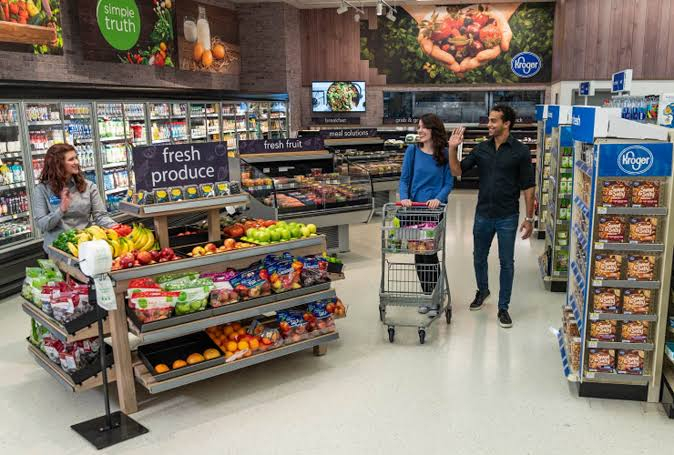
America’s supermarket giant says more customers are coming through its doors. Analyst data suggests the opposite. Behind the disagreement is a much bigger question: are shoppers still choosing traditional supermarkets in the same way?
Something unusual is happening at Kroger, and it is not simply a question of whether sales are rising or falling. The supermarket giant is facing conflicting signals about one of the most basic measurements in retail: how many people are actually walking through its doors.
Kroger’s new CEO Greg Foran has been telling investors that customer traffic is improving. During the company’s first-quarter results, Foran said customers were coming through Kroger’s stores more frequently and that the company’s affordability strategy was beginning to resonate with shoppers. Kroger also reported that its loyal households had grown for 17 consecutive quarters.
But independent analyst data is painting a different picture. Jefferies examined a sample of Kroger locations and found that in-store visits had declined for three consecutive months, according to reporting by the Cincinnati Business Courier. The data therefore appears to contradict the retailer’s own assessment of traffic.
That disagreement is more than a statistical curiosity.
It raises a fundamental question for one of America’s biggest supermarket chains: where are the shoppers going?
The supermarket visit is changing
For decades, foot traffic was one of the clearest indicators of supermarket health. If more people entered the store, there was a good chance more groceries would end up in their baskets.
But that relationship is becoming less straightforward.
A customer can now shop through a supermarket website, order through an app, use a delivery service or collect an online order without spending much time inside the store. Kroger itself reported that adjusted e-commerce sales increased 19% in its first quarter, while the company said its e-commerce operation became profitable for the first time.
That means a decline in physical visits does not automatically mean customers have abandoned Kroger.
Some may simply be changing how they shop.
But Kroger cannot ignore the physical store
There is another side to the argument.
Kroger still operates thousands of physical supermarkets across the United States, and those stores remain central to its business model. Fresh food, prepared meals, bakery, meat and produce are categories where the physical shopping experience remains particularly important.
The supermarket is also where Kroger can influence what customers see, discover and ultimately purchase.
If fewer people are walking through the doors, that matters even if online sales are growing.
The question therefore isn’t simply whether Kroger is losing customers.
It is whether the customer is becoming less dependent on the supermarket store itself.
Walmart is waiting
This is where the story becomes much bigger than Kroger.
America’s grocery market is increasingly dominated by retailers that can offer consumers different reasons to shop with them.
Walmart has enormous scale and a powerful combination of physical stores, online shopping and competitive pricing.
Costco has developed an extremely strong membership model.
Amazon and Whole Foods continue to expand the role of online grocery.
Aldi and Lidl compete aggressively on value.
And regional supermarket chains continue to defend their local markets.
Recent Numerator data showed Walmart, Costco and Amazon/Whole Foods gaining grocery market share, while Kroger and Albertsons were among the major supermarket companies losing share over the year ending June 30.
That is a much more important warning sign than one month’s foot-traffic figures.
Kroger is fighting back with price
Kroger knows that price has become one of the most important weapons in the supermarket battle.
The company has been focusing on affordability, private label and improving the shopping experience under Foran’s leadership.
Its own brands are performing strongly, with Kroger reporting that private-label products gained share and outpaced national brands by 175 basis points during the first quarter.
That strategy makes sense.
If shoppers are increasingly price-conscious, Kroger needs to convince them that they do not have to leave the traditional supermarket to find value.
The problem is that Aldi, Lidl and Walmart have spent years building their identities around value.
Kroger therefore has to compete against retailers for whom low prices are already part of the brand.
The online customer may actually be more valuable
There is an interesting twist in Kroger’s numbers.
The company says its omnichannel customers spend nearly two and a half times as much as customers who shop only in stores.
That changes the way Kroger should think about foot traffic.
A shopper who visits a Kroger store once a week may be valuable.
But a shopper who visits occasionally and also orders groceries online could potentially be even more valuable.
The future supermarket customer may therefore not be the person who walks through the doors most often.
It may be the person who uses every channel Kroger provides.
The store is becoming part of a larger system
This is perhaps where Kroger’s strategy becomes particularly interesting.
The company is increasingly using its physical stores to support online fulfilment, while also using its digital business to bring customers back into the broader Kroger ecosystem.
Its delivery business is growing, and the company has expanded partnerships with platforms including DoorDash and Uber Eats.
The traditional definition of a supermarket is therefore changing.
A store is no longer simply somewhere a customer goes to shop.
It can also be a warehouse, a fulfilment centre, a delivery hub, an advertising platform and a source of customer data.
Kroger has another problem: too many stores may not all be equally good
The company has already acknowledged that a significant proportion of its stores need improvement.
Kroger has announced plans to close 60 underperforming locations by the end of 2026, and reports indicate that at least 39 stores across its various banners have already closed as part of the broader restructuring.
That makes the foot-traffic question even more important.
If customers are visiting some stores less frequently, Kroger has to decide whether the problem is the location, the store itself, the pricing, the competition or changing consumer behaviour.
Closing a weak store may solve the problem.
But if the same customer behaviour is appearing across the network, closing individual stores will not be enough.
The business model itself has to change.
And then Kroger wants to get bigger
This is perhaps the most fascinating part of the story.
While Kroger is closing underperforming stores, it is also pursuing expansion through acquisitions.
Its proposed acquisition of Giant Eagle would add nearly 200 locations to the company, and analysts estimate that an approved deal could push Kroger’s grocery market share to around 8.7%, putting it ahead of Costco and behind only Walmart among the largest US food retailers.
So Kroger is simultaneously doing two things.
It is getting rid of stores that do not work.
And it is buying another supermarket business.
That tells us something important about modern grocery retail.
The objective is no longer simply to have more stores.
It is to have the right stores, in the right markets, serving the right customers.
The real battle may be for the weekly shopping trip
Kroger does not necessarily need customers to visit its stores every day.
What it needs is to remain part of the consumer’s regular grocery routine.
That could mean a physical visit on Saturday, a delivery order on Wednesday and a quick online purchase on Friday.
The retailer wants to own as much of that relationship as possible.
That is why loyalty data, e-commerce, private label and retail media have become so important.
Kroger says 95% of its transactions are linked to loyalty-card data, giving the company more than two decades of purchase information on its customers.
That information could become just as valuable as the physical stores themselves.
The ISN View
The Kroger foot-traffic story should not be reduced to a simple headline saying that shoppers are abandoning the supermarket.
The evidence is more complicated.
Kroger says traffic is improving, while independent analyst data suggests declining visits at a sample of stores. At the same time, Kroger’s e-commerce business is growing rapidly and has finally reached profitability.
