Lidl Leads Spain’s Supermarket Growth While Mercadona Strengthens Its Market Leadership
By International Supermarket News
Spain’s grocery retail market continues to demonstrate remarkable resilience, with discount retailers leading the way as consumers remain focused on value, quality and convenience. According to the latest market data from Algori, Lidl has emerged as one of Spain’s fastest-growing supermarket chains, highlighting the continued shift in consumer shopping habits.
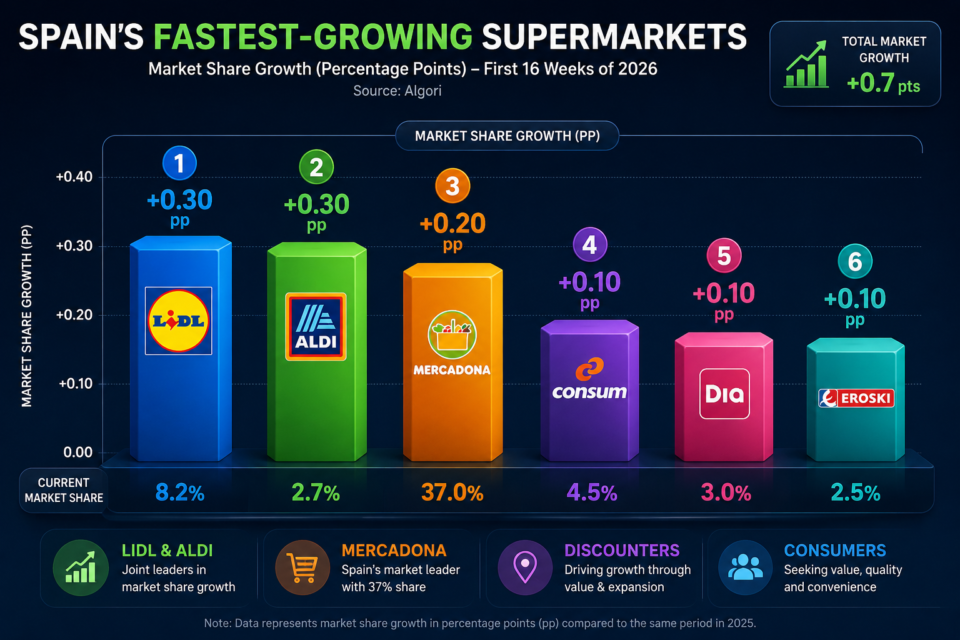
Lidl and Aldi recorded the strongest market share growth during the first 16 weeks of 2026, each adding approximately 0.3 percentage points. While Mercadona remains Spain’s dominant retailer with around 37% market share, Lidl’s performance reflects its ability to attract new customers and increase shopping frequency.
Industry analysts suggest Lidl is not only increasing its share of the market but is also winning more customer baskets. More Spanish households are choosing Lidl for regular grocery shopping, particularly for fresh produce, bakery products and private-label ranges. The retailer has successfully positioned itself as a destination offering quality products at competitive prices, a strategy that continues to resonate with consumers facing ongoing cost-of-living pressures.
Aldi continues its impressive expansion across Spain. The retailer’s investment in new stores, combined with an expanding assortment of Spanish products, has enabled it to strengthen its position and establish itself as one of the country’s fastest-growing supermarket operators. The German discounter has continued to attract shoppers looking for quality products at affordable prices, reinforcing the growing influence of the discount sector within the Spanish grocery market.
Mercadona, meanwhile, continues to dominate the Spanish grocery industry through its extensive store network, strong customer loyalty, efficient supply chain and continuous investment in innovation. Although its market share continues to increase, its percentage growth naturally appears lower than that of Lidl and Aldi because it already operates from an exceptionally large base.
Looking Beyond the Percentages
The latest Algori figures require careful interpretation. While Lidl and Aldi are recording the highest percentage growth in market share, this does not necessarily mean they are growing more in absolute business value than Mercadona.
Mercadona already accounts for approximately 37% of Spain’s grocery market, making it by far the country’s largest supermarket chain. At this scale, even a modest increase in market share represents hundreds of millions of euros in additional sales. A gain of just 0.2 percentage points for Mercadona may actually represent more revenue than a 0.3-point gain achieved by a much smaller competitor.
This is one of the realities of retail economics. The larger a retailer becomes, the harder it is to maintain the same percentage growth achieved during its expansion years. A company with a 37% market share simply cannot continue growing at the same rate indefinitely without reaching unrealistic levels of market dominance. Smaller retailers, by contrast, have considerably more room to expand, making higher percentage growth easier to achieve.
For this reason, analysts often distinguish between relative growth and absolute growth. Lidl and Aldi are leading in relative market share gains, while Mercadona continues to generate enormous sales growth from its already dominant position.
Lidl Continues to Win More Shopping Trips
One of the most significant trends highlighted by Algori’s data is Lidl’s ability to attract more shopping baskets. Consumers are visiting Lidl more frequently for both weekly grocery shops and top-up purchases, particularly in fresh produce, bakery, dairy and private-label products.
Lidl’s strategy has evolved significantly over the past decade. Rather than competing solely on price, the retailer has invested heavily in store design, fresh food quality, sustainability and Spanish sourcing. These improvements have broadened its customer base well beyond traditional discount shoppers.
The retailer’s continued expansion of its store network has also enabled it to reach new customers in regions where its presence was previously limited. Combined with an efficient supply chain and competitive pricing, this has made Lidl one of the strongest performers in the Spanish grocery market.
Competition Remains Intense
Spain remains one of Europe’s most competitive grocery markets. Mercadona continues to set the benchmark in overall market leadership, while Carrefour, Lidl, Aldi, Consum, DIA and Eroski compete aggressively for market share through promotions, digital innovation, private-label development and omnichannel services.
Other retailers, including Consum, DIA and Eroski, continue to strengthen their regional positions by investing in store refurbishment, customer service and local sourcing. Competition remains fierce as every retailer seeks to differentiate itself in an increasingly demanding marketplace.
Value Still Drives Consumer Behaviour
Spanish consumers continue to place value at the centre of their purchasing decisions. However, value is no longer defined solely by low prices. Today’s shoppers increasingly expect good quality, fresh products, sustainability and convenience alongside competitive pricing.
This shift has worked in favour of retailers such as Lidl and Aldi, whose private-label ranges now compete successfully with many branded products. Their investments in fresh food, local suppliers and modern stores have helped transform consumer perceptions of discount retailing.
Mercadona has responded by continuing to invest in product innovation, operational efficiency and customer experience, enabling it to retain the loyalty of millions of Spanish shoppers despite increasing competition.
Two Success Stories
The latest Algori data tells two different but equally important stories.
The first is that Lidl and Aldi are currently Spain’s fastest-growing supermarket chains in percentage terms, demonstrating the continuing momentum of the discount retail model.
The second is that Mercadona remains Spain’s undisputed grocery leader. With approximately 37% market share, it operates from a scale unmatched by any competitor. As a result, percentage comparisons alone do not tell the full story. Every incremental gain achieved by Mercadona represents a substantial increase in sales value, making its continued growth particularly impressive.
Unless there is a dramatic restructuring of the Spanish grocery market, Mercadona is expected to remain the country’s largest supermarket retailer for many years to come. Meanwhile, Lidl and Aldi are likely to continue narrowing the gap through sustained expansion, increased customer traffic and growing basket numbers.
For investors, suppliers and the wider retail industry, Spain offers one of Europe’s most fascinating grocery markets—where established leadership and fast-growing challengers are shaping the future of food retail at the same time.