
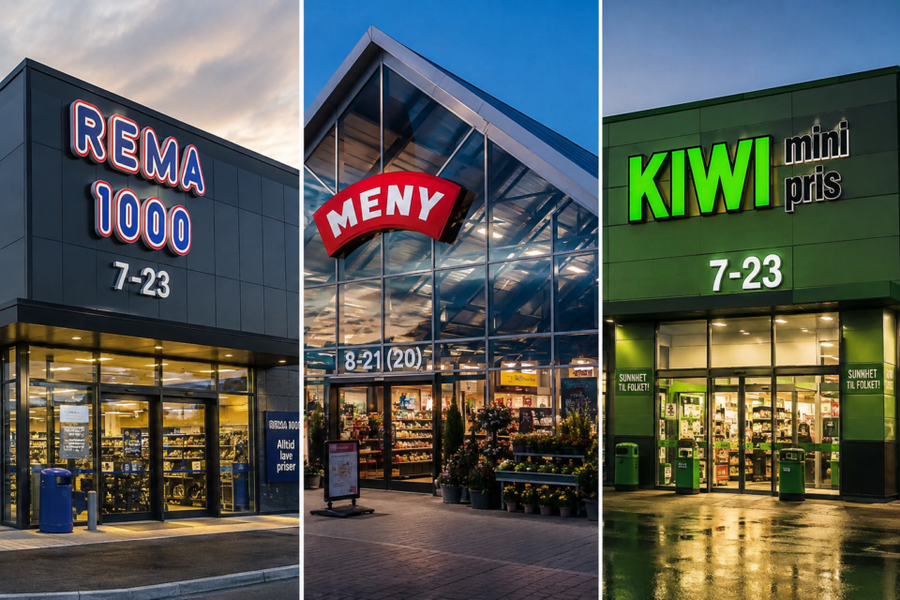
Norway’s grocery market has a competition problem that is difficult to ignore: three major grocery groups control more than 95% of the market.
The concentration has become a long-running concern for Norwegian authorities, particularly as consumers continue to face relatively high food prices and limited choice of major grocery operators. The OECD’s 2026 economic survey highlights the structure of the market as a significant competition issue.
The three dominant groups are NorgesGruppen, Coop and Reitan Retail, whose businesses include some of Norway’s best-known supermarket and discount chains.
But market concentration is only part of the story.
THE PRICE INFORMATION PROBLEM
One of the most controversial issues has been the way the major chains monitored each other’s prices.
The Norwegian Competition Authority found that the chains had cooperated in extensive monitoring of competitors’ prices between 2011 and 2018. The authority concluded that the cooperation was illegal and imposed financial sanctions.
The companies appealed. In August 2025, Norway’s Competition Appeal Tribunal upheld the authority’s decision. The case has subsequently moved towards the courts, with the appeal expected to be heard in late 2026.
For retailers, monitoring competitors’ prices is nothing unusual.
The problem comes when price monitoring becomes a coordinated activity between major competitors in a market already dominated by a handful of companies.
That raises a much bigger question: does greater price transparency create stronger competition — or can it make it easier for dominant retailers to watch each other and react immediately?
WHO REALLY HAS THE ADVANTAGE?
Norway’s competition problem goes beyond what shoppers see on the shelf.
The Competition Authority has also investigated differences in the purchasing conditions offered by suppliers to the major chains.
Its investigation found significant differences between the prices paid by the major retailers for some of the same products. In some cases, the difference exceeded 15%, with the largest chain often receiving the most favourable terms.
That creates a powerful advantage.
A supermarket that buys more cheaply has greater room to reduce its retail price, protect its margin or increase promotional activity.
And the bigger the retailer becomes, the greater its purchasing power can become.
This creates a difficult cycle for smaller competitors: scale creates buying power, buying power supports competitive pricing, and competitive pricing can make it harder for smaller retailers to gain scale.
NORWAY WANTS MORE COMPETITION
The issue has attracted political attention because grocery prices remain a sensitive issue for Norwegian consumers.
The Norwegian government has previously proposed measures aimed at improving competition, including better price information for consumers, easier access to sites for new grocery stores and greater transparency through the food supply chain.
The challenge is that Norway cannot simply create competition by asking existing retailers to compete harder.
There are structural barriers.
A small number of powerful companies dominate retail. The market is concentrated further up the supply chain, while Norway’s geography, agricultural policies and import protection also influence prices and market access.
The result is a grocery market where competition exists — but the number of serious competitors is limited.
THE CONSUMER IS IN THE MIDDLE
For shoppers, the issue is ultimately simple.
They want more choice and lower prices.
Norway’s food and non-alcoholic beverage prices were still 2.3% higher year-on-year in June 2026, according to Statistics Norway.