
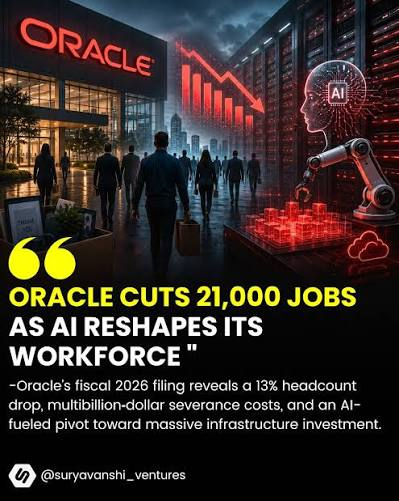
Oracle has confirmed that its workforce has fallen by approximately 21,000 employees over the past year, providing one of the clearest indications yet that artificial intelligence is beginning to change the size and structure of major corporate workforces.
The technology giant employed around 141,000 people at the end of May 2026, compared with approximately 162,000 a year earlier — a reduction of about 13%. Oracle also reported $1.84 billion in severance and other restructuring costs during the fiscal year.
But the most significant part of Oracle’s disclosure is not the number of jobs already eliminated. It is the warning that more workforce reductions could follow.
In its regulatory filing, Oracle said that the adoption and deployment of AI technologies across its operations had resulted, and may continue to result, in reductions to its workforce.
AI Investment Is Changing the Workforce Equation
Oracle’s strategy illustrates a rapidly emerging corporate model: invest heavily in artificial intelligence and cloud infrastructure while simultaneously reducing the number of people required to perform certain tasks.
The company is committing enormous resources to its AI and cloud ambitions, including major data-centre investments and partnerships. At the same time, fewer employees are now needed across parts of the organisation.
For workers, this represents a significant change.
For decades, technology companies generally created new jobs as their businesses expanded. AI is introducing a different equation: companies can increase computing capacity and productivity without necessarily increasing headcount at the same rate.
Oracle’s latest figures suggest that this transition is already happening at scale.
The 21,000 Jobs Are Only Part of the Story
Oracle’s workforce reduction should not be interpreted as meaning that every one of the 21,000 positions was directly replaced by AI.
The company said its workforce adjustments also reflected management and product changes, performance issues, strategic shifts and acquisitions.
However, the explicit reference to AI is significant.
Oracle is effectively acknowledging that artificial intelligence has become one of the factors influencing how many employees it needs.
That makes the company an important case study in the wider transformation of white-collar employment.
AI Is Moving From Experiment to Workforce Strategy
The discussion around AI has changed rapidly.
Initially, businesses presented generative AI largely as a tool designed to help employees work faster. Now, some major companies are asking a different question:
If AI makes employees substantially more productive, how many employees will be required in the future?
That question is increasingly being asked in technology, finance, customer service, administration and other sectors.
Oracle’s disclosure gives investors and workers a rare view of how that calculation can translate into actual workforce numbers.
A Warning for Other Industries
The significance of Oracle’s cuts extends beyond the technology sector.
Retailers, supermarkets, banks, logistics companies and other large employers are investing heavily in AI to automate customer service, administration, forecasting, pricing, inventory management and other operations.
The lesson from Oracle is not necessarily that AI will eliminate entire occupations overnight.
Instead, the bigger change could be gradual: fewer people performing the same amount of work, with AI taking over an increasing share of routine and repetitive tasks.
For employers, that can mean greater productivity.
For employees, it can mean fewer traditional roles and a growing requirement to work alongside AI systems.
Oracle’s Message Is Clear
Oracle’s latest workforce figures have turned the company’s AI strategy into a workforce story.
Approximately 21,000 employees have disappeared from its workforce in one year, while the company says AI deployment may contribute to further reductions.
The technology is no longer simply something companies are testing.
AI is becoming part of the calculation of how many people a company needs.
And Oracle may be one of the clearest examples yet of what that could mean for the global workforce.
International Supermarket News will continue to follow the impact of AI on jobs, retail technology and the future workforce.
