
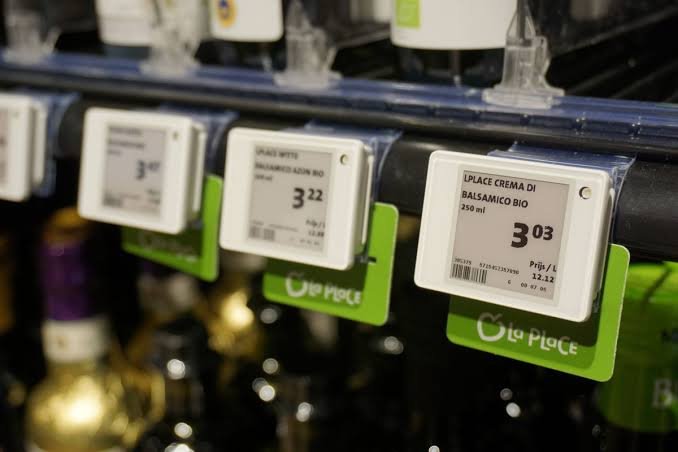
Tesco is preparing to roll out electronic shelf labels (ESLs) across around 3,000 stores in what is expected to be one of the largest in-store digital pricing transformations in the UK grocery sector.
The initiative will see traditional paper price tags replaced with fully digital shelf displays capable of updating pricing and product information in real time. The move is part of a broader push by the UK’s largest supermarket to modernise its store operations, increase pricing agility, and reduce manual workload across its estate.
While Tesco has not publicly confirmed a single supplier, large-scale ESL deployments of this nature are typically delivered by a small group of global retail technology providers specialising in digital shelf systems and store automation infrastructure.
What the Technology Will Change in Stores
Electronic shelf labels are small digital screens fixed to store shelves that are connected to a central pricing system. Once implemented, they allow retailers to update thousands of prices instantly from a central dashboard.
For a retailer operating thousands of stores, this replaces a highly labour-intensive process where staff manually print and replace paper price labels.
In practical terms, the system allows:
- Instant price changes across entire store networks
- Automatic synchronisation between shelf price and checkout systems
- Real-time promotional updates
- Faster reaction to competitor pricing
- Reduced reliance on manual in-store label changes
Industry analysts have long described ESLs as a “foundational technology” for smart retail environments, particularly in large-scale grocery chains.
Scale of the Rollout
A deployment across approximately 3,000 stores would place Tesco among the most advanced adopters of electronic shelf label technology in European grocery retail.
At this scale, the rollout would likely involve:
- Millions of individual shelf labels
- Complex integration with Tesco’s pricing and inventory systems
- Phased installation across store formats (Express, Superstore, Extra)
- Extensive staff training programmes
- Ongoing maintenance and battery lifecycle management
The implementation is expected to take place in phases over a multi-year period, rather than as a single national rollout.
Who Would Be Supplying the Technology?
Although Tesco has not confirmed a specific vendor, large-scale ESL systems in European supermarkets are typically supplied by a small number of specialist technology firms. The most established global providers in this space include:
1. SES-imagotag
One of the world’s largest ESL suppliers, SES-imagotag provides digital shelf systems used by major grocery retailers across Europe. The company specialises in IoT-connected shelf labels, cloud-based pricing platforms, and real-time retail data systems. Its solutions are widely deployed in large supermarket chains seeking full-store digitalisation.
2. Pricer
A Swedish technology company focused on digital shelf-edge systems, Pricer is known for its scalable ESL infrastructure and long-life battery labels. Its systems are commonly used in high-volume retail environments where reliability and low maintenance are critical.
3. VusionGroup
Formerly part of SES-imagotag branding evolution, VusionGroup develops connected retail platforms that combine electronic shelf labels with advanced data analytics, pricing automation, and in-store digital communication tools.
Why Retailers Are Investing in ESL Technology
For major supermarkets like Tesco, the business case for electronic shelf labels extends far beyond convenience.
1. Labour efficiency
One of the most immediate benefits is the reduction in manual labour required for pricing updates. In large stores, staff can spend significant time each week changing paper labels during promotions or price adjustments. ESLs remove much of this workload.
2. Pricing speed and competitiveness
In a highly competitive grocery market, pricing decisions need to be implemented quickly. ESLs allow retailers to react almost instantly to competitor moves or supply chain changes.
3. Accuracy and compliance
Mispriced shelves are a long-standing issue in grocery retail. Digital synchronisation reduces the risk of discrepancies between shelf prices and checkout systems, improving customer trust and reducing complaints.
4. Foundation for smart retail
ESLs are increasingly viewed as a gateway technology for broader digital transformation. Once installed, they can integrate with:
- AI-driven pricing systems
- Dynamic promotions
- Loyalty-based personalised pricing
- Real-time stock management systems
- In-store digital advertising
Operational Impact on Stores
The introduction of electronic shelf labels is expected to significantly reshape day-to-day store operations.
Store workforce changes
While Tesco has not indicated job reductions linked specifically to the rollout, industry practice suggests that staff previously focused on manual ticketing may be redeployed toward:
- Customer service roles
- Stock replenishment
- Online order fulfilment (click-and-collect and delivery)
Faster promotional cycles
Promotional activity can be activated across entire store networks within minutes, allowing for more dynamic pricing campaigns and improved coordination with national marketing activity.
Reduced administrative burden
Store managers will be able to implement pricing changes centrally without coordinating physical updates across individual aisles.
Challenges and Considerations
Despite the benefits, large-scale ESL deployment also comes with challenges:
- High upfront capital investment across thousands of stores
- System integration complexity with legacy retail IT infrastructure
- Hardware maintenance, including battery replacement cycles
- Cybersecurity and pricing control safeguards
- Staff training and change management
Retail analysts note that while ESLs deliver long-term efficiency gains, the initial rollout phase is operationally intensive.
Industry Context
Across European grocery retail, electronic shelf labels are becoming increasingly common, particularly among large chains seeking operational efficiency and pricing flexibility.
However, a rollout at the scale of approximately 3,000 stores places Tesco among the more aggressive adopters of in-store digitisation in the sector.
The move reflects a broader trend in grocery retail: the shift toward data-led, automated store environments, where pricing, promotions, and inventory are managed dynamically rather than manually.
Conclusion
The planned introduction of electronic shelf labels across Tesco stores represents a major step in the evolution of supermarket operations.
While the company has not confirmed its technology partners, the scale of deployment strongly suggests collaboration with leading global providers such as SES-imagotag, Pricer, or VusionGroup.
Ultimately, the rollout signals a decisive shift toward fully digitised store environments, where pricing becomes real-time, operations become more automated, and the traditional paper shelf edge is replaced by a connected, data-driven retail system.