


Walmart’s biggest advantage may no longer be its size. It is the fact that groceries are only one part of the shopping relationship it has built with millions of American households.
For decades, Walmart’s position in grocery retail was relatively easy to understand. It offered consumers a combination of low prices, enormous stores and a huge range of products, using its scale to put pressure on traditional supermarkets.
Today, however, describing Walmart simply as America’s biggest supermarket would miss the bigger story.
Walmart is increasingly becoming an entire retail ecosystem, combining physical stores, online shopping, grocery delivery, advertising, membership services, financial products, technology and an enormous supply chain. Its grocery operation remains at the centre of that ecosystem, but the company can use the strength of its other businesses to reinforce its position in food.
That creates a problem for traditional supermarket companies because they are not necessarily competing against Walmart on equal terms. They may be competing against a company that can make money from a much wider range of customer activities.
The grocery basket is only the beginning
A customer entering a traditional supermarket generally has one main purpose: buying groceries.
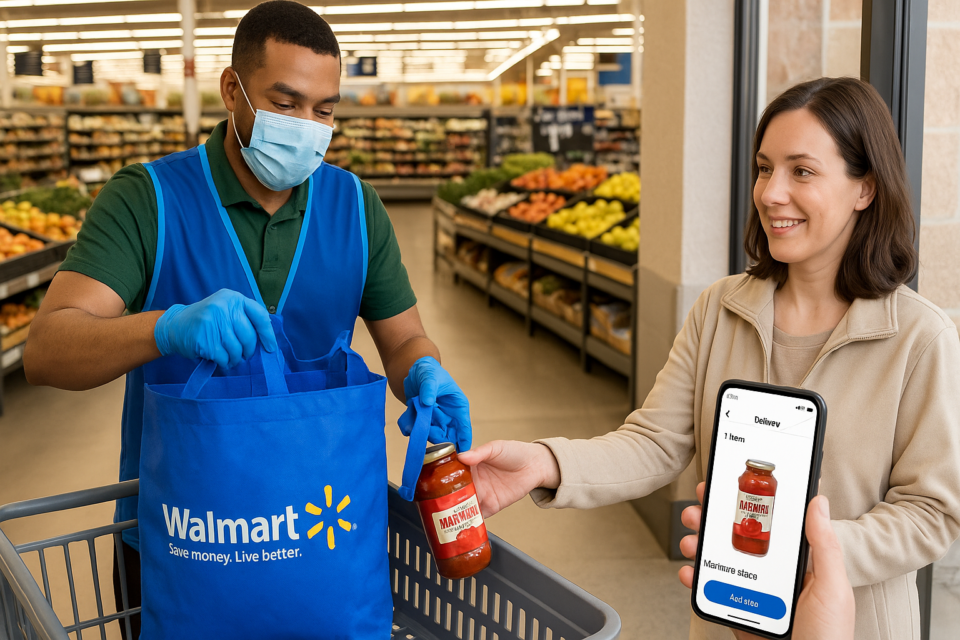
A Walmart customer can arrive for groceries and leave with household products, clothing, electronics, pharmacy products and other goods. The same customer can order online, collect an order from a store, receive a delivery or use Walmart’s membership ecosystem.
That difference matters.
The more reasons Walmart gives customers to interact with the company, the more opportunities it has to keep those customers inside its ecosystem.
The supermarket is therefore no longer simply a destination.
It becomes one component of a much larger relationship.
Walmart’s scale is becoming a technology advantage
Scale has always been important in supermarket retail because bigger companies can negotiate with suppliers, operate sophisticated distribution systems and spread costs across millions of transactions.
But scale is becoming even more powerful in the digital era.
Walmart can invest heavily in artificial intelligence, automation, e-commerce and logistics because it has a customer base large enough to justify those investments.
A regional supermarket chain may want to develop the same technology, but the economics are completely different.
The cost of building the system is similar.
The number of customers using it is not.
That creates a widening technology gap.
The store is becoming Walmart’s secret weapon
There is an interesting contradiction in modern retail.
For years, the industry predicted that online shopping would make physical stores less important.
Walmart has demonstrated another possibility.
The physical store can actually make online retail stronger.
A huge network of stores gives Walmart thousands of potential fulfilment locations across the country. Products can be stored closer to customers, orders can be collected locally and deliveries can be organised around existing infrastructure.
The store therefore becomes more than a place to shop.
It becomes part supermarket, part warehouse and part delivery network.
That is extraordinarily difficult for an online-only competitor to replicate.
Walmart can compete on price in a way few others can
Price remains one of Walmart’s most powerful weapons.
Food shoppers are increasingly sensitive to the cost of their weekly basket, and Walmart’s scale gives it significant purchasing power.
But the company’s advantage is not simply that it can sell products cheaply.
It can also use price as a reason to bring customers into a much larger ecosystem.
A shopper may choose Walmart because the grocery basket is cheaper.
Once there, that customer is exposed to thousands of other products and services.
This is a fundamentally different model from a supermarket that depends almost entirely on grocery margins.
And then there is advertising
One of Walmart’s most interesting businesses is no longer something sitting on a supermarket shelf.
It is advertising.
Retail media allows Walmart to use its enormous amount of customer and transaction data to sell advertising opportunities to brands.
Food manufacturers can effectively pay to reach Walmart shoppers at different stages of the purchasing journey.
That creates another source of revenue.
It also creates a powerful feedback loop.
More customers generate more shopping data.
More data makes advertising more valuable.
More advertising revenue can support investment in prices, technology and customer acquisition.
More competitive prices attract more customers.
The cycle continues.
Traditional supermarkets cannot simply copy Walmart
This is where the threat becomes particularly serious for companies such as Kroger, Albertsons and other conventional supermarket groups.
They can invest in better apps.
They can improve delivery.
They can develop loyalty programmes.
They can build retail-media businesses.
They can invest in automation.
But they cannot easily recreate Walmart’s entire ecosystem.
Walmart did not suddenly become a technology company.
It spent decades building the infrastructure that allows technology to operate at enormous scale.
That infrastructure is now becoming an advantage.
Walmart’s biggest competitor may be Walmart itself
There is another interesting side to the story.
The bigger Walmart becomes, the more difficult it becomes to maintain the simplicity that originally made the company so powerful.
More services mean more complexity.
More technology means more investment.
More online orders mean more logistical challenges.
More marketplace sellers mean more quality-control questions.
More advertising means more potential conflicts between commercial interests and the customer experience.
Walmart therefore has to manage a delicate balance.
It needs to become more sophisticated without becoming less convenient.
The supermarket is becoming a platform
This may be the most important change taking place.
The traditional supermarket sells products.
The modern retail platform connects consumers, brands, suppliers, advertisers, delivery services and technology.
Walmart increasingly operates like the second model.
A consumer can buy a product.
A brand can advertise it.
A supplier can sell it.
A delivery network can transport it.
An algorithm can recommend it.
And Walmart can potentially earn revenue from several points along that journey.
That is much more powerful than simply making a profit on the product sitting on the shelf.
What does this mean for Aldi and Lidl?
This is where the story connects to the European supermarket battle we have been following.
Aldi and Lidl have built their success around a very different model: simplicity, efficiency, private label and low prices.
Walmart represents another answer to the same consumer demand for value.
But Walmart has something the discounters generally do not have at the same scale: an enormous multi-category ecosystem.
That makes the American market particularly interesting.
The battle is no longer simply between supermarket chains.
It is between different retail models.
Discount.
Traditional supermarket.
Warehouse club.
Online marketplace.
Retail platform.
And increasingly, AI-powered shopping.
The future shopper may not care who is a supermarket
Consumers are unlikely to think about these categories in the same way executives do.
They simply want to know where they can get what they need at the best price with the least effort.
If Walmart can offer groceries, household products, delivery, online shopping and competitive prices in one relationship, that is extremely powerful.
The customer does not need to care whether Walmart is technically a supermarket, marketplace or technology company.
They simply know that it works.
The ISN View
Walmart’s biggest threat to traditional supermarkets may not be that it has more stores.
It may be that it has built a business where grocery retail is connected to almost everything else the customer does when shopping.
That changes the competitive equation.
Kroger has to compete for the grocery basket.
Aldi has to compete on price.
Lidl has to compete on value.
Amazon competes on convenience.
Costco competes through membership and bulk purchasing.
Walmart increasingly competes across all of those dimensions at once.
That is why the Walmart story deserves to be watched so closely.
The next supermarket battle may not be about who has the biggest supermarket.
It may be about who controls the customer relationship.
And if that is the battle, Walmart is already standing in a very powerful position.