

By Riad Beladi
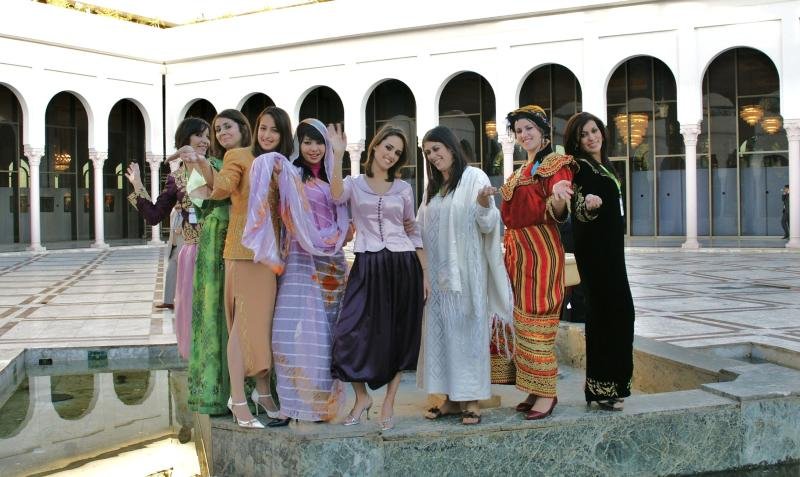
Algeria today presents a complex social landscape shaped by uneven change, where different models of life for women coexist—sometimes in harmony, often in tension. In urban centers and among more economically secure families, a visible culture has emerged in which women participate actively in public life. They attend film festivals, work, study, travel, and socialize freely. Young women are seen pursuing careers in the arts, business, and academia, supported by families who encourage ambition and independence. It is not unusual, for example, to see a father accompanying his teenage daughter to a cultural event, openly supporting her aspirations in fields such as acting or media—scenes that reflect a growing acceptance of female visibility and autonomy.
At the same time, a quieter and less visible reality persists, particularly in rural areas and more conservative households. In these settings, many women continue to live under strict family control, where mobility is limited and daily life revolves around domestic responsibilities. Their roles are often defined early: cleaning, cooking, and serving the household while waiting for marriage, which is frequently arranged or heavily influenced by the family. Access to higher education may be restricted, and participation in the workforce is rare. Social interaction outside the family can be minimal, and in some cases, even basic freedoms—such as going out independently—are tightly controlled by male relatives.
What makes this contrast more striking today is the role of technology. Even in remote villages, smartphones and social media have become widespread. Women who are physically confined to their homes are not isolated from the outside world. Through their screens, they witness the lives of other Algerian women—women their age enjoying beaches, swimming pools, social events, and careers, dressing freely and building relationships that sometimes lead to marriage by choice. This constant exposure creates a powerful sense of comparison, and often, a growing awareness of alternative possibilities.
For some, this awareness remains internal, constrained by the same social structures that limit their physical movement. For others, it leads to more drastic decisions. There are cases where young women, unable to reconcile the gap between their own lives and what they see online, choose to leave their family homes in search of independence. Such actions carry significant social consequences, as they challenge deeply rooted norms around family authority, honor, and gender roles. Within a religious and cultural framework, this situation is often described as a form of fitna—a state of social discord or moral disruption—where rapid change and conflicting values create instability within communities.
Economic conditions play a central role in maintaining these divisions. Rural areas and lower-income households often lack the infrastructure and opportunities that would allow women to pursue education or employment. In these contexts, traditional roles are not only cultural but also practical, as families rely on internal labor to sustain daily life. In contrast, urban environments provide more pathways for financial independence, making it easier for women to step into public roles without destabilizing the household economy.
Family dynamics further reinforce these patterns. In many cases, restrictions placed on women are tied to broader concerns about reputation and social perception. Male relatives, particularly brothers, may enforce strict rules not solely out of personal conviction but also due to external pressure and fear of community judgment. This creates a system where even incremental change can be difficult, as it requires not just individual willingness but collective acceptance.
Despite these challenges, there are clear signs of transformation. Compared to two decades ago, access to education for women has expanded significantly, and participation in public life has increased. The proportion of women living under the most restrictive conditions appears to be gradually declining, though it has not disappeared. What remains is a fragmented social reality, where progress is uneven and deeply influenced by geography, class, and family background.
The result is a society where two distinct experiences of womanhood exist side by side. One is visible, modernizing, and increasingly normalized; the other is largely hidden, shaped by tradition and limited opportunity. The growing visibility of the first does not automatically dissolve the second—it often intensifies the contrast between them.
Understanding Algeria today requires acknowledging both realities without reducing one to the other. The country is neither uniformly conservative nor uniformly liberal; it is a space of negotiation, where values, expectations, and possibilities are constantly being redefined. For many women, especially those in more restrictive environments, the challenge is not simply imagining a different life—it is finding a way to access it within the constraints that still shape their daily existence.