
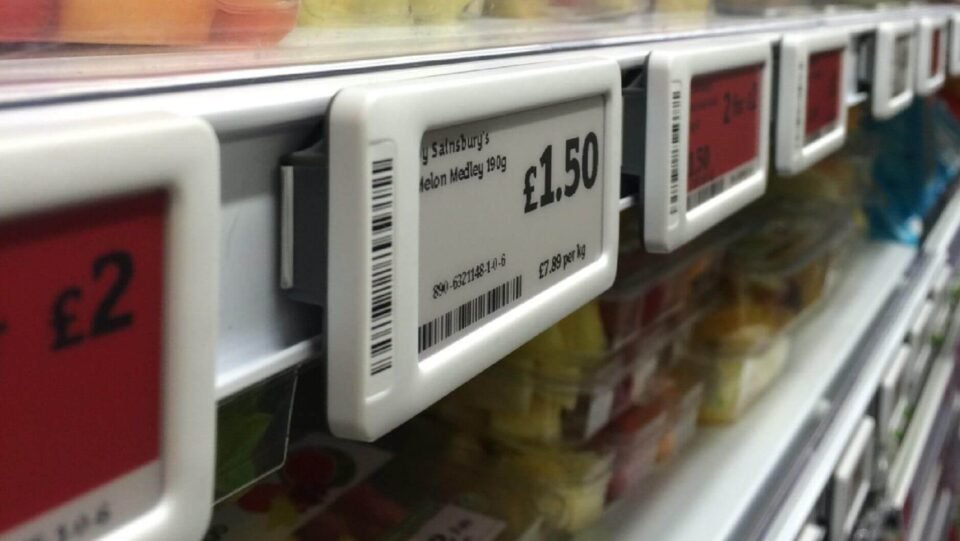
Electronic shelf labels are taking on a bigger role in supermarket operations, but the technology is also facing growing scrutiny over pricing, employment and the way retailers use digital information.
Once regarded mainly as a replacement for paper price tickets, electronic shelf labels (ESLs) can now support stock replenishment, order picking, inventory management and other in-store tasks. New functions are turning the shelf into a connected part of the supermarket’s technology infrastructure.
A report published by EuroShop in August highlighted how retailers, including Carrefour, are exploring applications that extend beyond changing prices. Some systems use small indicator lights to help employees locate products for replenishment or online order picking.
For retailers operating thousands of products across multiple stores, the attraction is clear. Digital labels can reduce the time spent changing paper tickets, improve price accuracy and help employees find products more quickly.
Retailers increase technology investment
The wider investment picture is also changing. The 2026 State of Technology report from FMI, the Food Industry Association, sponsored by Vusion, found that 71% of surveyed retailers planned to increase technology spending this year.
The research covers a broader range of grocery technology, including artificial intelligence, analytics, connected stores and digital commerce. It suggests that retailers are looking beyond individual systems towards more connected operations.
For ESL suppliers, this creates an opportunity to demonstrate that their technology can deliver value beyond labour savings from price changes. For supermarket buyers, however, the important question remains whether these additional functions justify the installation and ongoing operating costs.
The debate over digital pricing
The technology is not without controversy. In the United States, electronic shelf labels have become part of a wider debate about dynamic pricing, surveillance pricing and the future of retail employment.
In September, The Guardian reported on an AFL-CIO Tech Institute analysis estimating that widespread adoption of ESLs could put tens of thousands of grocery retail jobs at risk. Those figures are projections from an advocacy-linked analysis, not a count of jobs already lost, and should be treated accordingly.
Retailers have argued that electronic labels are primarily tools for operational efficiency and do not automatically mean that individual shoppers will receive different prices.
The distinction matters. The ability to change a price remotely does not, by itself, establish that a retailer is using personalised pricing or changing prices more frequently.
The next test is measurable value
At ISN, we believe electronic shelf labels are becoming part of a much wider conversation about the digital supermarket. Their long-term value will depend on whether retailers can connect pricing, inventory, replenishment and online fulfilment without adding unnecessary complexity.
Suppliers also need to be realistic about the business case. Supermarkets will want evidence of time saved, fewer pricing errors, better product availability and a return on investment that can be demonstrated across an entire store estate.
The next stage of ESL adoption will therefore be about more than replacing paper. Technology providers will need to show that the connected shelf can improve supermarket operations while maintaining customer trust.
For the industry, the opportunity is significant. But the winners will be those able to demonstrate practical results rather than simply promise a more digital store.
Sources: EuroShop: New add-on functions of ESL technology; FMI–Vusion State of Technology 2026; The Guardian: Electronic shelf labels and potential job losses.
