

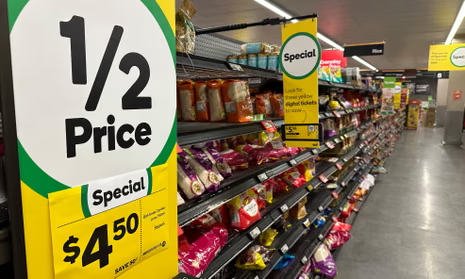

Woolworths has delivered a stronger-than-expected financial performance, highlighting just how dramatically Australia’s grocery shoppers have changed their behaviour as household budgets remain under pressure. Australia’s largest supermarket group reported underlying net profit of A$1.60 billion for the year to 28 June, ahead of market expectations of around A$1.55 billion and well above the A$1.39 billion recorded a year earlier.
The result provides an important insight into the current supermarket market. Consumers may be spending less freely, but they are still shopping frequently for essential groceries. The difference is that shoppers are becoming considerably more selective about where their money goes, with promotions, lower-priced products and supermarket own-label ranges playing an increasingly important role in purchasing decisions.
Woolworths has benefited from this shift by placing value at the centre of its offer. Customers facing higher household expenses have increasingly moved towards cheaper alternatives, promotional deals and private-label products. Rather than abandoning the supermarket, many shoppers are changing what they put into their baskets.
That change is particularly significant for the grocery industry because private label can give retailers greater control over pricing and product positioning. For consumers, own-brand products can offer a cheaper alternative to established brands, while retailers can use them to create a broader range of price points and strengthen customer loyalty.
Woolworths’ Australian Food business generated sales of A$53.85 billion, an increase of 4.6% during the financial year. The business has also carried momentum into the new financial year, with Australian Food sales reported to be 7.6% higher in the first eight weeks of fiscal 2027.
Online grocery is another important part of the changing retail landscape. Consumers increasingly expect supermarkets to combine competitive pricing with convenient collection and delivery options. Woolworths has continued to expand its digital grocery operation, with online sales showing strong growth as shoppers become more comfortable moving between physical stores and digital channels.
The figures also demonstrate that the cost-of-living crisis is not necessarily producing a simple decline in grocery consumption. Instead, it is changing the composition of the shopping basket. Consumers can continue to spend substantial amounts on food while trading down from premium brands, waiting for promotions and buying more supermarket-owned products.
For suppliers, this represents a significant challenge. National supermarket chains have considerable influence over what consumers see on shelves, and the growing popularity of private-label products creates tougher competition for branded manufacturers. Suppliers must increasingly demonstrate clear value, innovation or differentiation if they are to persuade shoppers to pay more.
Woolworths’ performance also comes as competition across Australia’s supermarket sector remains intense. Rival Coles reported underlying annual profit of A$1.26 billion shortly before Woolworths released its results, underlining the scale of the earnings being generated by the country’s major grocery operators.
Yet the Woolworths result should not be interpreted simply as evidence that consumers are feeling financially comfortable. Quite the opposite: the strength of discounting and private-label purchasing suggests that value remains one of the defining forces shaping Australian grocery retail.
The supermarket that can convince shoppers that it offers the best combination of price, quality, availability and convenience is likely to have a significant advantage. Woolworths’ latest numbers suggest that its strategy is currently working.
The bigger question is whether this behaviour will remain once household finances improve. If shoppers become accustomed to cheaper own-brand products and aggressive promotions, some may continue buying them even when economic conditions become less difficult.
For Australia’s supermarket industry, that could make the current cost-of-living crisis more than a temporary period of discount-driven shopping. It could accelerate a permanent change in how consumers define value — and how supermarkets compete for their weekly grocery basket.