
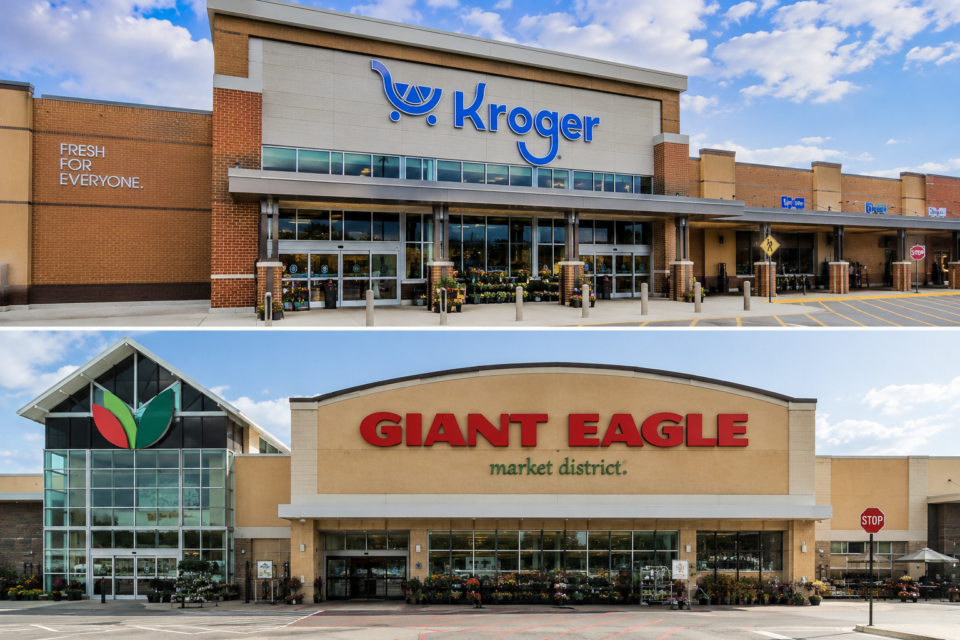
The second half of 2026 has opened with one of the biggest supermarket deals of the year as Kroger announced a definitive agreement to acquire regional grocery chain Giant Eagle, Inc. for $1.65 billion.
Although far smaller than Kroger’s abandoned attempt to merge with Albertsons, the acquisition is strategically significant. Rather than transforming the national grocery landscape overnight, it strengthens Kroger in markets where the company has long sought a larger presence while adding billions of dollars in annual revenue.
A Bigger Footprint
Giant Eagle operates 197 supermarkets across northern Ohio, western Pennsylvania, West Virginia, Maryland, and Indiana. The company also operates pharmacies, fuel stations, and convenience stores, generating approximately $9 billion in annual sales.
Kroger currently operates about 2,685 supermarkets under numerous regional banners. Once the transaction closes, the combined company will operate roughly 2,882 supermarkets, making Kroger’s network even more extensive across the United States.
The combined company is expected to generate approximately $159 billion in annual revenue, further cementing Kroger’s position as one of North America’s largest food retailers.
Will Giant Eagle Disappear?
Probably not.
Kroger has spent decades building a portfolio of regional supermarket brands rather than replacing them with the Kroger name. Chains such as Ralphs, Harris Teeter, King Soopers, Fred Meyer, Smith’s and Dillons have all retained their identities after joining the company.
Keeping established local brands often preserves customer loyalty while allowing Kroger to improve operations behind the scenes through centralized purchasing, technology, distribution and private-label products.
For Giant Eagle shoppers, the signs above the stores may remain unchanged, even though ownership changes.
Why This Acquisition Makes Financial Sense
Unlike the proposed Albertsons merger, which faced major regulatory challenges because of overlapping markets, Giant Eagle fills geographic gaps and expands Kroger’s presence in important regions.
The acquisition offers several long-term financial advantages:
- Nearly $9 billion in additional annual sales.
- Greater buying power with suppliers.
- Improved distribution efficiency.
- Expanded pharmacy operations.
- Stronger digital grocery and home delivery capabilities.
- Increased economies of scale across nearly 2,900 supermarkets.
Industry analysts believe these efficiencies could produce tens of millions of dollars in annual cost savings over time.
Can Kroger Continue Buying Supermarket Chains?
The Giant Eagle acquisition raises another question: Is Kroger finished expanding?
Probably not.
While mega-mergers may receive intense scrutiny from regulators, smaller regional acquisitions are generally easier to approve. The grocery industry remains highly fragmented, with dozens of privately owned supermarket groups operating across the country.
Future opportunities could include acquiring independent regional chains with strong customer loyalty but limited resources to compete with national retailers.
Rather than pursuing another blockbuster transaction, Kroger may focus on adding carefully selected regional operators that strengthen existing distribution networks and fill geographic gaps.
Can Kroger Really Compete With Walmart?
Even after adding Giant Eagle, Walmart remains the largest grocery retailer by a substantial margin.
However, grocery competition is no longer determined solely by store count.
Success increasingly depends on supply-chain efficiency, digital ordering, home delivery, private-label products, pharmacy services and customer loyalty programs.
Kroger already operates one of the country’s largest grocery e-commerce businesses and continues investing heavily in automated fulfillment centers and data-driven inventory management.
Adding Giant Eagle gives Kroger greater scale in regions where Walmart has faced stronger local competition.
The Long-Term Outlook
The acquisition is unlikely to transform Kroger overnight, but it appears to be a disciplined long-term investment.
By adding approximately 200 stores, $9 billion in annual revenue, and millions of new customers, Kroger strengthens its competitive position without taking on the enormous regulatory risks associated with another national merger.
If integration proceeds smoothly, the company could improve profitability through purchasing efficiencies, logistics optimization and expanded private-label sales while maintaining the local identities customers already trust.
Rather than chasing size for its own sake, Kroger appears to be building a broader regional network one strategic acquisition at a time. If that strategy continues, Giant Eagle may prove to be only one chapter in Kroger’s next phase of expansion.