
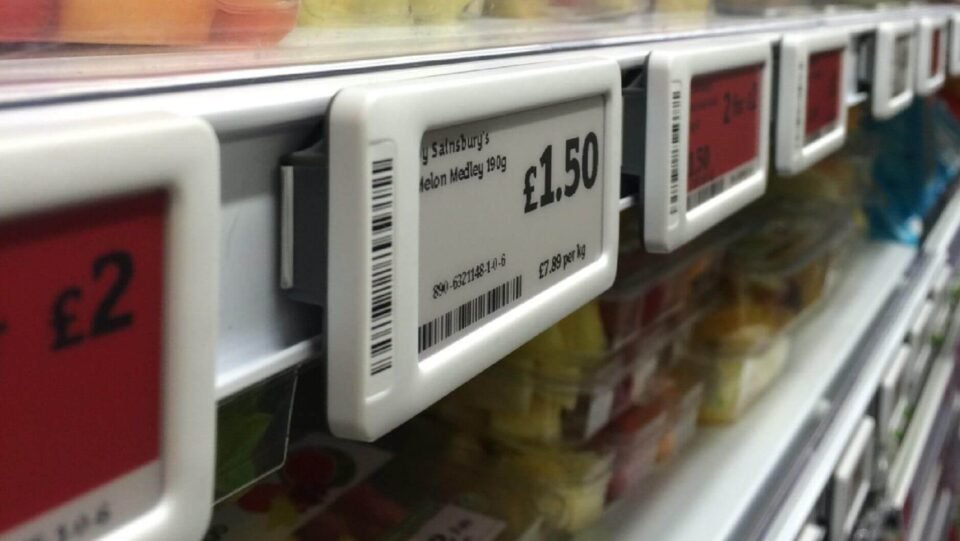
Electronic Shelf Labels (ESLs) have emerged as one of the most significant retail technology investments since the widespread adoption of self-checkout systems. What began as a niche technology for reducing labor associated with paper price tags has evolved into a foundational component of the digital store.
During 2024–2026, the industry reached an inflection point. Large retailers that had spent years piloting ESLs are now deploying them across thousands of stores. Major chains including Walmart, Tesco, Kroger, Morrisons, Co-op, Carrefour, and Lidl are investing heavily in store digitization programs centered around ESL infrastructure.
The market is increasingly dominated by three major technology providers:
The strategic importance of ESLs has shifted from simple price automation to becoming a platform for inventory management, omnichannel retailing, store analytics, and AI-enabled operations.
1. What Are Electronic Shelf Labels?
Electronic Shelf Labels are battery-powered digital displays attached to store shelves that replace traditional paper price tags.
The labels communicate wirelessly with a central management system, allowing retailers to:
- Update prices instantly
- Synchronize online and in-store pricing
- Display promotions automatically
- Improve inventory accuracy
- Reduce labor costs
- Support omnichannel operations
Modern ESL systems use:
- E-ink displays
- Wireless communication networks
- Cloud management software
- Real-time inventory integrations
- QR codes and customer interaction tools
Today’s ESL deployments are increasingly integrated with:
- AI inventory systems
- Computer vision platforms
- Digital twins of stores
- Retail media networks
2. Why Retailers Are Accelerating ESL Adoption
Labor Savings
One of the largest drivers is labor efficiency.
A large supermarket may process:
- 5,000–20,000 price changes weekly
- Promotional updates
- Supplier-funded discounts
- Seasonal markdowns
Traditionally employees manually replace paper labels.
ESLs eliminate most of this work.
Large retailers estimate:
- 50–80% reduction in shelf-price maintenance labor
- Faster promotion execution
- Reduced pricing errors
Price Accuracy
Retailers increasingly face regulatory scrutiny over pricing discrepancies.
Common problems include:
- Shelf price differs from checkout price
- Promotional signs remain after expiration
- Human error during tag replacement
ESLs dramatically improve compliance because prices update centrally.
Omnichannel Commerce
Retailers increasingly operate:
- Physical stores
- E-commerce websites
- Mobile apps
- Click-and-collect services
Maintaining consistent pricing across channels has become difficult.
ESLs allow:
- Real-time synchronization
- Promotional consistency
- Faster reaction to market conditions
Inflation and Cost Volatility
Recent years have seen rapid changes in:
- Food costs
- Energy costs
- Transportation costs
Retailers need the ability to update pricing quickly without deploying large teams.
This is particularly important for:
- Grocery chains
- Convenience stores
- Discount retailers
3. Major Retailers Implementing ESLs
Walmart
Walmart is arguably the most influential ESL deployment globally.
Strategy
The retailer is integrating ESLs into:
- Price management
- Inventory management
- Employee productivity tools
Scale
Industry reports indicate Walmart plans deployment across thousands of stores.
The company views ESLs as part of its broader digital store transformation strategy rather than merely a pricing tool.
Strategic Impact
Walmart’s adoption is particularly important because suppliers often follow technologies adopted by the retailer.
Tesco
Tesco recently announced one of Europe’s largest ESL initiatives.
Technology Partner
Tesco selected:
Scope
The deployment reportedly targets approximately 3,000 stores over a multi-year period.
Strategic Goals
- Reduce operational costs
- Improve pricing accuracy
- Enhance promotional execution
- Support digital transformation
Kroger
Kroger has used ESLs for several years but is now expanding deployment.
Focus Areas
- Grocery pricing
- Promotion automation
- Store efficiency
Importance
Kroger’s expansion demonstrates that early pilots have generated sufficient returns to justify broader investment.
Morrisons
Morrisons has expanded ESL installations across numerous stores.
Key objectives include:
- Operational efficiency
- Improved customer experience
- Reduced pricing discrepancies
Co-op
Co-op is among the more advanced ESL adopters in the UK market.
The retailer has already implemented ESL technology across a substantial portion of its network and continues expansion.
Carrefour
Carrefour is one of Europe’s longest-standing ESL users.
The company uses ESLs as part of broader store digitization initiatives.
Carrefour is often viewed as a benchmark retailer for ESL implementation.
Lidl and Aldi
Both discount giants have accelerated adoption in multiple European markets.
Why ESLs Matter to Discounters
Discounters operate on:
- Thin margins
- High efficiency
- Limited labor models
ESLs align perfectly with these operational priorities.
4. Technology Vendors Winning the ESL Race
VusionGroup
VusionGroup is generally considered the global market leader.
Strengths
- Large-scale deployments
- Enterprise software ecosystem
- Walmart relationship
- Computer vision integrations
Competitive Advantage
The company increasingly positions itself as a complete digital store platform provider rather than simply an ESL manufacturer.
Hanshow
Hanshow has become one of the fastest-growing ESL suppliers globally.
Strengths
- Competitive pricing
- Strong European expansion
- Large grocery deployments
Major Win
The Tesco deployment is considered one of the company’s most important recent contracts.
Solum
Solum (Samsung ESL division) remains a major global supplier.
Market Position
Strong in:
- Airports
- Specialty retail
- Department stores
- Grocery formats
The company recently secured deployments with several travel retail operators.
5. Future of ESL Technology
Dynamic Pricing
The most controversial future application is dynamic pricing.
Potential capabilities include:
- Time-of-day pricing
- Demand-based pricing
- Inventory-driven markdowns
- Competitor-based pricing
While technically possible, retailers remain cautious because consumers may perceive frequent price changes negatively.
AI-Powered Stores
ESLs are increasingly becoming part of AI-enabled retail systems.
Future integrations include:
- Computer vision
- Shelf monitoring
- Automated replenishment
- Predictive inventory management
Retail Media
Retailers are exploring ESLs as media assets.
Future labels may:
- Display targeted promotions
- Support customer interaction
- Connect directly to mobile applications
Smart Inventory
Next-generation ESL platforms will likely function as inventory nodes.
Benefits include:
- Real-time stock visibility
- Faster replenishment
- Reduced out-of-stock situations
6. Investment Implications
For investors, ESL adoption represents more than a hardware story.
The major beneficiaries may be:
Hardware Vendors
- VusionGroup
- Hanshow
- Solum
Software Providers
Companies offering:
- Retail analytics
- Store operations software
- Inventory management platforms
Retailers
Chains with large-scale ESL deployments may achieve:
- Lower labor costs
- Better inventory accuracy
- Improved pricing compliance
- Faster promotion execution
Conclusion
The ESL market has entered a mass-adoption phase. Retailers are no longer asking whether electronic shelf labels work; they are increasingly deciding how quickly they can deploy them.
The most significant implementations currently underway involve Walmart in North America and Tesco in the United Kingdom, while Carrefour, Lidl, Aldi, Co-op, Morrisons, and Kroger continue expanding their digital shelf infrastructure.
Over the next five years, ESLs are likely to evolve from simple electronic price tags into a core component of the intelligent retail store, supporting AI, inventory automation, retail media, and real-time operational decision-making. Retailers that successfully integrate ESLs into broader digital transformation strategies may gain meaningful advantages in efficiency, accuracy, and customer experience.
