
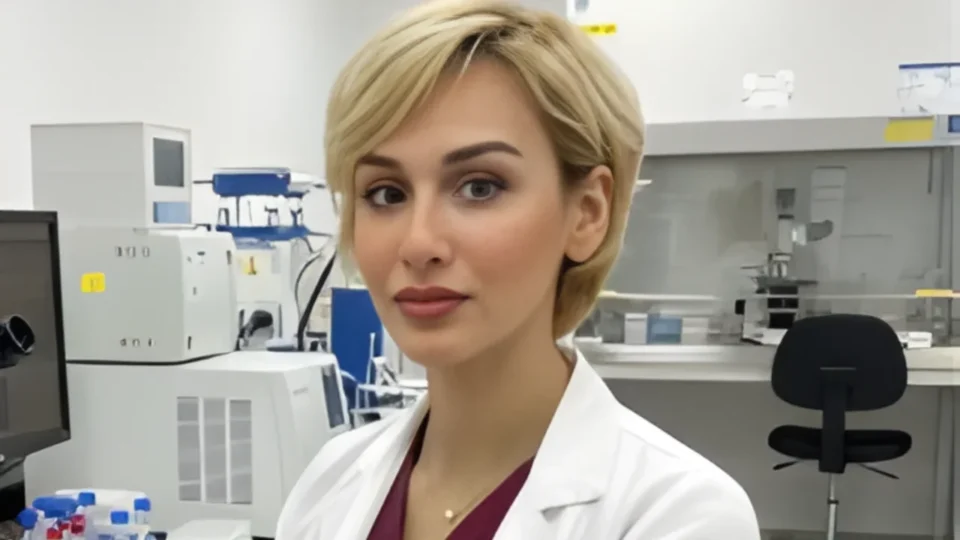
There is something deeply contradictory—almost unsettling—about the story of a young Algerian scientist who is recognized abroad, yet unable to build a viable career at home.
Rasha Zenasni, an Algerian biologist who has contributed to Fertilité News and remained in contact with American and British scientific journals, represents a growing category of researchers: visible internationally, but professionally constrained locally. Having also worked within a fertility clinic environment, she brings not only academic excellence but practical, clinical experience to her field.
Her profile is not ordinary. Graduating as major de promotion with an Mention Excellent in her master’s degree, Zenasni has demonstrated both intellectual rigor and commitment. Her insights into reproductive biology and related scientific discussions have found space in international platforms—an achievement that, in most systems, would open doors.
Instead, it has led to a dead end.
Job opportunities, when offered, come with salaries of around 30,000 Algerian dinars per month—approximately 120 euros. This is not a symbolic issue; it is a structural one. At that level, even the basic cost of commuting can absorb a significant portion of income. In her case, work in a fertility clinic reportedly paid so little that simply getting to and from the workplace became a financial burden.
For a scientist already contributing to international dialogue and bringing hands-on clinical experience, the disconnect is striking.
Her ambitions remain clear and grounded. She aims to pursue a doctorate in Advanced Tumor Pathophysiology while continuing to work—a path that aligns with global research priorities in oncology and biomedical science. Yet, like many others in similar situations, she faces a barrier that is not academic, but administrative: access. Visa constraints and limited mobility prevent her from fully engaging with the international institutions that recognize her potential.
What emerges is a broader picture—one that extends beyond a single individual.
Algeria continues to produce highly capable graduates in science and medicine. But without adequate research funding, sustainable career paths, and competitive compensation, these individuals are left navigating a system that does not match their level of expertise. When mobility is also restricted, the result is a quiet but persistent stagnation.
This is not just about fairness. It is about strategy.
A scientist with international exposure, clinical experience, and academic distinction is not simply a job seeker—she is an asset. In fields like fertility science and tumor pathophysiology, where knowledge evolves rapidly and global collaboration is essential, retaining and supporting such profiles should be a priority.
The reality, however, suggests otherwise.
Addressing this gap requires more than recognition. It calls for concrete measures: investment in research infrastructure, alignment of salaries with qualifications, and stronger bridges between local institutions and the global scientific community.
Rasha Zenasni’s story reflects both promise and frustration. It highlights what is possible—and what is currently out of reach.
And it leaves an open question: how long can a system afford to overlook the very talent it works so hard to produce?