
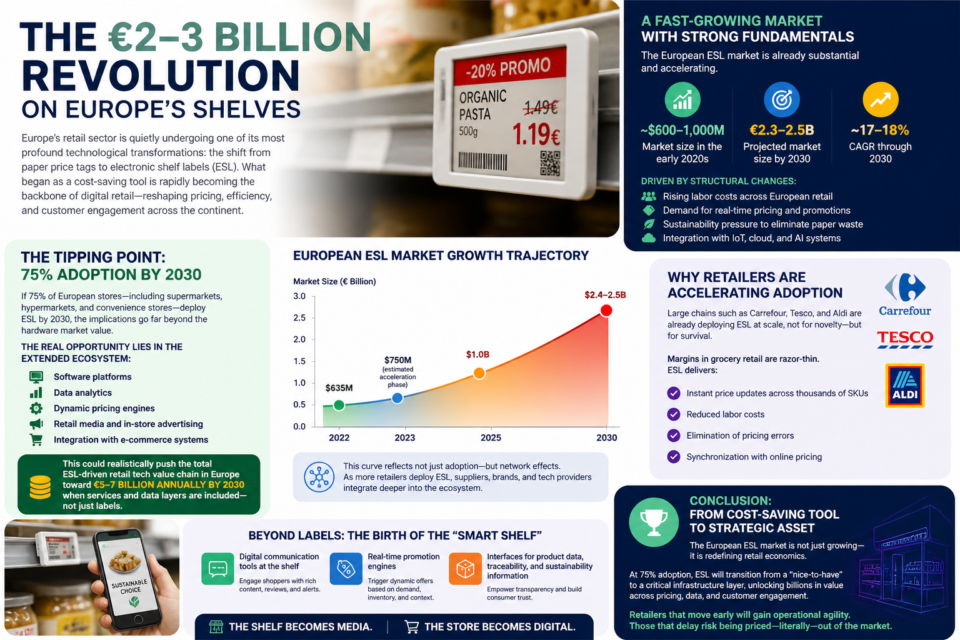
Europe’s retail sector is quietly undergoing one of its most profound technological transformations: the shift from paper price tags to electronic shelf labels (ESL). What began as a cost-saving tool is rapidly becoming the backbone of digital retail—reshaping pricing, efficiency, and customer engagement across the continent.
A fast-growing market with strong fundamentals
Today, the European ESL market is already substantial and accelerating. Estimates place the market at roughly $600–1,000 million in the early 2020s, with projections reaching €2.3–2.5 billion by 2030, growing at around 17–18% annually.
This growth is not speculative—it is driven by structural changes:
Rising labor costs across European retail
Demand for real-time pricing and promotions
Sustainability pressure to eliminate paper waste
Integration with IoT, cloud, and AI systems
In short, ESL is no longer optional. It is becoming infrastructure.
The tipping point: 75% adoption by 2030
If we assume that 75% of European stores—including supermarkets, hypermarkets, and convenience stores—deploy ESL by 2030, the implications go far beyond the hardware market value.
The real opportunity lies in the extended ecosystem:
Software platforms
Data analytics
Dynamic pricing engines
Retail media and in-store advertising
Integration with e-commerce systems
This could realistically push the total ESL-driven retail tech value chain in Europe toward €5–7 billion annually by 2030, when services and data layers are included—not just labels.
Why retailers are accelerating adoption
Large chains such as Carrefour, Tesco, and Aldi are already deploying ESL at scale, not for novelty—but for survival.
Margins in grocery retail are razor-thin. ESL delivers:
Instant price updates across thousands of SKUs
Reduced labor costs
Elimination of pricing errors
Synchronization with online pricing
In a world of volatile costs and dynamic promotions, manual pricing simply cannot compete.
The chart: market growth trajectory
Here is a simplified projection of the European ESL market growth:
2022: ~$635M
2023: ~$750M (estimated acceleration phase)
2025: ~$1.0B
2030: ~$2.4–2.5B
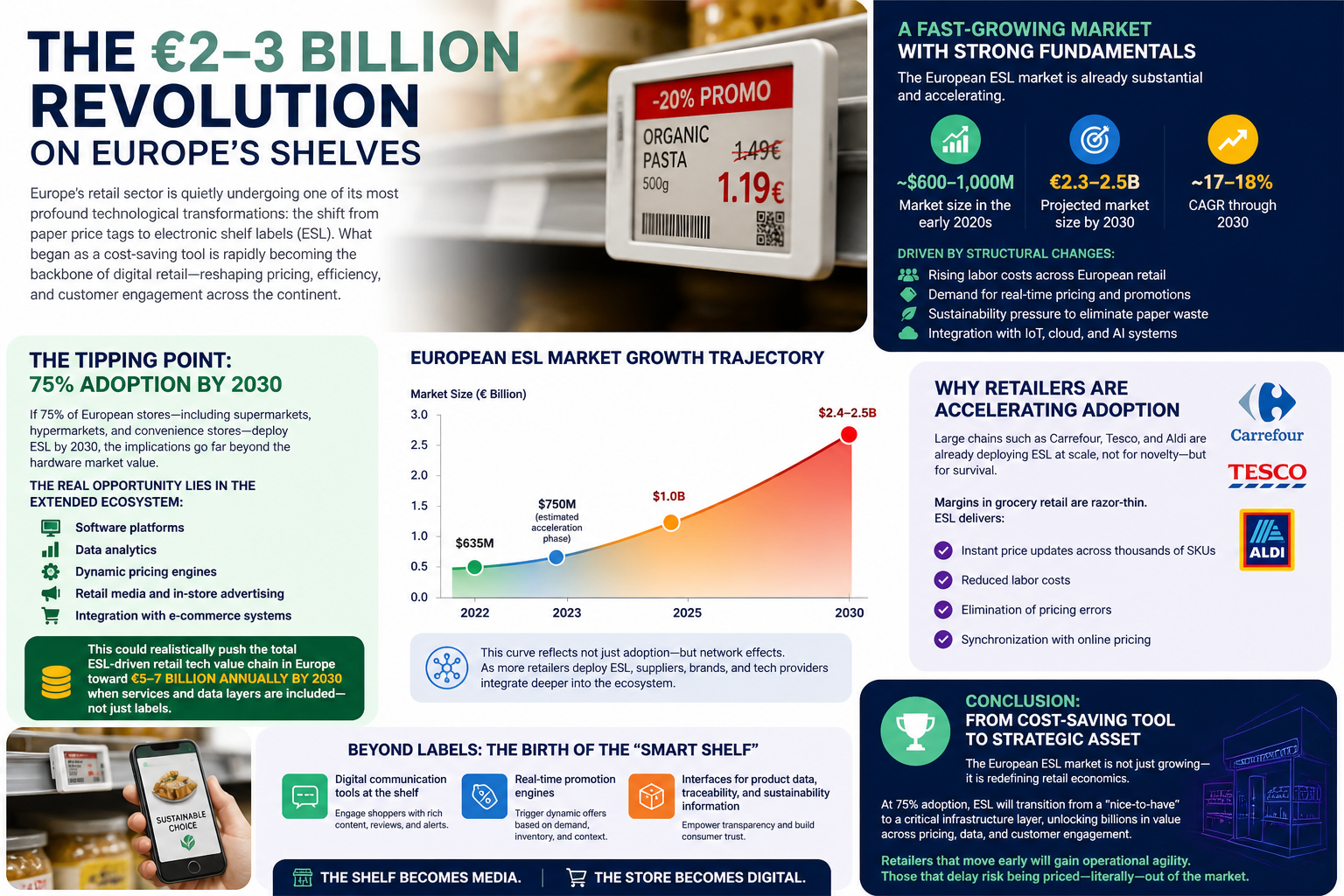
This curve reflects not just adoption—but network effects. As more retailers deploy ESL, suppliers, brands, and tech providers integrate deeper into the ecosystem.
Beyond labels: the birth of the “smart shelf”
By 2030, ESL will evolve into something much bigger:
Digital communication tools at the shelf
Real-time promotion engines
Interfaces for product data, traceability, and sustainability information
The shelf becomes media. The store becomes digital.
Conclusion: from cost-saving tool to strategic asset
The European ESL market is not just growing—it is redefining retail economics.
At 75% adoption, ESL will transition from a “nice-to-have” to a critical infrastructure layer, unlocking billions in value across pricing, data, and customer engagement.
Retailers that move early will gain operational agility. Those that delay risk being priced—literally—out of the market.