
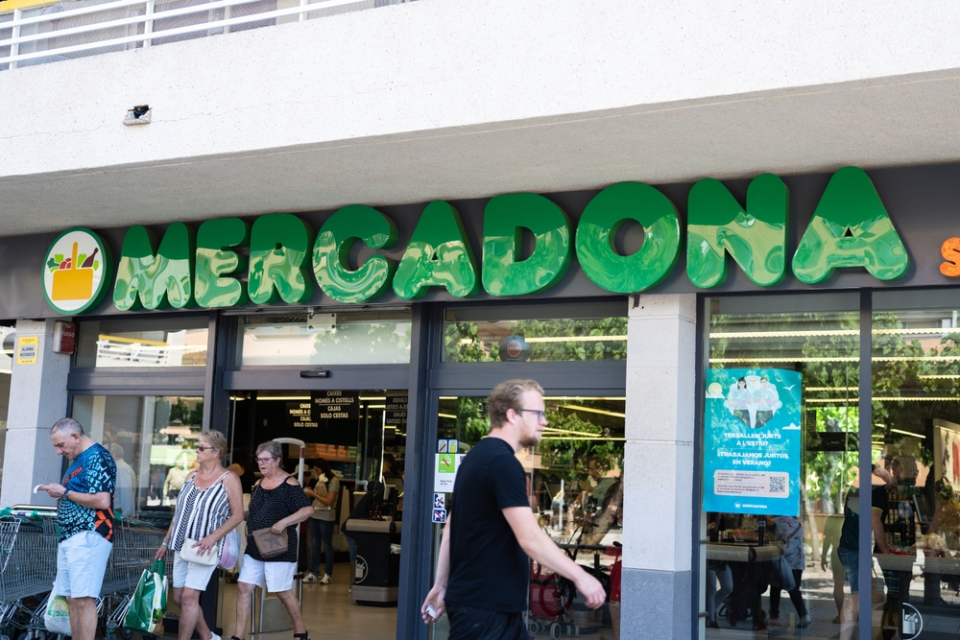
Mercadona remains the dominant supermarket chain in Spain in 2026, maintaining its leadership through a clear focus on efficiency, private-label strength, and consistent customer experience. Unlike many international competitors that operate across multiple regions, Mercadona’s strategy is largely centred on Spain and Portugal, allowing it to concentrate on operational excellence within a focused geographic area.
One of the key reasons for Mercadona’s continued success is its strong private-label system. The company’s own-brand products, often developed in close collaboration with suppliers, account for a large share of sales. These products are designed to offer good quality at competitive prices, which has become increasingly important as consumers in Spain remain sensitive to inflation and household costs. This strategy allows Mercadona to maintain control over pricing while protecting margins.
In 2026, price stability remains a major concern for both retailers and consumers. While inflation has eased compared to previous years, food prices are still a sensitive issue. Mercadona has responded by carefully managing its pricing strategy, avoiding sharp increases where possible and focusing on efficiency gains in its supply chain to absorb cost pressures. This approach has helped the company maintain a strong reputation for value.
Store performance continues to be a core strength. Mercadona operates a large network of modern supermarkets designed for efficiency and ease of shopping. Over the past several years, the company has been updating its store format to improve layout, reduce waiting times, and enhance product presentation. These improvements are aimed at making shopping faster and more convenient, reflecting changing consumer habits.
Convenience is increasingly important in the Spanish grocery market. Customers are shopping more frequently but buying smaller quantities per visit. In response, Mercadona has adjusted its operations to better serve these patterns, ensuring that stores are well-stocked with high-turnover products and that fresh food sections remain a central focus. Fresh produce, bakery items, and ready-to-eat meals continue to play a major role in attracting customers.
Online grocery is another area where Mercadona has made steady progress, although it remains more cautious than some international competitors. The company has developed its digital shopping platform and delivery services in select areas, but it has not pursued aggressive national expansion in online retail. Instead, it has focused on profitability and operational control, ensuring that online services are efficient rather than simply large in scale.
Supply chain management is one of Mercadona’s key strengths. The company works closely with a network of suppliers, many of whom are long-term partners. This allows for better coordination, stable pricing, and consistent product quality. In a period of global supply chain uncertainty, this model has helped Mercadona avoid some of the disruptions faced by other retailers.
Sustainability is also becoming increasingly important in the company’s strategy. Mercadona has introduced initiatives aimed at reducing plastic use, improving energy efficiency, and reducing food waste. These efforts are aligned with broader European environmental goals and growing consumer expectations. While sustainability investments require upfront costs, they are also seen as necessary for long-term competitiveness.
Another important factor in Mercadona’s success is its focus on operational efficiency. The company is known for its strict cost control and streamlined management structure. Decisions are often made centrally, allowing for consistent implementation across its store network. This efficiency-driven approach helps keep prices competitive while maintaining profitability.
Labour management is also a key part of its model. Mercadona invests in employee training and tends to offer stable contracts compared to some competitors in the retail sector. This has helped the company maintain relatively high levels of staff retention and service quality. In a sector where labour shortages can be an issue, this stability is an advantage.
Competition in Spain remains strong, particularly from international retailers such as Carrefour, Lidl, and Aldi. Discount chains continue to grow their presence, putting pressure on traditional supermarkets. However, Mercadona has maintained its leading position by focusing on consistency, quality private-label products, and strong supply chain integration.
Looking ahead, Mercadona is expected to continue its cautious but steady expansion strategy. Rather than rapid international growth, the company is likely to prioritise strengthening its position in existing markets. This includes further improvements to store efficiency, gradual expansion of digital services, and continued investment in product development.
In a changing retail environment, Mercadona’s strategy is defined by stability and control. It does not rely on aggressive expansion or complex global operations, but instead on refining a proven model within a focused market. This approach has allowed it to remain highly competitive even as the broader grocery industry becomes more fragmented and cost-sensitive.
As consumer expectations evolve, Mercadona’s ability to balance price, quality, and convenience will remain central to its success. Its strong domestic position gives it a solid foundation, but continued adaptation will be necessary to maintain leadership in Spain’s increasingly competitive supermarket sector.